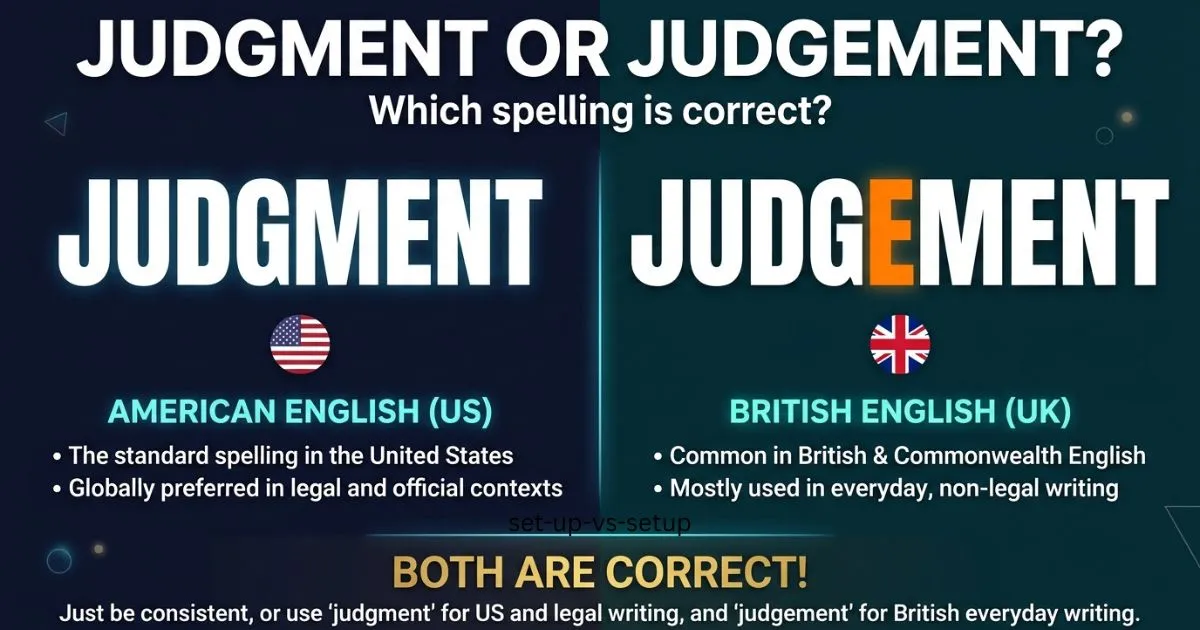
In American English, the correct spelling is judgment, with no E in the middle. Judgement, with the E, is the common British spelling, but even in the UK it is not the only choice.
Picture this. You finish a cover letter and type “I have strong judgement.” A red line appears. You delete the E, and the line disappears.
Then you read a UK blog that spells it the other way. Now you doubt yourself.
You are not wrong to wonder. Both spellings are real, and both mean the same thing. The right one depends on your reader and, in one special case, on your topic. This guide gives you the rule, the exception, and simple ways to remember both.
Quick Answer
Use judgment (no E) in American English. Use judgement (with E) in general British English, and in Australia and New Zealand. Use judgment in British legal writing, too, when you mean a court’s decision. Both spellings mean the same thing: an opinion, a decision, or the ability to decide wisely.
⚡ Quick Rule in One Line
Americans drop the E: write judgment. Britain keeps it, except in court, where judgment wins again.
Judgment vs. Judgement: What Is the Difference?
There is no difference in meaning. Judgment and judgement are two spellings of one noun. The only change is the letter E. Americans write judgment. Most British writers write judgement. Courts in both places prefer judgment.
The word has three main meanings:
- The act of forming an opinion. Example: “It is too soon for judgment.”
- The ability to decide well. Example: “She has good judgment.”
- A formal decision by a court. Example: “The court issued its judgment.”
The spelling does not change any of these meanings. It also does not change how you say the word.
In the United States, judgment is the clear winner. One review of usage data found it ahead of judgement by more than ten to one. Judgement is rare in American writing.
The UK picture is messier. Style guides and the Oxford English Dictionary say judgement is the usual spelling in everyday British writing. Yet some usage counts show judgment still appears often in UK text. Legal writing is a big reason.
That is why this pair is not a simple “US versus UK” rule.
Read More: Full Time or Full-Time? The Simple Hyphen Rule
Why Does the E Disappear in American English?
American English often drops a silent E when adding -ment. British English often keeps it. Judgment is one of a small group of words that follow this pattern. The US form is shorter, and the UK form keeps the E.
This is part of a bigger story. Noah Webster wanted to make American spelling simpler. His 1828 dictionary helped fix judgment as the American form.
Here are other words with the same split:
| American English | British English |
|---|---|
| judgment | judgement |
| acknowledgment | acknowledgement |
| aging | ageing |
| likable | likeable |
Notice the pattern. The American spelling drops the E. The British spelling keeps it.
A warning: do not apply this as a rule to every word. Americans still write management, engagement, and arrangement with the E. The pattern covers only certain words. When in doubt, check a dictionary.
The Twist: Why British Courts Use Judgment
In British legal writing, a court’s decision is spelled judgment, with no E. This is the standard in UK law. So judgment is not only American. It appears in both countries, and it is the safest spelling in legal settings.
The Oxford English Dictionary explains the history. Judgment was the main spelling in British English from the late 1600s into the 1800s. During the 1800s, judgement became more common in everyday British writing.
Law did not follow that change. British legal writers kept judgment. They still use it for court decisions today.
This gives you a simple legal rule:
- Court decision, anywhere: judgment.
- Personal opinion, UK: judgement is standard.
- Personal opinion, US: judgment.
You may see British writers use both spellings on the same page. That is not always an error. One may refer to a court ruling. The other may refer to a person’s opinion.
If you are not sure, judgment is the lower-risk choice.
Judgment vs. Judgement Comparison Table
The table below shows who uses which spelling. Use it as a quick check before you publish.
| Situation | Judgment (no E) | Judgement (with E) |
|---|---|---|
| American English | ✅ Correct | ❌ Rare, treated as a UK spelling |
| General British English | ✅ Accepted | ✅ Standard |
| British legal writing | ✅ Standard | ❌ Avoid |
| Australia and New Zealand | ✅ Accepted | ✅ Common |
| AP style | ✅ Correct | ❌ Not used |
| Academic papers for US readers | ✅ Use this | ❌ Avoid |
| Court decisions (any country) | ✅ Use this | ❌ Avoid |
How to read the table: if your reader is in the United States, choose judgment every time. If your reader is in the UK, you may choose either. Just stay consistent. If you write about the law, choose judgment.
Judgmental, Judgment Call, and Judgment-Free
The same spelling rule applies to words built from judgment. Americans write judgmental, judgment call, and judgment-free. British writers often add the E to each one. The meaning stays the same.
Here are the common forms:
| American English | British English |
|---|---|
| judgmental | judgemental |
| judgmentally | judgementally |
| judgment call | judgement call |
| judgment-free | judgement-free |
| good judgment | good judgement |
| error of judgment | error of judgement |
Merriam-Webster lists judgmental as a word with two senses. The first means “related to judgment.” The second means “quick to judge others harshly.” Most people mean the second one in daily speech.
Two more points help:
- Keep your spelling the same across a whole page. Do not write “judgment” in the title and “judgemental” in the body.
- A set phrase keeps the same spelling as the root word. “Against my better judgment” becomes “against my better judgement” in UK English.
Easy Memory Tricks
A good memory trick is short and easy to picture. Here are three for this word. Pick the one that sticks for you.
Trick 1: Ax the E in America. The word “America” and the word “ax” both start with A. Ax the E for the American spelling.
Trick 2: The hurried judge. Imagine an American judge in a hurry. She cuts the extra letter and gets to the decision faster. Judgment is the shorter word.
Trick 3: Courts cut it short. When the word means a court ruling, think “short and final.” A final ruling gets the short spelling, in the UK and the US.
There is also a trap to avoid. The word “judge” ends in E. That tempts people to keep the E in the longer word. In American English, the E drops out.
18 Example Sentences
Real sentences make the rule easier to see. Here are examples sorted by use.
American English (judgment)
- Trust your own judgment when the choice is yours.
- She showed good judgment under pressure.
- Skipping the meeting was a poor judgment call.
- Against my better judgment, I lent him the car.
- Please do not pass judgment before you hear the whole story.
- The manager’s judgment is final.
- Our book club is a judgment-free zone.
- Use your best judgment when you edit the report.
British English (judgement)
- He has sound judgement for someone so young.
- That was an error of judgement.
- Her judgement was clouded by stress.
- I would not trust his judgement on money.
- The panel will sit in judgement over the contest entries.
- It is a matter of personal judgement.
Legal Use (judgment in both countries)
- The court entered judgment for the plaintiff.
- The judge reserved judgment until Friday.
- The company appealed the judgment last week.
- A default judgment can hurt your credit.
Notice that sentences 15 to 18 use the same spelling in the US and the UK.
Common Mistakes
Most errors come from one of three habits. Writers mix the spellings, assume one is wrong, or trust a spellchecker set to the wrong language. Here are the mistakes to watch for.
1. Mixing both spellings in one piece.
Wrong: “Her judgment was sound, but his judgement was poor.” Fix: pick one spelling and keep it for the whole piece.
2. Using judgement in a US paper or article.
American readers may see it as a typo. Use judgment instead.
3. Calling judgement “wrong.”
It is the usual spelling in everyday British writing. It is just the wrong choice for American readers.
4. Thinking judgment is only American.
It is also the standard spelling in British courts. Many UK writers use it.
5. Changing the root but not the family.
Wrong: “He is judgemental about her judgment.” Fix: match the spelling in judgment, judgmental, and judgment call.
6. Trusting the wrong spellchecker.
If your tool is set to UK English, it may flag judgment. Check your language setting before you accept changes.
7. Copying the E from “judge.”
The root word ends in E, so the longer form feels natural. For American readers, it is still wrong.
When to Use Each Spelling
Choose the spelling that matches your reader. Above all, stay consistent from the first line to the last.
Use this quick guide:
| Your audience or document | Best choice |
|---|---|
| US readers, blogs, school papers | judgment |
| US business writing, emails, resumes | judgment |
| AP, APA, and Merriam-Webster style | judgment |
| UK readers, general writing | judgement |
| Australian or New Zealand readers | judgement |
| Legal documents, anywhere | judgment |
| Readers from many countries | judgment (or follow your style guide) |
A few extra tips:
- ESL learners: learn judgment first. It works in the US and in UK law. You can add judgement later if you write for UK readers.
- Bloggers: set your site to one English style. Then check each post against it.
- Students: follow your school or journal style guide. If none exists, choose one spelling and stay with it.
- Professionals: if you write for a global team, ask which style your company uses.
Key Takeaways
- Judgment (no E) is the correct American spelling.
- Judgement (with E) is the usual spelling in general British English.
- Judgment is the standard spelling for court decisions in the UK and the US.
- Both spellings mean the same thing and sound the same.
- The same rule applies to judgmental, judgment call, and judgment-free.
- Never mix both spellings in one piece of writing.
- When unsure, choose judgment. It is safe for US readers and for UK law.
- Remember: ax the E in America.
FAQs
1. Is it judgement or judgment in American English?
It is judgment, with no E. American dictionaries and style guides list judgment as the standard. Judgement is rare in American writing and may look like a typo to US readers.
2. Is judgement a real word?
Yes. Judgement is a real word and a valid spelling. It is also common in Australia and New Zealand. It is simply not the American form.
3. Which spelling is correct in the UK?
Both are accepted. Judgement is the usual spelling in everyday British writing. Judgment is standard in British legal writing. If you write for a UK audience, either works as long as you stay consistent.
4. Why do British courts use judgment without the E?
British legal writers kept the older, shorter spelling when everyday writing moved to judgement. Courts still use judgment for formal decisions. That makes judgment the standard legal spelling in the UK and the US.
5. Is it judgmental or judgemental?
In American English, it is judgmental. British writers often write judgemental with the extra E. The spelling follows the root word. Pick the form that matches your audience.
6. Is it “judgment call” or “judgement call”?
For American readers, write judgment call. For British readers, judgement call is common. The phrase keeps the same spelling as the main word.
7. What do AP and APA style say?
AP style follows American English, so it uses judgment. APA tells writers to follow Merriam-Webster, which lists judgment as the main spelling. If your school or job uses another guide, follow that guide.
8. Does the extra E change the meaning or the sound?
No. The two spellings mean the same thing. They also sound the same when you say them. The only difference is how the word looks on the page.
9. What if my readers come from many countries?
Choose one spelling and use it everywhere. Judgment is a safe pick because it is correct in the US and in UK law. If your company has a style guide, follow it.
10. How can I remember the American spelling?
Use the trick “Ax the E in America.” American English drops the middle E. If you need a backup, remember that Americans like the shorter form.
Conclusion:
The answer depends on who will read your writing. For American readers, write judgment. For general British readers, judgement is standard.
There is no difference in meaning or sound. The only difference is one letter.
So pick the spelling that fits your audience. Then use it from the first sentence to the last. Consistency is what readers notice most.

I am an English language writer passionate about grammar and clear communication. I create simple, easy-to-understand content that helps readers improve their English skills. My goal is to make learning English both practical and enjoyable.