You are about to post a job ad and freeze: is it full time or full-time?
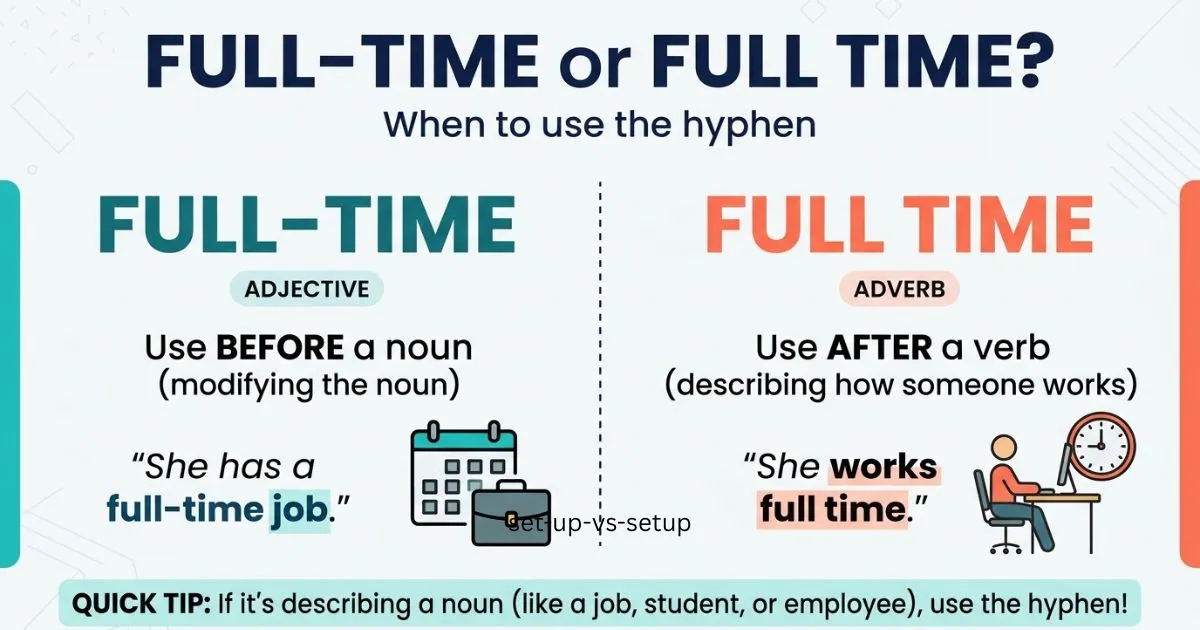
Use full-time before a noun (a full-time job). After a verb, write works full time.
That tiny hyphen trips up students, writers, and hiring managers. Both forms look right. Both appear online every day.
The good news: the rule is short. Position decides the spelling. Before a noun, the hyphen glues two words into one idea. After a verb, the phrase stands alone, so most guides drop it.
There is one gray area, and we cover it below. Some dictionaries list a hyphenated adverb. This guide shows you which form to pick and when.
Quick Answer
Quick Answer: Write full-time with a hyphen when it comes before a noun: a full-time job, a full-time student. Write full time without a hyphen when it follows a verb: she works full time. As a noun, full time has no hyphen. Avoid the closed form fulltime in formal writing.
⚡ Quick Rule in 1 Line
Hyphen it before a noun, leave it open after a verb — that’s the whole rule.
What Is the Difference Between Full Time and Full-Time?
The difference is the hyphen, and the hyphen depends on where the phrase sits. Full-time is a compound adjective that describes a noun. Full time is an open phrase that follows a verb or acts as a noun. Same two words, different jobs.
Think of it this way. The two words never change. Only their job in the sentence changes.
Here is the same idea in two short sentences:
- She has a full-time job. (Full-time describes the noun job.)
- She works full time. (Full time tells how she works.)
Merriam-Webster’s entry covers three roles: the adjective full-time, the adverb full-time, and the noun full time. It explains the adjective by pointing back to the noun: work that involves full time.
That one entry shows why writers get confused. The same words play three roles, and sources do not agree on every spelling.
The Hyphen Rule: Compound Adjectives Before a Noun
Hyphenate full-time when it comes right before the noun it describes. The hyphen shows that full and time work together as one idea. Without it, readers may see two separate describing words, which breaks the meaning.
A compound adjective is two or more words that team up to describe a noun. The hyphen shows they belong together.
Try this quick test. Split the phrase and use each word alone. A full job? A time job? Neither idea matches what you mean. The pair only works as a unit, so it needs the hyphen.
Common pairings include:
- full-time job
- full-time student
- full-time employee
- full-time position
- full-time schedule
- full-time staff
Style guides from several US colleges give the same advice. Hyphenate full-time when it modifies a noun.
Part-Time Works the Same Way
Part-time follows the identical pattern. You write a part-time job, but she works part time.
The Suspended Hyphen
Sometimes two of these phrases share the word time. You can write the shared word once. Keep the hyphen on the first word: full- and part-time jobs.
Do not write full and part-time jobs. That version drops the hyphen from the first half and confuses the reader.
If the suspended hyphen looks odd, just repeat the word: full-time and part-time jobs. Nobody will mind.
Read More: Lifelong or Life-Long? The Correct Spelling Explained
Full Time After a Verb: Where Guides Disagree
After a verb, most style guides write full time with no hyphen: she works full time. The phrase now tells how or how long, so it acts as an adverb. But some dictionaries list the hyphenated adverb too, so full-time after a verb is not an error.
Here is why the open form is popular. After a verb, the phrase no longer sits in front of a noun. There is nothing for the hyphen to hook onto.
Now the twist. Dictionaries do not fully agree with each other:
- Merriam-Webster lists an adverb spelled full-time, with the hyphen.
- Oxford’s American English entry also lists an adverb and gives the example she works full-time.
- Collins, as shown on Dictionary.com, gives the open form: he works full time.
Style guides lean toward the open form. Guides from several US colleges say to drop the hyphen after the verb. Language writers at Grammarphobia also note that the adverb is generally left open, though opinions differ.
What Should You Do?
For a US audience, choose the open form after verbs: she works full time. It matches most style guides, and editors rarely object to it.
If your school, boss, or publisher has a style guide, follow it. Whatever you choose, use it the same way across the whole document.
Full Time as a Noun (and in Sports)
As a noun, full time means the normal number of hours for a job, and it takes no hyphen. In British sports, full time also means the end of a match. Both uses stay open.
Merriam-Webster lists the noun as the standard amount of time considered normal for working. You see it in sentences like these:
- She moved from part time to full time in June.
- Going to full time was a big step for the small team.
The British sports sense is different. Collins, shown on Dictionary.com, labels it British and defines it as the end of a football or other match.
- The referee blew the whistle at full time, and the crowd went quiet.
No hyphen is needed in either case. There is no noun after the phrase to describe.
Full Time vs Full-Time: Comparison Table
This table shows every form at a glance. Find your sentence type in the first column, then copy the matching spelling. The adjective form always takes a hyphen. The adverb and noun forms are usually open.
| Use | Spelling | Example | Why |
|---|---|---|---|
| Before a noun (adjective) | full-time | She has a full-time job. | The hyphen joins two words into one describer. |
| After a verb (adverb) | full time | He studies full time. | Open form is common; some dictionaries list full-time. |
| As a noun | full time | She moved to full time. | A noun needs no hyphen. |
| End of a match (British) | full time | The referee blew at full time. | A noun again, so no hyphen. |
| Paired with part-time | full- and part-time | We hire full- and part-time staff. | Suspended hyphen saves a word. |
| Closed form | fulltime | Avoid in formal writing. | The dictionaries checked list full-time instead. |
Memory Trick
Ask one question: is a noun right behind it? If yes, add the hyphen. If a verb comes right before it instead, leave the phrase open. The hyphen is a hook, and it only hooks onto a noun.
See the hook at work:
- full-time job: the hook grabs the noun job.
- works full time: there is no noun to grab, so no hook.
Here is a second trick. Say the sentence with part-time instead. You would write a part-time job and works part time. Part-time follows the same pattern, so it is a handy mirror.
One more check helps. Cover the noun with your hand. If the phrase is left hanging with nothing to describe, drop the hyphen.
This idea is close to the one behind everyday and every day. A single compound before a noun, two separate words after the verb. Our guide on Everyday vs Every Day shows the same logic.
20 Example Sentences
These examples are grouped by use so you can spot the pattern fast. Notice how the hyphen appears only when a noun follows. Read each group aloud, and the rule will start to feel natural.
Before a Noun (Use the Hyphen)
- Maya accepted a full-time job at a hospital.
- He is a full-time student at a state university.
- The company hired three full-time employees in May.
- A full-time parent works harder than most people think.
- She wants a full-time position with health benefits.
- Our full-time staff meets every Monday morning.
- Writing is now his full-time career.
- The school offers a full-time program in nursing.
After a Verb (Leave It Open)
- My brother works full time at a bakery.
- She studies full time and sleeps very little.
- They plan to farm full time after retirement.
- I started freelancing full time last year.
- Can you teach full time next fall?
- He has been writing full time since 2020.
As a Noun
- She moved from part time to full time in June.
- Full time at this firm means a 40-hour week.
- The referee blew the whistle at full time.
Paired and Mixed Uses
- We are hiring full- and part-time cashiers.
- Is the job full time or part time?
- Her full-time job pays well, but her part-time job is more fun.
Common Mistakes
The most common mistakes are a missing hyphen before a noun, a hyphen in the wrong place, and the closed form fulltime. Each one is easy to fix once you spot it. Here are the mistakes and the fixes.
1. Missing the hyphen before a noun
- ✗ She applied for a full time job.
- ✓ She applied for a full-time job.
2. Writing the closed form
- ✗ We need a fulltime editor.
- ✓ We need a full-time editor.
The dictionaries I checked list full-time, not fulltime. Skip the closed form.
3. Forgetting the hyphen in “on a basis”
- ✗ He works on a full time basis.
- ✓ He works on a full-time basis.
Basis is a noun, so the phrase before it needs the hyphen.
4. Dropping the hyphen in a pair
- ✗ We have full and part-time jobs.
- ✓ We have full- and part-time jobs.
5. Mixing styles in one document
- ✗ Ana works full-time. Ben works full time.
- ✓ Ana works full time. Ben works full time.
The hyphenated adverb is not wrong. The problem is switching between forms. Pick one and keep it.
Is Full-Time Different in US and UK English?
No. This is not a US vs UK spelling split. Both countries hyphenate the adjective before a noun. The only regional twist is British sports, where full time names the end of a match.
UK university style guides, such as the one from Oxford Brookes, hyphenate pairs like full-time students. That matches US advice.
This makes full-time different from words like color and colour. You do not need to change anything for a UK or US audience. Just follow the position rule.
When to Use Each Form
Choose the form by checking the words around the phrase. A noun right after it calls for full-time. A verb right before it calls for full time. Use this short checklist when you edit.
- Noun follows: write full-time (a full-time role).
- Verb comes before: write full time (she works full time).
- Used as a noun: write full time (moving to full time).
- Paired with part-time: write full- and part-time.
- Following a style guide: use the form your guide prefers, and stay consistent.
On a Resume or Job Post
Resumes and job posts follow the same rules. Write full-time position, full-time role, and full-time experience.
Job boards often show Full-time as a label for the employment type. That label describes the job, so the hyphen fits.
In a sentence, you can write worked full time at a school. That follows the open-form advice above.
Key Takeaways
- Hyphenate full-time before a noun: a full-time job.
- Leave full time open after a verb: she works full time.
- Some dictionaries list a hyphenated adverb, so full-time after a verb is not an error.
- Many style guides still prefer the open form after a verb.
- As a noun, full time stays open: moving to full time.
- Write full- and part-time jobs with a suspended hyphen.
- Avoid fulltime in formal writing.
- There is no US vs UK spelling split for the adjective.
- Pick one style for verb use and keep it consistent.
FAQs
Is it full time or full-time?
Both exist. Use full-time with a hyphen before a noun, as in a full-time job. After a verb, most style guides use full time without a hyphen, as in she works full time. As a noun, full time stays open.
Is full-time an adjective or an adverb?
It can be both. Merriam-Webster and Oxford list full-time as an adjective and an adverb. Merriam-Webster also lists full time as a noun. The role of the phrase in your sentence decides the best spelling.
Is fulltime a word?
Not in standard English. The major dictionaries checked for this guide list full-time with a hyphen. Fulltime may appear in casual posts, but it is best avoided in formal writing, resumes, and job ads.
Is “works full-time” wrong?
No, it is not wrong. Merriam-Webster lists a hyphenated adverb, and Oxford’s example uses she works full-time. Still, many style guides prefer the open form after a verb. Choose one style and stay consistent.
Do I hyphenate full-time on a resume?
Yes, when it sits before a noun. Write full-time position or full-time experience. After a verb, write worked full time. Using the same style throughout your resume looks polished.
How do I write full-time and part-time together?
Use a suspended hyphen: full- and part-time jobs. You can also repeat the word: full-time and part-time jobs. Avoid full and part-time jobs, because the first half loses its hyphen.
Is it part time or part-time?
Part-time follows the same rule. Write part-time job before a noun and works part time after a verb. Treat it as the mirror of full-time and you will not go wrong.
Is full-time spelled differently in UK English?
No. UK and US writers both hyphenate full-time before a noun. The only difference is that British English also uses full time for the end of a football or other match.
What does full time mean in football?
In British English, full time is the end of a match. A referee blows the whistle at full time. It is a noun, so it has no hyphen.
Conclusion:
Full time or full-time comes down to position. Put the hyphen in when the phrase sits before a noun: a full-time job.
Leave it out after a verb or when it is a noun: she works full time.
Some dictionaries list a hyphenated adverb, but many style guides prefer the open form. Pick one and stay consistent. Skip fulltime.

I’m Sophia Mitchell, an English grammar and writing enthusiast. I create simple, easy-to-understand content to help learners improve their English. My goal is to make grammar clear, practical, and enjoyable for everyone.






2 thoughts on “Full Time or Full-Time? The Simple Hyphen Rule”