You’re about to message a friend who just got a big promotion. You type, “I’m so proud of you,” then pause. You want to say something stronger.
Is it “more proud” or “prouder”? Both look right, and both sound right when you say them aloud.
That small doubt is why so many learners search for more proud or prouder. In this guide, you’ll get a clear answer, the simple grammar rule behind it, and an easy way to choose between the two in any situation.
You’ll also see real examples, common mistakes, and a short practice set so the rule actually sticks.
The Short Answer
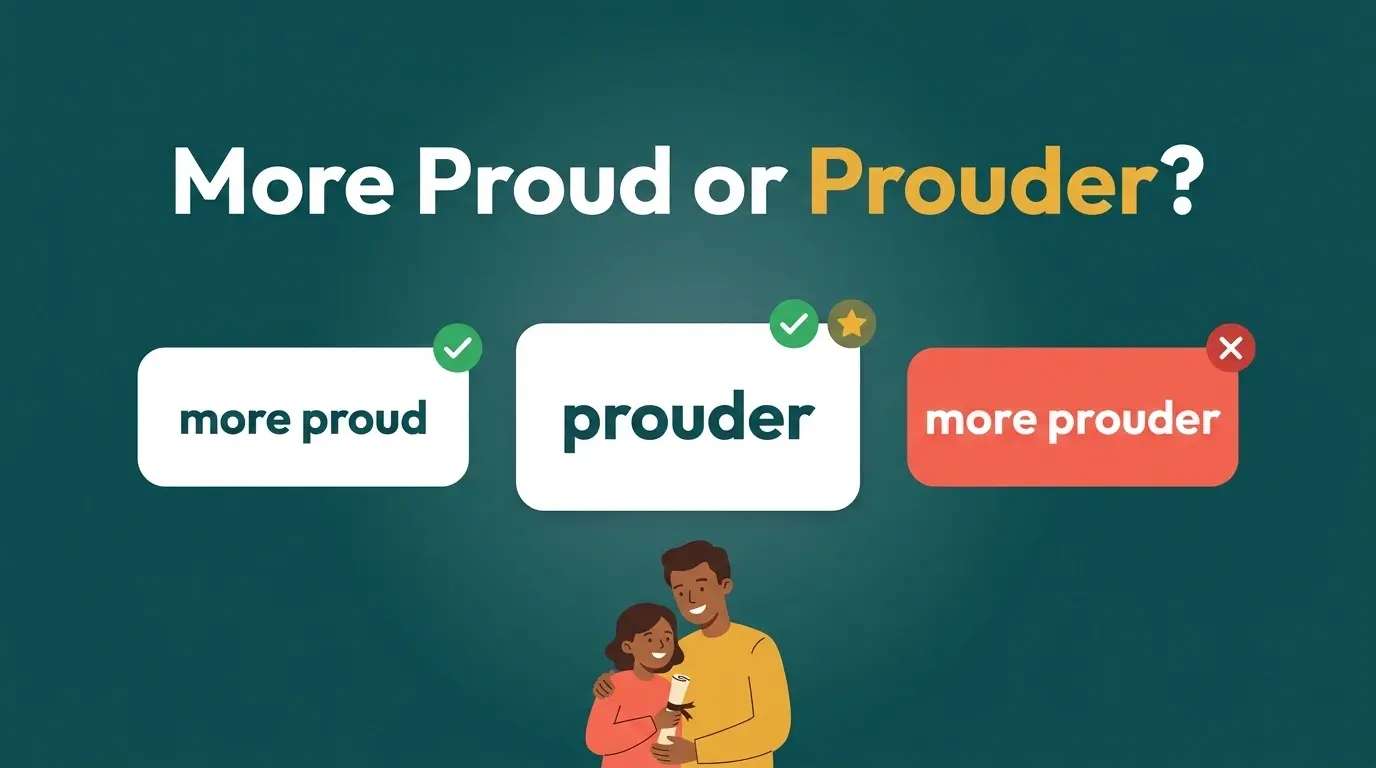
Both forms are correct. Prouder is the standard choice, and more proud is an accepted alternative.
Here’s the quick version:
- Prouder follows the normal rule for short adjectives. It is the safest option in writing.
- More proud is also used, especially in speech and in set phrases like “I couldn’t be more proud.”
- More prouder is wrong. It uses two comparison markers at once.
If you only remember one sentence, remember this: when in doubt, write “prouder.”
What Does “Proud” Mean?
Before comparing the forms, it helps to be clear about the word itself. “Proud” describes a feeling of pleasure or satisfaction about something good, whether you did it or someone else did.
- I’m proud of how hard you worked.
- They are proud parents of three children.
- She felt proud of her first published article.
“Proud” can also have a negative meaning. It can describe someone who thinks too highly of themselves, as in He was too proud to say sorry.
In this article, we focus on the positive meaning, because that is what almost everyone has in mind when they ask which comparative is correct.
Read More: Lay in Bed or Lie in Bed? The Simple Rule Explained
Why “Prouder” Is the Standard Choice
The One-Syllable Rule
English has two main ways to make a comparison:
- Add -er to short adjectives, usually those with one syllable.
- Put “more” before longer adjectives.
Look at how this works:
| Adjective | Comparative |
| tall | taller |
| fast | faster |
| small | smaller |
| strong | stronger |
| proud | prouder |
| beautiful | more beautiful |
| important | more important |
“Proud” has just one syllable, so the regular pattern gives us prouder. That’s all there is to it. There is nothing unusual or irregular about the word.
What Dictionaries Say
Dictionaries back this up. The Britannica Dictionary lists prouder and proudest as the main forms of “proud,” and it also notes more proud and most proud as alternatives. Merriam-Webster, as described by other grammar sources, lists prouder and proudest as the inflected forms.
So the dictionary picture is simple. Prouder comes first. More proud is recognized, but it is the second option.
Is “More Proud” Wrong?
No, it isn’t wrong. It is simply the less standard choice for a one-syllable adjective.
Native speakers use “more proud” every day, and nobody misunderstands them. Compare these two sentences:
- She was prouder of her students than ever before.
- She was more proud of her students than ever before.
Both mean exactly the same thing. The difference is not in meaning. It is in style and formality.
Why Do People Say “More Proud”?
A few reasons explain why this form is so common:
- Habit. Most English adjectives use “more,” so people carry that pattern over to short words like “proud.”
- Emphasis. “More proud” can feel a little heavier and more emotional, especially when you add words like even, much, or far: I’m even more proud of you today.
- Speech rhythm. In casual conversation, people care more about flow than about textbook rules.
So think of it this way. “Prouder” is the rule, and “more proud” is how many people naturally talk.
More Proud or Prouder: How to Choose in Seconds
Here is a simple decision guide you can use whenever you’re unsure.
Step 1: Ask Where You Are Writing
If it’s an essay, a report, a job application, or a professional email, choose prouder. It follows the standard rule, so nobody can question it.
If it’s a text message, a speech, a card, or a social media caption, either form works. Pick the one that sounds more natural to you.
Step 2: Check for a Set Phrase
Some phrases have become so familiar that people use them in one form out of habit. The best example is “I couldn’t be more proud of you.” Changing it to “I couldn’t be prouder” is fine, but the original version sounds completely normal to most listeners. We’ll look at this phrase in detail below.
Step 3: Check What You Are Comparing
This step is the one most learners miss. Sometimes you are not comparing two people. You are comparing two feelings inside the same person. In that case, “more … than” is the natural pattern:
- She sounded more proud than surprised.
- He was more relieved than happy.
Here “more proud” is the better choice, because the sentence weighs one quality against another. Writing “prouder than surprised” would sound odd.
Step 4: Still Unsure? Use Prouder
When none of the steps above gives a clear answer, go with prouder. It is correct in every situation, and it is shorter.
“Couldn’t Be More Proud” or “Couldn’t Be Prouder”?
This is the phrase most people are actually trying to check, so it deserves its own section.
Both versions are correct:
- I couldn’t be prouder of you.
- I couldn’t be more proud of you.
What does the phrase really mean? You are comparing your feeling with itself. In other words: “I don’t have room to feel any prouder than I already do.” It is a way of saying you are at the very top of the pride scale.
Some examples:
- Their parents couldn’t be more proud of all their achievements.
- I couldn’t be prouder to be your father.
- Nobody could have been prouder.
Pay attention to one common error. “Couldn’t be more prouder” is not correct. You have to choose one: more proud, or prouder. Never both.
Proud, Prouder, Proudest
Learners often mix up the comparative and the superlative, so here is the full set side by side:
| Form | Word | Used for | Example |
| Base | proud | one person or thing | I’m proud of you. |
| Comparative | prouder | comparing two | I’m prouder of my daughter than you are. |
| Superlative | proudest | the highest degree among three or more | This is my proudest moment. |
A simple way to remember it: comparative compares two, superlative picks the top one.
“Most proud” also appears in casual speech, as in I’m most proud of my children. But “proudest” is the standard superlative, just like “prouder” is the standard comparative. For a simple sentence, proudest is the easy choice.
Common Mistakes to Avoid
1. Writing “More Prouder”
- ❌ I am more prouder of my brother.
- ✅ I am prouder of my brother.
- ✅ I am more proud of my brother.
The word “prouder” already contains the comparison. Adding “more” doubles it.
2. Writing “Couldn’t Be More Prouder”
- ❌ I couldn’t be more prouder.
- ✅ I couldn’t be prouder.
- ✅ I couldn’t be more proud.
3. Mixing Up Comparative and Superlative
- ❌ She is the prouder person in the family.
- ✅ She is the proudest person in the family.
- ✅ She is prouder than anyone else in the family.
Use “proudest” when you pick one person from a group. Use “prouder” when you compare.
4. Forgetting “Than”
- ❌ I am prouder as my sister.
- ✅ I am prouder than my sister.
When you compare two people directly, “than” is what connects them.
5. Using Proudest When You Mean Prouder
- ❌ I am proudest than my brother.
- ✅ I am prouder than my brother.
6. Calling “More Proud” a Mistake
This one is a mistake in the other direction. Some people think “more proud” is simply wrong and correct it in other people’s writing. That is too strict. It is accepted usage, just not the first choice in formal writing.
More Examples You Can Use
With “Prouder”
- I’ve never felt prouder of my team than I did after that presentation.
- He became prouder and prouder of his son every day.
- No one in the room looked prouder than her father.
- They felt prouder about their work than their classmates did about theirs.
- Moving to a new country made her prouder of her own culture.
With “More Proud”
- She is more proud of her brother than he is of himself.
- They became more and more proud by the day.
- We are even more proud of the process than the final result.
- He was more proud of his best friend than he was of anyone else.
- You should be more proud of yourself.
Notice the patterns prouder and prouder and more and more proud. Both describe pride that keeps growing over time.
Other Short Adjectives With the Same Confusion
“Proud” is not the only word that causes this doubt. Many short adjectives get a “more” in casual speech, even though the standard comparative uses -er:
| Adjective | Standard comparative | Also heard in speech |
| proud | prouder | more proud |
| clever | cleverer | more clever |
| quiet | quieter | more quiet |
| calm | calmer | more calm |
If you understand the rule for “proud,” you can apply the same thinking to these words. Use the -er form as your default, and treat the “more” version as a casual alternative.
A Simple Memory Trick
Say the word out loud. “Proud” is one quick beat. Words with one beat usually want -er, not “more.”
This is a memory aid, not an official grammar law. But it works well for most short adjectives, and it gives you the right answer far more often than guessing.
Here is a tiny checklist to keep in mind:
- One syllable? Try -er first.
- Writing formally? Choose prouder.
- Comparing two feelings in one person? Choose more proud … than.
- Never combine more with -er.
Quick Practice
Test yourself. The answers are right below.
- Fix this sentence: She is more prouder than me.
- Complete it: This is my ____ moment. (prouder / proudest)
- In a formal report, which is the safer choice: prouder or more proud?
- Is “I couldn’t be more proud of you” an error?
- Complete it: He sounded ____ than surprised. (prouder / more proud)
Answers
- She is prouder than me (or more proud than me).
- Proudest. You are picking the top moment.
- Prouder.
- No. It is correct and very common.
- More proud, because you are comparing two feelings.
FAQs
Is it “more proud” or “prouder”?
Both are correct. Prouder is the standard comparative and the safest choice in writing. More proud is an accepted alternative that you will often hear in speech. Both mean “feeling a greater amount of pride,” so you can use either without changing the meaning.
Is “prouder” a real word?
Yes. Prouder is the standard comparative form of proud, and major dictionaries list it. Its superlative form is proudest. You can use it safely in school work, emails, and professional writing without worrying about whether it counts as a real English word.
Can I say “I couldn’t be more proud of you”?
Yes. It is a very common and natural phrase. It means you already feel the highest level of pride possible. “I couldn’t be prouder of you” is also correct and means the same thing, so choose whichever sounds better to you.
Is “more prouder” ever correct?
No. More prouder is not standard English because it uses two comparison markers together. The word prouder already has the comparative ending. Use either “prouder” or “more proud,” but never both in the same phrase.
What is the superlative of proud: proudest or most proud?
Proudest is the standard superlative. Most proud also appears in casual speech, but proudest follows the usual rule for short adjectives. Use it to show the highest degree of pride, as in “This is my proudest moment.”
Which form should I use in formal writing?
Use prouder. It follows the standard one-syllable rule and is listed first in dictionaries, so it reads as polished in essays, reports, and professional emails. Save more proud for speech, casual messages, and sentences where you compare two feelings.
Conclusion:
Choosing between more proud or prouder is easier than it first seems. Both are correct. Prouder is the standard form, because “proud” is a short, one-syllable adjective.
More proud is an accepted alternative, especially in speech, in emphatic sentences, and when you compare two qualities.
The only form to avoid is more prouder, which doubles the comparison.
Your next step is simple. The next time you write a message, an email, or an essay, pick one form on purpose using the steps above. After a few tries, it will feel automatic.

I am an English language writer passionate about grammar and clear communication. I create simple, easy-to-understand content that helps readers improve their English skills. My goal is to make learning English both practical and enjoyable.


1 thought on “More Proud or Prouder? Pick the Right One Every Time”