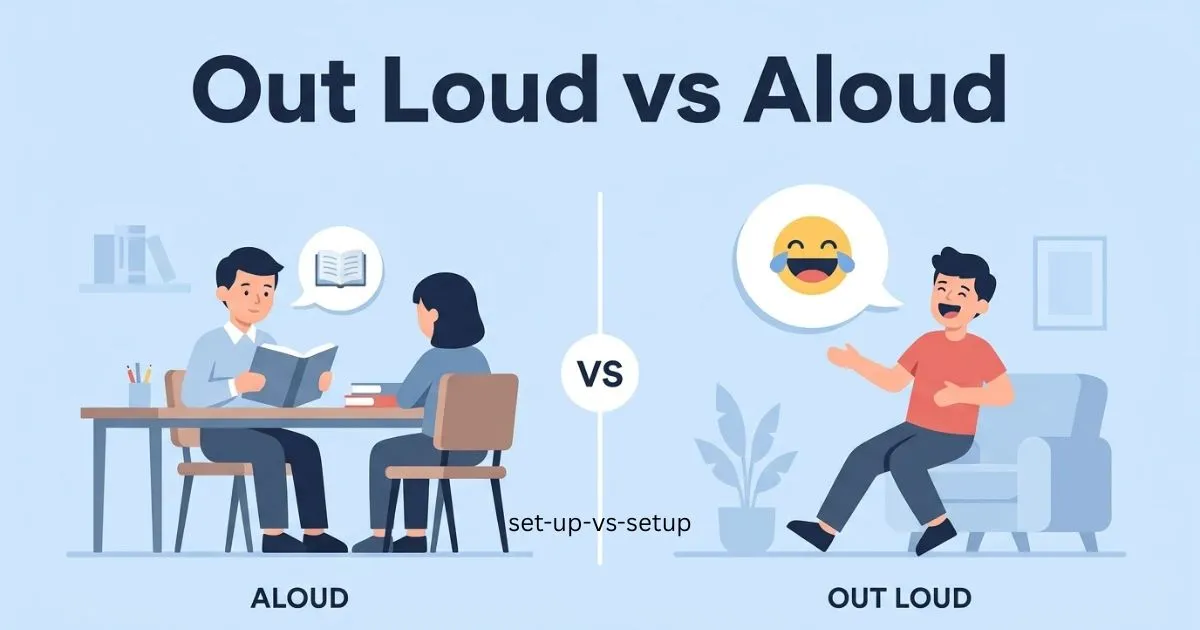
You are typing a sentence and suddenly stop. Should it be “read it aloud” or “read it out loud”? Both look right. Both are right. That is exactly why this pair confuses so many people.
The good news is that the two mean almost the same thing, and you can swap them in most sentences.
The even better news is that small habits sit behind the choice: which one sounds formal, which one sounds emotional, and which idioms only feel natural one way.
In this guide, you will get clear meanings, a simple tone rule, a table of common expressions, a 3-step test, and a short practice quiz. After that, out loud vs aloud will stop slowing you down.
Out Loud vs Aloud: The Short Answer
Both expressions mean “in a voice that other people can hear.” You are saying, reading, or reacting with sound instead of keeping it silent in your head.
- Aloud is a one-word adverb.
- Out loud is a two-word adverbial phrase.
In most sentences, you can use either one:
- She read the note aloud.
- She read the note out loud.
Where they differ is in tendency, not in meaning. Aloud leans formal and shows up in classic idioms. Out loud leans casual and often carries a feeling of volume or emotion. Think of these as habits of English, not strict rules.
What Does Aloud Mean?
Aloud means audibly, so that others can hear you. If you speak aloud, you are not silently thinking or muttering inside your head.
Here is a point many people miss: aloud is not really about volume. You can talk aloud in a calm, quiet voice. The key idea is that the sound is real and can be heard.
Different sources phrase this slightly differently. One describes it as “more than a whisper,” while another says it still applies when a person quietly talks to themselves. The safest takeaway is simple: aloud is about being heard, not about being loud.
Examples of aloud
- The teacher asked Hira to read the paragraph aloud.
- He counted the steps aloud to stay focused.
- I wondered aloud whether the shop was still open.
- Some thoughts are better not said aloud.
A quick look at its history
According to Capitalize My Title, aloud dates back to the late 13th century. It comes from the Middle English word loud combined with the prefix a-. So it is the older of the two expressions, which helps explain why it feels a little more traditional.
Read More: More Proud or Prouder? Pick the Right One Every Time
What Does Out Loud Mean?
Out loud also means audibly, so that others can hear. If you “think out loud,” you speak your thoughts instead of keeping them inside.
It is a two-word phrase, and it should stay that way in standard writing.
Interestingly, out loud once had a slightly casual reputation. Capitalize My Title traces it to an 1821 letter by Maria Edgeworth, and LanguageTool notes that it used to be seen as too colloquial. That is no longer true. Today, it appears in both formal and casual writing.
Examples of out loud
- I did not realize I had said that out loud.
- The comedian made the whole room laugh out loud.
- Please read the question out loud before you answer.
- She practiced her speech out loud in front of the mirror.
How Are They Different? Tone, Not Meaning
If the meanings match, why do two forms exist? Because writers and speakers have developed small preferences over time.
1. Formality
Aloud is shorter and older, so it is often the preferred choice in formal writing. Think instructions, school material, and reports. That said, both forms are widely accepted everywhere. Using out loud in a formal document is not a mistake.
2. Volume and emotion
Out loud is often used to stress that something was done loudly or with strong feeling. Compare these:
- “I can’t believe I said that out loud.” (embarrassment)
- “He read the report aloud.” (neutral, just spoken)
Verbs like laugh and blurt usually go with out loud. That is also why the texting abbreviation LOL stands for “laughing out loud.”
3. Idiom habits
Some phrases have a favorite partner. Read aloud and think aloud sound very natural. Laugh out loud and for crying out loud sound natural too. Swapping them is not wrong, but it can feel slightly unusual.
Why sources seem to disagree
One article says the two words are fully interchangeable. Another says out loud has a “burst of volume” feeling. Both can be true. They are interchangeable in meaning, but out loud often carries more emotional color. If a reader would understand your sentence either way, you are safe.
Common Expressions: Which One Sounds More Natural?
A Google Ngram search cited by LanguageTool shows that thinking aloud and reading aloud appear more often than their out loud versions. On the other side, crying out loud and laughing out loud win.
| Expression | Usually sounds more natural | Quick note |
| Read aloud | Aloud | Common in classrooms and instructions |
| Think aloud | Aloud | Also fine as “think out loud” |
| Laugh out loud | Out loud | Source of the acronym LOL |
| For crying out loud | Out loud | An exclamation of frustration or anger |
| Blurt out loud | Out loud | Suggests something said suddenly |
| Say it aloud / out loud | Either | Choose by tone |
One important warning: for crying out loud has nothing to do with actually crying. It is a fixed phrase people use when they are annoyed or impatient.
A Simple 3-Step Test
When you are stuck, run through these steps.
- Is it a fixed expression? If yes, use the familiar form: read aloud, think aloud, laugh out loud, for crying out loud.
- Does tone matter? For formal or academic writing, lean toward aloud. For casual or emotional moments, lean toward out loud.
- Still unsure? Use either one. Say your sentence in your head and pick the one that sounds more natural to you.
This works because neither version is wrong. You are only choosing the smoother fit.
Grammar Notes You Should Know
Both are adverbs of manner
They describe how an action happens. They usually come after the verb or after its object:
- She read aloud.
- She read the poem aloud.
- She read the poem out loud.
Spelling matters
- Aloud is always one word. “A loud” is something different, as in “a loud noise.”
- Out loud is two words. “Outloud” is not standard English.
Aloud is not the same as loud or loudly
Loud is an adjective, and loudly is an adverb of volume. Aloud only says that sound is audible. Compare:
- The music was loud. (adjective)
- The crowd cheered loudly. (strong volume)
- The boy read the sign aloud. (audible, but not necessarily noisy)
Common Mistakes to Avoid
1. Writing “outloud.” It looks neat, but it is wrong. Keep two words.
2. Writing “a loud” for aloud. “She spoke a loud” is incorrect. Use aloud.
3. Mixing up aloud and allowed. These two sound the same, but they are not related. LanguageTool explains that aloud is an adverb and allowed is a verb form meaning “permitted.”
- She read the rules aloud.
- Students are allowed to bring a dictionary.
4. Thinking “think aloud” means thinking silently. It means the opposite. You put your thoughts into spoken words.
5. Treating “for crying out loud” literally. It is an exclamation. It does not describe someone crying.
6. Believing one form is wrong. Neither is. Dictionaries and language guides treat them as accepted English.
Practical Tips for Students, Learners, and Writers
- Use aloud in formal documents. If you are writing a report, an essay, or classroom instructions, aloud is the safer, more traditional pick.
- Be consistent in one piece of writing. If you start with “read aloud,” do not switch to “read out loud” two lines later without a reason.
- Practice speaking aloud to improve pronunciation. Speaking a new language aloud, even when you are alone, helps your ear and your mouth work together.
- Think aloud while solving problems. Saying each step helps you notice mistakes. David, in one LanguageTool example, even did this to work out a solution.
- Keep out loud for natural speech. In dialogue, chats, and casual emails, it sounds relaxed and human.
Quick Practice: Choose the Best Option
Try these before you check the answers.
- Please read the instructions ______ before the exam begins.
- That video made me laugh ______.
- ______ crying out loud, hurry up!
- I am too shy to say it ______.
- Students are ______ to use calculators.
Answers:
- Aloud (best for formal instructions), though out loud also works.
- Out loud (the usual pairing with laugh).
- This one is a trick. The correct phrase is “For crying out loud,” so the blank is “For.”
- Either aloud or out loud works.
- Allowed. This is the homophone trap.
Similar Words to Know
If you want variety in your writing, a few related words can help:
- Audibly, vocally, and orally all refer to speaking with the voice.
- Loudly, noisily, and deafeningly emphasize actual volume, which is closer to the feeling of out loud.
FAQs
1. Are aloud and out loud the same?
Yes, they carry the same basic meaning: saying something so others can hear. The difference is mostly style. Aloud feels slightly more formal and appears in set phrases like read aloud, while out loud is common in conversation and often adds a feeling of emotion or volume.
2. Is it “read aloud” or “read out loud”?
Both are correct. Read aloud is a bit more common in school and formal contexts, while read out loud is natural in everyday speech. If you are writing instructions, choose aloud. If you are chatting, either one is fine.
3. Is out loud informal?
Not anymore. It was once considered too colloquial, but today it appears in both formal and casual writing. Many writers still choose aloud for very formal pieces because it is shorter and traditional, but using out loud is not an error.
4. Does aloud mean loudly?
No. Aloud means audibly, so others can hear you. It says nothing about how big the volume is. Loudly describes strong volume. A person can read a story aloud in a soft, calm voice and still be using the word correctly.
5. What does “for crying out loud” mean?
It is a fixed exclamation used to show anger, annoyance, or frustration, such as “For crying out loud, we are late again!” It does not describe real crying. Because this is an idiom, out loud is the form to use.
6. Is it “outloud” or “out loud”?
The correct form is two words: out loud. “Outloud” is not standard English, so your spell checker or editor will likely flag it. In contrast, aloud is always written as one word.
7. What is the difference between aloud and allowed?
They sound alike but have different meanings. Aloud means audibly, as in “He read the rule aloud.” Allowed means permitted, as in “Phones are not allowed.” If you can replace the word with “permitted,” you need allowed.
Conclusion:
Out loud vs aloud is not really a battle between right and wrong. Both mean “so that others can hear,” and both are correct.
Aloud tends to be shorter, older, and more formal, and it fits idioms like read aloud and think aloud.
Out loud tends to feel more natural in everyday speech and strong reactions, as in laugh out loud.
Your next step is easy. The next time you write one of these, run the 3-step test: check for a fixed expression, think about tone, and then trust what sounds natural. Bookmark the table above if you want a quick reminder.

As an American English writer, I specialize in creating clear and engaging content that makes grammar and language learning accessible to everyone. I enjoy breaking down complex English concepts into simple, practical lessons that readers can apply with confidence. My mission is to help learners strengthen their communication skills through easy and reliable content.







1 thought on “Out Loud vs Aloud: When to Use Each (With Examples)”