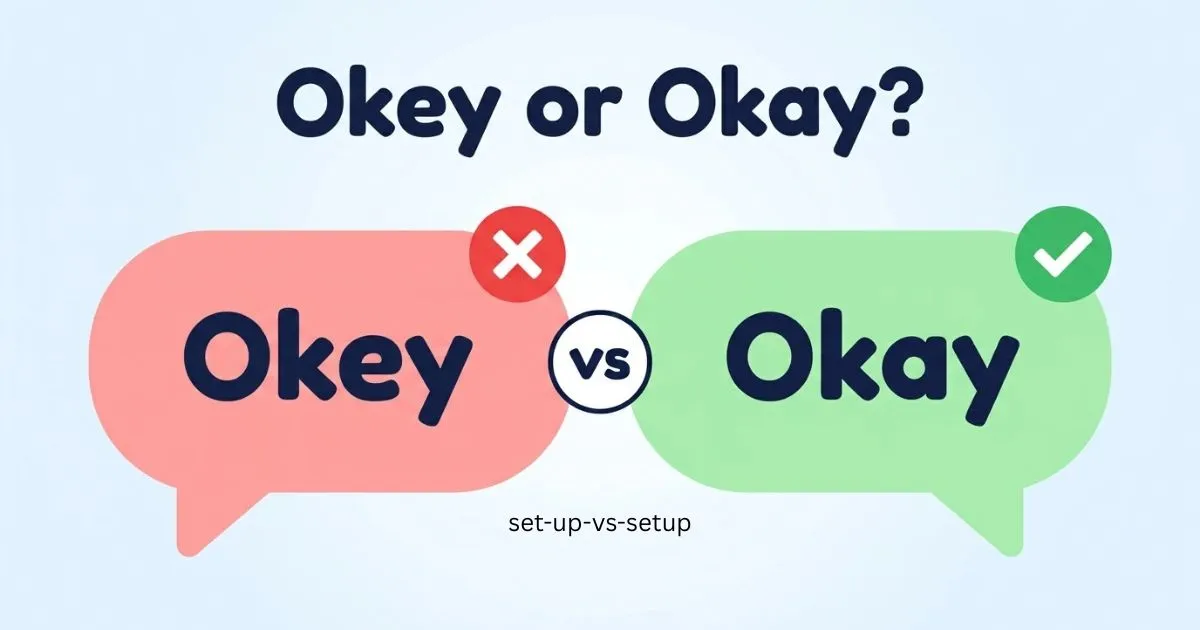
You are typing a quick reply and your fingers freeze: okey or okay?
It looks like a tiny question, yet it is exactly the kind of slip that makes a teacher circle a word or an editor pause.
Here is the short answer: okay is correct. None of the dictionary-style and grammar guides we reviewed list okey as an accepted spelling. The accepted forms are okay and OK.
In this guide, you will learn why okay wins, what the word really means, how OK and okay differ (less than you might think), how to write the past tense, and when a different word works better. You will also get a simple checklist to use every time you write.
Okey or Okay: The Quick Answer
Write okay or OK. Both are standard and both mean the same thing.
- Correct and common: okay, OK
- Less common variants: ok, O.K.
- Not recommended: okey
If you want one rule to remember, here it is: okay ends with “ay,” like “day” and “say.”
Why Do People Write “Okey”?
The most likely reason is sound. Say the word aloud and the last syllable rhymes with “day,” but many English words end that sound in different ways, so spelling it by ear can go wrong. Adding an extra E feels natural, but it does not match the accepted spelling.
You may spot okey in a chat message or a username. In ordinary English writing, treat it as a typo and fix it.
Here is how it looks in practice:
| Instead of this | Write this |
| Okey, I understand. | Okay, I understand. |
| Everything is okey. | Everything is okay. |
| Are you okey? | Are you okay? |
| She okeyed the request. | She okayed the request. |
What Does Okay Mean?
Okay is a small word that does a lot of jobs. Its meaning depends on how the sentence uses it.
1. Agreement (“yes, fine”)
Used as an interjection, okay shows that you accept an idea or request.
- “Shall we start?” “Okay.”
- Okay, I will send the file tonight.
It can also signal that you are about to begin speaking, as in “Okay, let’s get started.” And at the end of a sentence, it asks the listener to confirm: “We meet at six, okay?”
2. Acceptable, but not amazing
As an adjective, okay means acceptable or passable. Something okay is positive, but not as positive as it could be.
- The food was okay, but nothing special.
- Was the weather okay for the trip?
This is why “How was the movie?” followed by “It was okay” rarely means the person loved it.
3. Safe or well
Okay is also the natural word for checking on someone.
- Are you okay after the journey?
- My brother is okay now.
4. How well something went
As an adverb, okay describes how an action turned out.
- She did okay in the exam.
- The car runs okay.
5. Permission or approval (a noun)
You can give or receive an okay.
- We need the manager’s okay before we begin.
- The teacher gave me the okay to submit late.
6. To approve (a verb)
Okay can also be a verb meaning to approve or authorize.
- The director okayed the proposal.
- Has he okayed the budget yet?
So the same little word can be an interjection, adjective, adverb, noun, or verb. That flexibility is a big reason it is everywhere.
OK vs. Okay: Are They Different?
No. They are two spellings of the same word, and the meaning does not change.
A common belief is that OK is a short form of okay. It is the other way round. OK came first, appearing in the 1840s, and okay showed up a few decades later. In fact, OK is not really a short form of anything today. It is a word in its own right.
Which one is more common?
The sources disagree slightly, which tells you something: it really is a matter of preference. One source says okay is more common in edited writing, with OK appearing about a third of the time. Another says OK is more common overall. Both agree that neither one is wrong.
What do style guides say?
Style guides are where the real difference lives.
- The AP Stylebook prefers OK.
- Other guides accept both spellings, and some tell you to check a dictionary.
- If you write for a school, publisher, or company with its own style guide, follow it.
Where did OK come from?
The most widely accepted story is that OK began in early-19th-century America as a joke. Writers of the time enjoyed deliberate misspellings, and “oll korrect” was a playful take on “all correct.”
A popular second theory links it to President Martin Van Buren, nicknamed “Old Kinderhook.” His supporters formed an “OK Club” during his 1840 campaign. Treat this as part of the word’s colorful history rather than a settled explanation, because etymologists have proposed several origins.
Read More: Out Loud vs Aloud: When to Use Each (With Examples)
Capital Letters and Punctuation
A few small rules keep your writing tidy.
- okay is written in lowercase, unless it starts a sentence.
- OK is written in capital letters.
- ok (all lowercase) is a less common variant. It is better to choose OK or okay.
- O.K. with periods appears in older texts and is considered nonstandard in modern English by one source, though another calls it widely accepted but less common. The safe move is to skip it.
Whichever form you choose, use it consistently in the same document. Switching between OK and okay at random distracts readers.
Past Tense and Other Verb Forms
When okay works as a verb, the forms follow regular patterns.
| Form | OK spelling | Okay spelling |
| Base | OK | okay |
| Past | OK’d | okayed |
| -ing | OK’ing | okaying |
The apostrophe in OK’d is recommended by the AP Stylebook. If you prefer okay, the past tense is simply okayed, with no apostrophe.
Example: “The editor okayed the headline” and “The editor OK’d the headline” mean exactly the same thing.
Is Okay Formal or Informal?
Here, the sources do not fully agree. One says neither spelling is more formal than the other. Another calls OK slightly more informal. A third says the word as a whole belongs mainly to speech rather than formal writing such as academic papers.
What this means for you is practical: the spelling matters less than the setting. The word itself has a relaxed, conversational feel. It suits texts, emails to colleagues, dialogue, and everyday writing. It is a good tool for fiction too, where it helps give a character a natural voice.
For formal reports, essays, or official letters, a more precise word is often stronger.
Better word choices for formal writing
| Instead of | Try |
| Your application is okay. | Your application is acceptable. |
| The manager okayed the plan. | The manager approved the plan. |
| Okay, we agree. | Agreed. / We agree. |
| The results were okay. | The results were satisfactory. |
Other useful alternatives include fine and all right for the adjective, yes and sure for the interjection, approval and consent for the noun, and authorize for the verb.
How to Choose in Four Steps
Use this checklist whenever you are unsure.
- Check for a style guide. If your school, employer, or publication has one, follow it.
- No guide? Pick okay or OK. Both are correct, so choose the one that feels natural.
- Stay consistent. Do not switch within the same piece.
- Think about the setting. If the writing is formal, consider approved, acceptable, or satisfactory instead.
And never okey.
Common Mistakes to Avoid
- Writing okey. The standard spelling is okay.
- Believing okay and OK mean different things. They do not.
- Calling OK an abbreviation of okay. OK is older.
- Mixing styles in one document. Pick one and stay with it.
- Using okay for everything. In formal work, a sharper word is usually better.
- Forgetting the apostrophe in OK’d. If you use OK, write OK’d, not OKd.
Okay in Everyday Use
Seeing the word in real situations makes the rules stick.
In messages
- Okay, I’ll be there by five.
- Is it okay if I bring a friend?
At school
- My teacher said my essay was okay, but I can improve the ending.
- Okay, let’s look at question three.
At work
- We received the okay from the client this morning.
- Can you okay this expense report today?
In stories and dialogue
- “Are you okay?” she asked quietly.
- “I’m okay,” he said, though his voice shook.
Checking understanding
- You will send the draft tomorrow, okay?
- Okay, that makes sense now.
Easy Ways to Remember the Spelling
- Think “day.” Okay ends in -ay, exactly like day, say, and way.
- Remember OK came first. If you want the shortest form, OK is it, with no extra letters.
- Run a quick search. Before you publish or submit, search your document for “okey” and replace it.
FAQs
Is it okey or okay?
Okay is the correct spelling. Okey does not appear as an accepted form in the style and grammar guides we reviewed. If you want a shorter version, use OK, which is also fully accepted. Choose one and use it consistently throughout your writing.
Is OK or okay correct?
Both are correct. They are two spellings of the same word with the same meaning. Some style guides prefer one over the other, so check yours if you have one. If not, pick whichever feels natural and keep it consistent within each document.
Is OK short for okay?
No. OK is actually the older form, appearing in the 1840s, while okay came a few decades later. It likely began as a joking spelling of “all correct.” Today OK is simply a word in its own right, not an abbreviation of okay.
What is the past tense of okay?
The past tense of okay is okayed, as in “The manager okayed the request.” If you prefer the OK spelling, the past tense is OK’d, with an apostrophe, as recommended by the AP Stylebook. Both forms mean the same thing.
Is okay formal or informal?
Okay has a casual, conversational feel and mostly belongs to speech and everyday writing. Sources disagree about whether one spelling is more formal, but they agree it is less suited to academic writing. In formal documents, words like approved, acceptable, or satisfactory are usually stronger.
Can I write “ok” in lowercase?
Lowercase ok is a recognized but less common variant. It is fine in quick texts, but OK or okay are safer choices in anything you want to look polished. Whatever you pick, avoid switching between forms in the same document, because inconsistency distracts readers.
Is O.K. with periods still correct?
O.K. is the older, dotted style. Sources differ on it: one calls it widely accepted but less common, another calls it nonstandard in modern English. Since OK and okay are clearly safe, the simplest choice is to skip the periods entirely.
Conclusion:
Okey or okay? Okay is the correct choice, and OK is its equally valid cousin.
They mean the same thing, they work in the same sentences, and the only real decision is which one suits your style guide or your taste.
Your next step is simple: open the last thing you wrote, search for “okey,” and fix it. Then pick one form, either okay or OK, and use it consistently from now on.

I’m Sophia Mitchell, an English grammar and writing enthusiast. I create simple, easy-to-understand content to help learners improve their English. My goal is to make grammar clear, practical, and enjoyable for everyone.



1 thought on “Okay or Okey? The Correct Spelling (and OK vs Okay)”