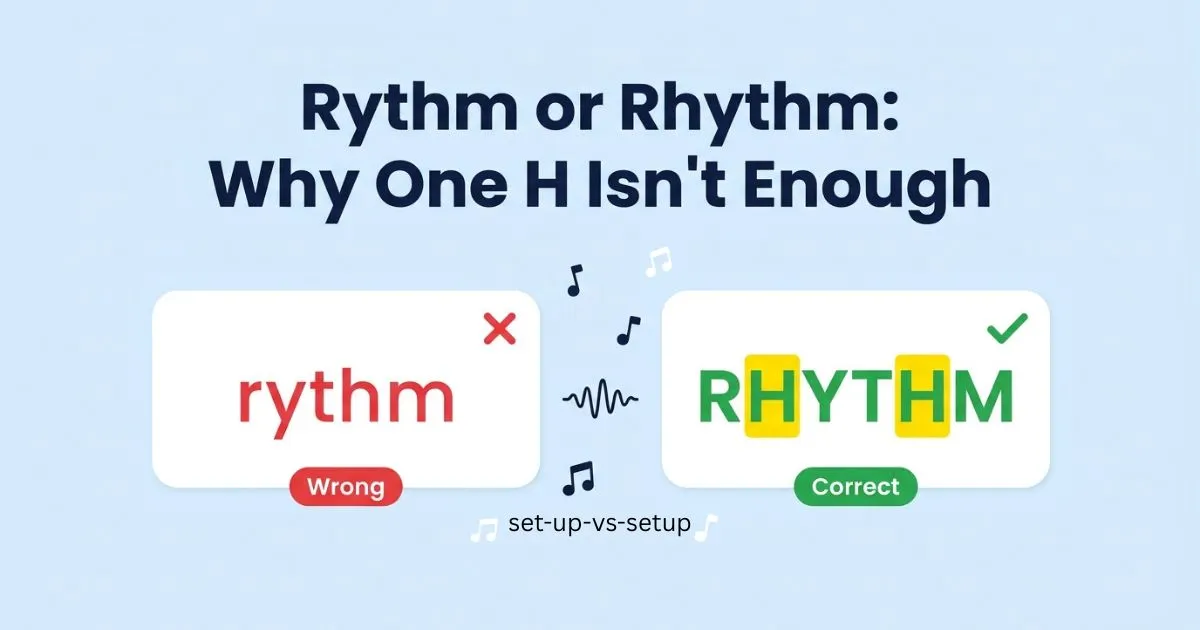
You’re typing a message about your favorite song, and then you stop. Is it “rythm” or “rhythm”? Both look believable, and neither sounds wrong when you say it out loud.
Here’s the short answer: rhythm is the correct spelling in both American and British English. Rythm is a misspelling.
It’s easy to make because the word has no a, e, i, o or u, and its first H is silent, so your eyes slide right past it.
In this guide, you’ll learn what rhythm means, how to say it, why it’s spelled so strangely, and which mistakes people make most. You’ll also get a memory trick and a one-minute drill that makes the correct spelling stick.
Quick Answer: Rythm or Rhythm?
Use rhythm. Every time, in every kind of writing.
| Spelling | Correct? | Note |
| rhythm | Yes | Standard in US and UK English |
| rythm | No | Missing the first H |
The one-line rule: rhythm has two H’s, one right after the R and one right after the T.
- Correct: The drummer kept a steady rhythm.
- Incorrect: The drummer kept a steady rythm.
Is “Rythm” a Real Word?
No. Rythm isn’t an older spelling, a regional variant, or a separate word. It is simply rhythm with a letter missing.
Some people assume the two are different words, for example that “rhythm” belongs to music while “rythm” describes things like a heartbeat. That’s a myth. Rhythm covers music and everything else.
You’ll often see “rythm” in social media comments, search boxes and quick messages. Seeing it everywhere doesn’t make it acceptable. In essays, emails, articles and schoolwork, write rhythm.
Read More: Okay or Okey? The Correct Spelling (and OK vs Okay)
What Does Rhythm Mean?
Rhythm is a noun. It means a repeated pattern of sounds, movements or events, or put even more simply, how things are arranged in time.
The word shows up in a lot of places, so it helps to see the main uses side by side.
Rhythm in Music
In music, rhythm is the pattern of sounds and silences in relation to the beat. You notice it when you clap along to a song or tap your foot without thinking.
- The drummer changed the rhythm during the chorus.
- I love the relaxed rhythm of this song.
- The album combines several different rhythms.
Rhythm in Dance and Movement
Dancers follow rhythm with their bodies. Athletes talk about it too, usually when everything starts to flow.
- She quickly found the rhythm of the dance.
- He moves across the court with a graceful rhythm.
- The children clapped to the rhythm of the song.
Rhythm in Everyday Life and the Body
Rhythm also describes regular patterns of change. Your heart has a rhythm, which is why doctors talk about heart rhythm. Your body also follows circadian rhythms, the cycle that governs when you sleep and wake. Even the seasons have a rhythm.
It works for routines, too:
- It took me a week to find my work rhythm.
- A steady morning rhythm makes the day feel calmer.
- The doctor checked his heart rhythm.
Rhythm in Words
Writers and speakers use rhythm to control how a text feels. A poem relies on it. A speech with good rhythm is easier to follow. Even a plain paragraph reads better when long and short sentences are mixed.
- The poem has a gentle rhythm.
- His speech had a natural rhythm.
- The rain made a calming rhythm against the window.
Rhythm, Beat and Tempo: What’s the Difference?
People mix these three up all the time. They’re related, but they are not the same thing.
- Beat is the steady pulse of the music, the thing you tap your foot to.
- Rhythm is the pattern of sounds and silences built around that pulse.
- Tempo is the speed of the music.
So you can tap a steady beat while a drummer plays a different rhythmic pattern over the top of it. And because tempo is about speed, it isn’t a true synonym for rhythm, even though dictionaries often list it nearby.
Quick Answers to Common Music Questions
Many people who search for this spelling are also curious about the music side of the word. Here are the questions that come up most.
What Is Rhythm Guitar?
Rhythm guitar is guitar playing that supports the rhythm and structure of a song. A rhythm guitarist usually plays chords or repeated patterns that give other instruments something to build on. Lead guitar focuses more on melodies and solos.
The spelling is rhythm guitar. “Rythm guitar” has the same missing H as any other “rythm.”
What Is 4/4 Time?
4/4 is called common time. It’s a time signature meaning four quarter-note beats in each measure.
One thing to keep in mind: 4/4 is not one specific rhythm. Countless different rhythmic patterns can be played in 4/4 time.
Can Rhythm Exist Without Melody?
Yes. Clapping, tapping or drumming creates rhythm with no melody at all. The timing of the claps is the rhythm. Rhythm and melody usually work together, but they are separate musical elements.
How Many Types of Rhythm Are There?
There is no single official list. Different musical traditions classify rhythm differently. One simple way to sort it is:
- Regular rhythm: follows a predictable pattern.
- Irregular rhythm: uses less predictable timing.
- Syncopated rhythm: puts emphasis in unexpected places in the beat.
- Free rhythm: has no strict repeating beat pattern.
Treat these as broad descriptions, not a rulebook.
Why Is Rhythm Spelled This Way?
The odd spelling isn’t random. It’s a leftover from the word’s history.
The Greek Roots
English borrowed the word from Ancient Greek, rhythmos, by way of Latin, rhythmus. The “rh” at the start and the “y” in the middle both come from that Greek origin, and English kept them instead of smoothing the word into something simpler.
That’s a useful thing to know. Many English spellings that feel illogical turn out to make perfect sense in the language they came from.
Where the Y Fits In
Here’s the trick that surprises people: rhythm does have a vowel sound. It just isn’t written with a, e, i, o or u. The letter Y carries the vowel sound in the first syllable, which is why the word looks like it’s made only of consonants.
Letter by letter, it goes:
R – H – Y – T – H – M
Six letters, one Y, two H’s.
Why Do People Misspell Rhythm?
Once you understand the word, the mistakes make sense. There are really only three causes.
- The silent H. The first H makes no separate sound, so it’s easy to forget. This is the cause of “rythm,” the most common error by far.
- Spelling by sound. People write what they hear, which gives forms like “rithm.”
- Adding a vowel. Because the word feels like it should have one between T and H, writers squeeze one in, giving “rhythem” or “rythum.”
Common Misspellings of Rhythm
| Incorrect | What went wrong |
| rythm | first H missing |
| rhytm | second H missing |
| rthym | letters rearranged |
| rhythem | extra E added |
| rythum | first H missing, extra U added |
| rhythmn | extra N at the end |
| rithm | spelled by sound |
| rithum | spelled by sound, extra U |
Every one of these fixes itself the same way: go back to R-H-Y-T-H-M.
How to Remember the Spelling of Rhythm
Don’t try to remember the whole word as a picture. Use one of these instead. Pick whichever feels most natural.
1. Use the Memory Sentence
The best-known trick is this sentence:
Rhythm Helps Your Two Hips Move.
Take the first letter of each word and you get R-H-Y-T-H-M. Some people swap “hips” for “hands.” Both work, so use whichever you’ll remember.
2. Remember “Two H’s”
Say it to yourself: rhythm has two H’s. One H follows the R, and one follows the T. If you can remember that, you won’t drop the first one again.
3. Split It Into Chunks
Break the word into three small pieces:
RHY + THM
Or, if that feels too big, try two-letter groups: RH + YT + HM. Then join them back together.
4. Link It to Music
Rhythm is what makes you clap, tap and move. If you picture a drummer or a favorite song while you write the word, the meaning helps anchor the spelling.
A 60-Second Practice Drill
Reading about spelling helps. Writing it down helps more. Try this once, right now:
- Write RH-YT-HM on paper in big letters.
- Cover it and write the full word from memory.
- Check it. If it’s wrong, find which letter you missed.
- Write one sentence using the word, such as “I love the rhythm of this song.”
- Repeat the whole thing tomorrow morning.
That second round, a day later, is what turns a trick into a habit.
Is Rhythm Spelled Differently in the UK and US?
No. This is not like color and colour, where the spelling changes between American and British English.
| American English | British English | |
| Spelling | rhythm | rhythm |
| Plural | rhythms | rhythms |
| Adjective | rhythmic | rhythmic |
Never treat “rythm” as a British version. It isn’t one. It’s a mistake in both varieties.
Rhythm Word Forms You Should Know
Once you can spell rhythm, its family is easy. Every form keeps the same unusual start.
- Rhythm: the noun (“The song has a strong rhythm.”)
- Rhythms: the plural (“Different songs have different rhythms.”)
- Rhythmic: the adjective (“The dancers followed a rhythmic pattern.”)
- Rhythmical: another adjective form, with a similar meaning
- Rhythmically: the adverb (“She clapped rhythmically.”)
Rhythm can be countable or uncountable. You can say “different rhythms” when you mean several patterns, and “a good sense of rhythm” when you mean the general ability.
Common word pairings include strong rhythm, natural rhythm, musical rhythm, heart rhythm and dance rhythm.
Words You Can Use Instead of Rhythm
Sometimes you want a different word. The right choice depends on the situation:
- Beat: best for the regular pulse of music
- Pulse: good for something steady and alive, like a heartbeat
- Cadence: works well for the flow of speech or marching
- Flow: natural for writing, speech or movement
- Pattern: a safe, general choice
- Meter: used mostly in music and poetry
These aren’t perfect swaps. “Beat” and “rhythm” in particular are not the same thing, as explained earlier.
How to Say Rhythm
Rhythm is a two-syllable word, pronounced roughly RITH-uhm. The stress falls on the first syllable. The Cambridge Dictionary gives the same pronunciation for both UK and US English.
- R: the usual R sound
- Y: a short vowel, like the I in “ship”
- TH: the soft sound you hear in “this”
- M: a closing M
Don’t try to sound out every letter. The spelling has more letters than the word has sounds, which is exactly why the spelling is so easy to get wrong.
A Simple Proofreading Checklist
Even when you know the correct spelling, typos happen when you’re typing fast. Before you publish or send anything that mentions rhythm, run through this:
- Search your document for “rythm.” If you find it, fix it.
- Also search for “rhytm” and “rhythem,” the next most common slips.
- Check that every instance has two H’s.
- Pay extra attention to titles, headings and image captions, which are easy to skip.
It takes ten seconds and protects you from the most visible kind of spelling mistake.
Frequently Asked Questions
1. Is it rythm or rhythm?
Rhythm is the correct spelling. Rythm is a common misspelling that leaves out the first H. This applies to both American and British English, and to every kind of writing, from school essays to professional emails. If you’re unsure, check for two H’s.
2. Is “rythm” ever correct?
No. Rythm is never correct, and it isn’t a different word with its own meaning. It is just rhythm with the first H missing. Dictionaries list only rhythm, so always replace rythm with the standard spelling, even in informal writing.
3. How do you spell rhythm?
The correct spelling is R-H-Y-T-H-M: six letters, with an H after the R and another after the T. A quick way to remember it is the sentence “Rhythm Helps Your Two Hips Move,” where each word’s first letter spells the word.
4. Does rhythm have a vowel?
Yes, though not one of the usual five. Rhythm contains no a, e, i, o or u, but the letter Y stands in as the vowel and gives the first syllable its sound. That unusual pattern is a big reason the word is so hard to spell.
5. Is rhythm spelled differently in British and American English?
No. Both varieties use rhythm, so there’s no regional spelling difference to learn. This isn’t like color and colour. Rythm is an error in both American and British English, and it shouldn’t be treated as a variant spelling anywhere.
6. What is the plural of rhythm?
The plural is rhythms. Just add an S to the end, with no extra vowels or spelling changes. For example: “The band played several different rhythms.” The adjective form, rhythmic, keeps the same unusual beginning, so the first H and the Y stay in place.
7. How do you pronounce rhythm?
Rhythm is pronounced RITH-uhm, with two syllables and the stress on the first. The TH is the soft sound found in “this,” and the first H is silent. UK and US speakers pronounce it in almost exactly the same way, so there’s no regional difference to worry about.
Conclusion:
When it comes to rythm or rhythm, the answer never changes: rhythm is correct, and rythm is a misspelling in both American and British English.
The word looks strange because it has no traditional vowels and starts with a silent H, but it comes from a Greek root that explains the odd letters.
To lock it in, remember three things: two H’s, one Y, and the sentence “Rhythm Helps Your Two Hips Move.”
Your next step is simple. Do the 60-second drill above, then search your most recent draft for “rythm.” If you find one, you’ve already proved why this trick is worth knowing.

I am an English language writer passionate about grammar and clear communication. I create simple, easy-to-understand content that helps readers improve their English skills. My goal is to make learning English both practical and enjoyable.







1 thought on “Rythm or Rhythm: Why One H Isn’t Enough”