You’re typing an email and write, “I’m not sure rather he will join us.” You pause. Something looks wrong, but you can’t say why.
You’re not alone. Rather and whether end with the same “-ther” sound, and both show up in sentences about choices. That’s enough to make anyone swap them by accident.
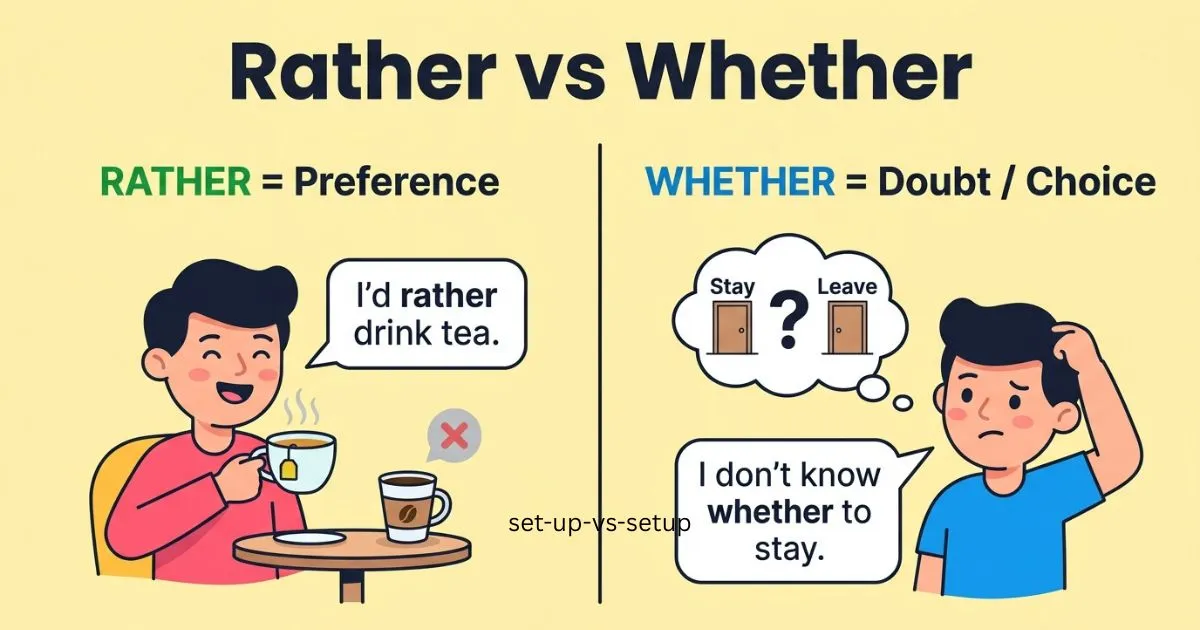
The good news is that the two words do completely different jobs. One expresses preference or degree. The other introduces doubt or alternatives.
In this guide, you’ll learn what each word does, a quick four-step test for choosing between them, the tricky grammar around “would rather” and “whether to,” and the mistakes to avoid. You’ll also get a short practice quiz at the end.
The Short Answer
Here is the whole difference in one table:
| Rather | Whether | |
| Part of speech | Adverb | Subordinating conjunction |
| Main jobs | Preference, degree, correction | Doubt, alternatives, “no matter what” |
| Typical sentence | I’d rather walk. | I don’t know whether he’ll walk. |
| Common partners | would, than, “or rather” | to, “or not”, prepositions |
If you want to say what you prefer, or how much of something there is, use rather. If you want to say you don’t know something, or that two options exist, use whether.
What Does “Rather” Do?
Rather is an adverb, and it has four jobs. Learn these four and you’ll recognize it everywhere.
1. Rather Shows Degree
Here, rather means “fairly” or “somewhat.” It sits before an adjective or adverb.
- The soup was rather salty.
- It’s rather early to call her.
- He drives rather slowly in the rain.
This use is a little casual. It softens a description instead of making it stronger, much like “fairly” or “quite.”
2. Rather Shows Preference
This is the job most learners know. In expressions of preference, rather usually comes after “would” or its contraction ‘d.
- I’d rather take the train.
- Would you rather eat now or later?
- They’d rather save the money.
Notice that “would” is part of the pattern. Writing “I rather stay home” leaves out a word that standard English expects.
3. Rather Than Means “Instead Of”
Rather than joins two options and tells the reader which one wins. It can mean “instead of” or “and not.”
- She chose to email rather than call.
- Rather than argue, he walked away.
- We picked a quiet cafe rather than a busy one.
Keep the two options in the same grammatical shape. In “She chose to email rather than call,” both are plain verbs. Mixing shapes, such as a verb with a noun, makes the sentence feel lopsided.
4. “Or Rather” Corrects What You Just Said
Sometimes you say something and then realize there’s a more accurate way to put it. “Or rather” lets you fix it on the spot.
- I’ll see him on Friday, or rather, Saturday morning.
- She’s my neighbor, or rather, my landlord’s sister.
Rather can also introduce a contrast, with the sense of “on the contrary,” as in: “He didn’t ignore the advice. Rather, he followed it too literally.”
Read More: Peoples or People’s? A Simple Test to Choose Correctly
What Does “Whether” Do?
Whether is a subordinating conjunction. That means it starts a clause that depends on the main part of the sentence. Its core idea is a choice between alternatives, even when only one alternative is spoken aloud.
1. Whether Reports a Yes-or-No Question
When you repeat or describe a question without asking it directly, whether does the work.
- She asked whether the package had arrived.
- I wonder whether the shop is open on Sundays.
- Nobody knew whether the meeting had been cancelled.
The direct versions would be “Has the package arrived?” and “Is the shop open?” Whether turns them into part of a statement.
2. Whether Presents Two Options
- I can’t decide whether to repaint or buy new furniture.
- Tell me whether you want the window seat or the aisle.
3. “Whether or Not” Means “No Matter What”
Often “or not” is already implied, so you don’t need to say it. “I don’t know whether he’s coming” already means “or not.” But “or not” earns its place when you mean “regardless.”
- We’re hiking whether or not it snows.
- She’ll apply whether you encourage her or not.
Both versions say that the outcome stays the same either way.
4. Whether Before “To” and After Prepositions
This is where whether becomes essential, because here “if” doesn’t work.
- Before a to-infinitive: She hasn’t decided whether to accept the offer.
- After a preposition: It depends on whether the client approves.
- After a preposition: We argued about whether the plan was fair.
If you remember only one grammar rule from this article, make it this one.
Rather vs Whether Side by Side
Why do these two get mixed up so often? Three reasons.
First, they look and sound alike. Both end in “-ther.” Add “weather” to the mix, which is a noun for what’s happening in the sky, and you have three lookalikes.
Second, both words appear in sentences about choices. “I’d rather stay” and “I don’t know whether to stay” feel similar because staying is the topic.
Third, fast typing and autocorrect don’t always catch the slip, because both are real words.
The difference is what each word does with the choice. Rather makes a choice: “I’d rather stay.” Whether describes a choice that hasn’t been made: “I don’t know whether to stay.”
A helpful way to picture it:
- Rather answers, “What would you prefer?”
- Whether answers, “What are you unsure about?”
Rather or Whether:
Both rather and whether are correct English words, but they have different meanings and uses. Rather expresses preference, degree, or correction, while whether introduces uncertainty or different possibilities. The correct choice depends on what you want to express in your sentence.
Use rather when showing a preference between two things or describing something as fairly or somewhat.
Examples:
- I’d rather stay home than go outside.
- She would rather drink coffee than tea.
- The weather is rather cold today.
Use whether when expressing uncertainty, asking indirectly about something, or discussing different choices.
Examples:
- I don’t know whether he is coming today.
- She asked whether I needed help.
- We must decide whether to stay or leave.
Here is a quick comparison:
| Rather | Whether |
| I’d rather sleep early. | I wonder whether he is sleeping. |
| She would rather travel by train. | She asked whether I preferred the train. |
| The movie was rather interesting. | I don’t know whether the movie is interesting. |
Grammar Tip: Use would rather + base verb to express preference. Use whether + clause or whether + to-infinitive to express uncertainty or a decision.
Remember, rather means preference or degree, while whether means uncertainty or alternatives. Both words are correct, but they cannot replace each other.
A Four-Step Test for Choosing the Right Word
When you’re stuck, run through these steps in order. They take about ten seconds.
- Is there a preference or an “instead”? If you can add “I’d choose this over that,” you need rather (or rather than).
- Can you replace the word with “fairly”? If “fairly” fits, you need rather. (“It’s fairly cold” works, so “It’s rather cold” is right.)
- Are you reporting a question or doubt? If you can rewrite the sentence as a direct question, you need whether. (“Is he coming?” becomes “I don’t know whether he’s coming.”)
- Look at the next word. After a preposition, or before “to + verb,” only whether works. After “would,” you need rather followed by a plain verb.
These steps are rules of thumb, not magic. But they handle the vast majority of everyday sentences.
“Would Rather”: The Pattern Learners Get Wrong
Would rather has its own small grammar system. Because it’s so common in speech and email, it’s worth getting right.
Same Subject: Use the Base Verb
When the same person is doing both the preferring and the action, add a plain verb with no “to.”
- ✔ I’d rather go home.
- ✘ I’d rather to go home.
Different Subject: Use the Past Simple
When you’re talking about what someone else should do, the verb after the second subject shifts to the past simple. The meaning is still present or future.
- I’d rather you went home now.
- She’d rather her son studied something different.
- Would you rather I waited here?
This past form doesn’t describe the past. It’s a way of expressing a gentle wish. That’s why “I’d rather you came tomorrow” means “please come tomorrow.”
Negatives Go on the Second Clause
When the subjects differ, put “not” on the second verb, not on “would rather.”
- ✔ I’d rather they didn’t tell anyone.
- ✘ I’d rather not they told anyone.
Regrets Use the Past Perfect
When you wish another person’s past action had gone differently, use the past perfect.
- I’d rather you hadn’t lied to me.
For your own past action, use “would rather have” plus the past participle: “I’d rather have stayed home last night.”
Whether vs If: Where the Confusion Spreads
Since whether means “if” in some sentences, it’s natural to ask whether the two are interchangeable. Sometimes, yes. In casual speech, “I don’t know if she left” and “I don’t know whether she left” mean the same thing.
But there are clear cases where only whether is correct:
- After a preposition: “We talked about whether to move.” (Not “about if.”)
- Before a to-infinitive: “I can’t decide whether to wait.” (Not “if to wait.”)
- Directly before “or not”: “Let me know whether or not you can come.”
And if has a job of its own: conditions. “I’ll go if it doesn’t rain” sets a condition. “I’ll go whether it rains or not” says the weather doesn’t matter.
A tidy habit: use if for conditions, and whether for choices and doubt. Whether is also the safer pick in formal and academic writing, since it’s correct in more situations.
“Rather Than Whether”: When Both Words Appear Together
Occasionally you’ll see the two words side by side, and it looks like a typo. It usually isn’t.
- Ask whether the plan works rather than whether it looks impressive.
- The board debated how to grow rather than whether to grow.
Each word keeps its own job. “Rather than” sets up the contrast, and “whether” introduces each doubtful question. The key is parallel structure: you compare one whether-clause with another.
If you ever feel unsure about a sentence like this, test each half separately. “Ask whether the plan works” is correct. “Ask whether it looks impressive” is correct. Rather than simply joins them.
Read More: Goodluck or Good Luck? Correct Spelling, Meaning & Examples
Common Mistakes (and Quick Fixes)
1: Using “Rather” When You Mean “Whether”
- ✘ I don’t know rather he’s coming.
- ✔ I don’t know whether he’s coming.
Fix: If the sentence reports doubt, use whether.
2: Using “Whether” When You Mean “Rather”
- ✘ I’d whether stay home.
- ✔ I’d rather stay home.
Fix: If the sentence says what you prefer, use rather.
3: Adding “To” After “Would Rather”
- ✘ She’d rather to travel by train.
- ✔ She’d rather travel by train.
4: Using “If” Before “To”
- ✘ He’s unsure if to apply.
- ✔ He’s unsure whether to apply.
5: Misplacing the Negative
- ✘ I’d rather not they called me.
- ✔ I’d rather they didn’t call me.
6: Dropping “Would”
- ✘ I rather eat at home.
- ✔ I’d rather eat at home.
Leaving out “would” is common in speech, but in writing it reads as an error.
Easy Ways to Remember the Difference
Memory tricks work best when they’re short.
- Rather = prefer. Both are about what you like better.
- Whether = wonder. Both begin with a “w” sound, and both are about not knowing yet.
- Rather = “fairly.” If “fairly” fits, you want rather.
- Whether = “if.” If “if” fits and the sentence is about doubt, you probably want whether.
Another good habit is to read your sentence aloud and ask, “Am I saying what I’d choose, or what I’m unsure about?” Your answer picks the word.
Practice: Fill In the Blank
Try these before checking the answers below.
- I’m not sure ______ the train leaves at six.
- She’d ______ walk than wait for a taxi.
- They can’t decide ______ to rent or buy.
- It was ______ a long meeting, to be honest.
- We’ll start ______ or not everyone arrives.
- He met my sister, or ______, my cousin.
- It depends on ______ you can get time off.
- I’d rather you ______ (not/call) so late.
Answers: 1. whether. 2. rather. 3. whether. 4. rather. 5. whether. 6. rather. 7. whether. 8. didn’t call.
If you got seven or more right, you’re in good shape. If you missed a few, go back to the four-step test and apply it slowly.
FAQs
1. What is the difference between rather and whether?
Rather is an adverb that expresses preference, degree, or correction, as in “I’d rather stay.” Whether is a conjunction that introduces doubt or alternatives, as in “I wonder whether he’ll stay.” They do different jobs, so one can’t replace the other.
2. Can I use rather instead of whether?
No. “I don’t know rather he’s coming” is incorrect. When a sentence reports doubt or a yes-or-no question, you need whether: “I don’t know whether he’s coming.” Rather belongs in sentences about preference (“I’d rather go”) or degree (“It’s rather cold”).
3. Is “would rather” followed by “to”?
No. After “would rather,” use the plain form of the verb: “I’d rather go home.” Adding “to” is a common error. If the second action belongs to someone else, switch to the past simple, even though the meaning is present or future: “I’d rather you went home.”
4. When should I use whether instead of if?
Use whether after a preposition (“talk about whether”), before a to-infinitive (“decide whether to go”), and directly before “or not.” Use if for conditions, such as “I’ll go if it’s sunny.” In formal writing, whether is usually the safer choice because it fits more situations.
5. Does “whether” always need “or not”?
No. “Or not” is already implied in “I don’t know whether he’s coming,” so adding it changes nothing. Add it when you mean “regardless,” as in “We’re leaving whether or not it rains.” It also works at the end of the clause: “whether it rains or not.”
6. What does “or rather” mean?
“Or rather” lets you correct or sharpen what you just said. For example, “I’ll arrive Monday, or rather, Tuesday morning.” You’re replacing the first statement with a more accurate one, so use it only when you’re genuinely fixing or refining something you’ve already said.
7. Can rather and whether appear in the same sentence?
Yes, because they do different jobs. A sentence like “Ask whether the plan works rather than whether it looks impressive” is correct. Rather than sets up the contrast, and each whether introduces its own question. Just keep both halves parallel so the comparison stays clear.
8.Is rather or whether correct?
Both words are correct English words. The correct choice depends on your sentence. Use rather for preference or degree and whether for uncertainty or alternatives.
Conclusion:
Rather vs whether isn’t a hard puzzle once you see what each word is for. Rather expresses preference, degree, or a correction.
Whether introduces doubt, alternatives, or “no matter what.” One decides, and the other wonders.
When in doubt, run the four-step test, and remember the two grammar rules that cause the most trouble: use whether after prepositions and before “to + verb,” and use a plain verb after “would rather.”
Your next step: open something you wrote recently, such as an email, an essay, or a message, and search for “rather” and “whether.”
Check each one against the test. It takes two minutes, and it’s the fastest way to make the rule stick.

As an American English writer, I specialize in creating clear and engaging content that makes grammar and language learning accessible to everyone. I enjoy breaking down complex English concepts into simple, practical lessons that readers can apply with confidence. My mission is to help learners strengthen their communication skills through easy and reliable content.



1 thought on “Rather vs Whether: How to Choose the Right Word Every Time”