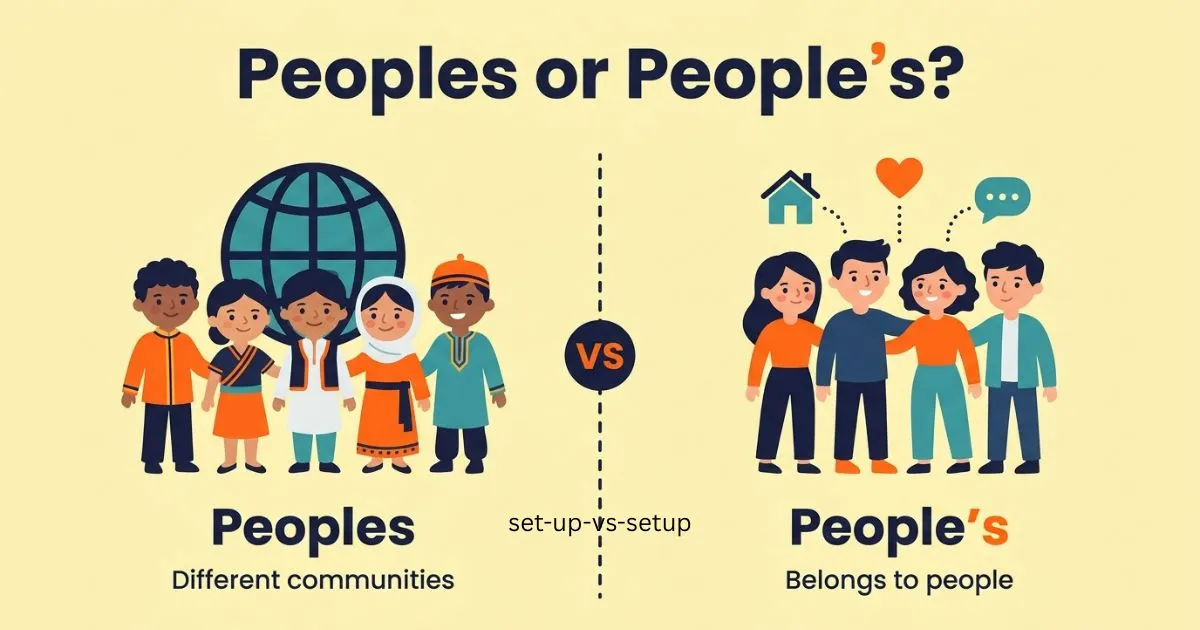
You are halfway through a sentence, your finger hovers over the apostrophe key, and you freeze. Should it be peoples or people’s? You are not alone. These two look almost identical, yet they say very different things.
Here is the short version: peoples names different communities, while people’s shows that something belongs to people. There is even a third form, peoples’, that trips up many writers.
In this guide, you will learn what each form means, see clear examples, avoid the most common mistakes, and get a quick three-step test you can use in any email, essay or blog post.
Peoples or People’s: The Quick Answer
Both spellings are correct. They just do different jobs.
- People is the everyday plural of person. Use it when you are counting or mentioning individuals.
- Peoples is a plural for distinct communities, nations or ethnic groups.
- People’s is the possessive form. It shows that something belongs to, or is linked with, people.
- Peoples’ is the possessive of peoples. It shows that something belongs to more than one distinct community.
| Form | Job | Example |
| people | Plural of person | Five people were waiting outside. |
| peoples | Several distinct communities | The peoples of the region speak different languages. |
| people’s | Something belongs to people | People’s opinions matter. |
| peoples’ | Something belongs to several communities | The two peoples’ customs were quite different. |
One-line rule: If no ownership is involved, you do not need an apostrophe. If ownership is involved, you do.
First, a Quick Look at “People”
To understand peoples, it helps to understand people first.
The normal plural of person is people, not persons. That is why we say “one person” and “three people.” Even though people has no “s” at the end, it is already plural, so it takes a plural verb: “People are waiting,” never “People is waiting.”
The word persons does exist. It appears mostly in legal or very formal writing, such as official notices. In daily writing, people is the safe choice.
Now here is the twist that causes the confusion. People can also mean a nation, team or cultural community. In that sense, you can say “a people,” meaning one community with a shared identity.
And if one community is “a people,” then several communities are “peoples.” That is the whole story behind the extra “s.”
Read More: Class’s or Class? The Correct Form Explained
What Does “Peoples” Mean?
Peoples is the plural of people when the word means separate communities. It does not mean “lots of individuals.” It means “lots of distinct groups,” each with its own identity, history or culture.
Peoples Names Separate Communities
Think of peoples as a word for groups, not headcounts. These sentences show the idea:
- Many Indigenous peoples have their own languages and traditions.
- The museum covers the history of several ancient peoples.
- The peoples of Central Asia have shaped each other’s cultures for centuries.
- The treaty involved three neighbouring peoples.
In every sentence, you could replace peoples with nations, teams or communities and the meaning would stay the same.
Is “Peoples” a Real Word?
Yes. Several grammar and teaching references list peoples as the plural of people in the “nation or community” sense. It is most common in history, anthropology, politics and writing about culture.
Some websites claim peoples is not a word. That is incorrect. The confusion probably comes from the fact that people already works as a plural in everyday English, so adding an “s” feels wrong. In the community sense, it is right.
If you want extra reassurance, look the word up in your favourite dictionary.
When You Should Not Use “Peoples”
Do not use peoples just because a lot of individuals are involved.
- ❌ Thousands of peoples came to the concert.
- ✅ Thousands of people came to the concert.
A concert crowd is a crowd of individuals. It is not a list of separate nations. The same goes for classrooms, offices, queues and shopping malls: use people.
What Does “People’s” Mean?
People’s is the possessive form of people. It shows that something belongs to people, relates to them, or comes from them.
Here are some everyday examples:
- People’s rights should be protected.
- Good teachers change people’s lives.
- The company must respect people’s privacy.
- The storm damaged people’s homes.
- Nobody can control other people’s opinions.
Notice that the apostrophe is the only thing separating this word from peoples. That tiny mark tells the reader that ownership is involved.
Why Does the Apostrophe Come Before the “S”?
This is the part most people never learn, and it clears up a lot of confusion.
When a plural noun ends in “s,” we usually add only an apostrophe: cats’, teachers’, boys’. But people is an irregular plural. It does not end in “s.” So it follows the other rule: add apostrophe + s.
| Singular | Plural | Singular possessive | Plural possessive |
| cat | cats | cat’s | cats’ |
| person | people | person’s | people’s |
| child | children | child’s | children’s |
| woman | women | woman’s | women’s |
| man | men | man’s | men’s |
Once you see people’s sitting next to children’s, women’s and men’s, it stops looking strange. It is the same pattern.
People’s in Names and Titles
You will also see people’s inside official names and titles, such as the People’s Republic of China or the People’s Choice Awards. In these names, the apostrophe is part of the title, and it works exactly the same way: it marks something connected to the people.
What About “Peoples’”?
Peoples’ is the possessive of peoples. It is the least common of the three forms, but it is correct in the right situation.
The deciding question is simple: how many groups own the thing?
- One group, or people in general → people’s
- More than one distinct community → peoples’
Compare these two sentences:
- The Spanish people’s opinions were mixed. (one group)
- The Spanish and French peoples’ opinions were mixed. (two groups)
Here is another pair:
- The people’s traditions were passed down through generations. (one community)
- The peoples’ traditions were recorded side by side in the archive. (several communities)
Does that mean you will use peoples’ all the time? Probably not. Most everyday sentences are about people in general or about one group, which means people’s is the form you will need most often. Save peoples’ for writing that clearly compares or discusses several communities at once, like a history essay or a report on different nations.
Peoples vs People’s: Side-by-Side
Seeing the pairs together makes the difference easier to spot.
| Peoples | People’s | |
| Apostrophe | No | Yes |
| Meaning | Different communities | Belonging to people |
| Grammar job | Plural noun | Possessive |
| Typical writing | History, culture, politics | Everyday writing, news, essays |
| Example | Indigenous peoples | People’s rights |
Now see how one small change shifts the meaning:
- The peoples of the world have different traditions. Many communities exist, and each has its own traditions.
- The people’s traditions are important. The traditions belong to one group, or to people in general.
- Different peoples have different languages. We are talking about several communities.
- People’s languages should be respected. The languages belong to people.
The 3-Step Test: How to Choose in Seconds
Here is a simple method you can run in your head. Use it every time you are unsure.
Step 1: Does Something Belong to Someone?
Look at the word that comes right after your peoples or people’s. Is it a thing that belongs to the group: rights, opinions, homes, choices, traditions?
- Yes → you need a possessive. Go to Step 3.
- No → you need a plain plural. Go to Step 2.
Quick trick: Try rewriting the phrase with “of.” If it works, you probably have a possessive. “The rights of the people” becomes “the people’s rights.” “The traditions of several peoples” becomes “several peoples’ traditions.”
Step 2: Individuals or Communities? (No Ownership)
- Are you talking about individuals? → people. (“Many people attended.”)
- Are you naming separate nations, teams or cultural groups? → peoples. (“The peoples of the Andes.”)
Step 3: One Group or Several? (Ownership)
- One group, or people in general → people’s
- Several distinct communities → peoples’
The Test in Action
Sentence: “The ___ voices were heard at the summit.”
- Step 1: Voices belong to someone, so you need a possessive.
- Step 3: If the summit involved one community, write people’s. If it brought together several distinct communities, write peoples’.
The test also shows you why context matters. The same words can be right or wrong depending on how many groups you mean.
Common Mistakes to Avoid
Most errors with these words fall into six patterns. Learn them, and you will catch almost every slip.
Mistake 1: Using “Peoples” for a Headcount
- ❌ Many peoples were at the wedding.
- ✅ Many people were at the wedding.
Guests are individuals, not separate nations.
Mistake 2: Forgetting the Apostrophe
- ❌ Peoples rights are important.
- ✅ People’s rights are important.
The rights belong to people, so you need the apostrophe.
Mistake 3: Using “Peoples’” for People in General
- ❌ Be kind to other peoples’ feelings.
- ✅ Be kind to other people’s feelings.
“Other people” here means individuals in general, not several communities. That makes people’s the right choice.
Mistake 4: Adding an Apostrophe to Make a Plural
- ❌ The people’s of Asia have rich histories.
- ✅ The peoples of Asia have rich histories.
An apostrophe never makes a word plural. It shows possession.
Mistake 5: Writing “Peoples’s”
This form does not exist. If you need the possessive of peoples, it is peoples’. If you need the possessive of people, it is people’s. Never stack both endings together.
Mistake 6: Treating “People” as Singular
- ❌ The people is waiting outside.
- ✅ The people are waiting outside.
Even without a final “s,” people is plural and needs a plural verb.
A Quick Note on “Persons”
You may wonder where persons fits in. It is a valid plural of person, but it sounds formal and mostly shows up in legal or official language, such as “persons under 18 are not allowed.”
If you ever need its possessive in that kind of text, you would write persons’. For everyday writing, though, stay with people and people’s.
Read More: Students’ or Student’s? The Correct Possessive Form Explained
Quick Practice: Test Yourself
Fill in each blank with people, peoples, people’s or peoples’. The answers are below.
- Thousands of ____ gathered in the square.
- The ____ of the region speak many different languages. (separate communities)
- Education can improve ____ lives.
- The museum compares the ____ histories of the two ancient nations.
- ____ opinions can change over time.
- Several Indigenous ____ live along the river.
- The ____ choice was clear. (one community)
- How many ____ are in the meeting room?
Answers:
- people
- peoples
- people’s
- peoples’ (the histories belong to two distinct nations)
- People’s
- peoples
- people’s
- people
If you scored 7 or 8, you have it. If you missed a few, run the 3-step test on those sentences and try again.
Easy Ways to Remember
You do not need a grammar degree. Keep these three habits instead:
- No ownership? No apostrophe. Choose people for individuals or peoples for communities.
- Ownership by people in general? Use people’s, just like children’s and women’s.
- Ownership by several communities? Use peoples’, and remember it is a specialist form.
When in doubt, ask two quick questions: “Does something belong to them?” and “How many groups am I talking about?” The answers point you straight to the right spelling.
Frequently Asked Questions
1. Is “peoples” a real word?
Yes. Peoples is the plural of people when people means a nation, team or ethnic group, as in “the peoples of Asia.” It is common in history, anthropology and politics. For a normal headcount of individuals, use people, not peoples.
2. Is it peoples or people’s?
It depends on meaning. Use peoples to name several distinct communities. Use people’s when something belongs to people, such as people’s rights. If there is no ownership, you do not need an apostrophe. If there is ownership, you do.
3. Is “peoples’” correct?
Yes, but only in a narrow case. Peoples’ is the possessive of peoples, so it fits when something belongs to more than one distinct community, such as “the two peoples’ traditions.” For one group or people in general, people’s is the right form.
4. Is it “people’s rights” or “peoples’ rights”?
Use people’s rights for people in general or one group. Use peoples’ rights when you clearly mean the rights of several separate communities, such as in a text about different nations. In most everyday writing, people’s rights is the form you need.
5. Is “people” singular or plural?
Plural. It takes plural verbs: “people are,” not “people is.” The exception is when people means one nation or community (“a people”), whose plural is peoples. In everyday writing, treat people as plural and you will almost always be correct.
6. Why does “people’s” have the apostrophe before the “s”?
Because people is a plural that does not end in “s.” Plurals like that form the possessive with apostrophe + s, just like children’s, women’s and men’s. Plurals that do end in “s,” such as cats, only take an apostrophe after the “s.”
7. What is the plural of “person”: people or persons?
People is the standard plural for everyday writing. Persons is also correct, but it sounds formal and appears mainly in legal or official text. The possessive of people is people’s, while the formal persons becomes persons’. If unsure, choose people.
Conclusion:
Choosing between peoples or people’s is really a question about meaning. Peoples names separate communities.
People’s shows that something belongs to people. Peoples’ shows that something belongs to several communities.
The apostrophe may look small, but it changes what your sentence says. Before you write, check for ownership, then check how many groups you mean.
Your next step: Open something you wrote recently and search for “peoples” and “people’s.” Run each one through the 3-step test. You will probably spot at least one fix, and you will never hesitate over these words again.

I am an English language writer passionate about grammar and clear communication. I create simple, easy-to-understand content that helps readers improve their English skills. My goal is to make learning English both practical and enjoyable.




1 thought on “Peoples or People’s? A Simple Test to Choose Correctly”