You’re typing an email and reach the sentence, “The new schedule will our deadline.” Affect or effect? You type both, stare at them, and guess.
You’re not alone. These two words sound almost identical and show up in the same kinds of sentences. The good news is that the fix is simpler than it looks.
In this guide to affect vs effect, you’ll get a 10-second rule, a three-step test that works on any sentence, memory tricks that stick, the rare exceptions that trip up careful writers, and a short quiz to check yourself.
Affect vs Effect in 10 Seconds
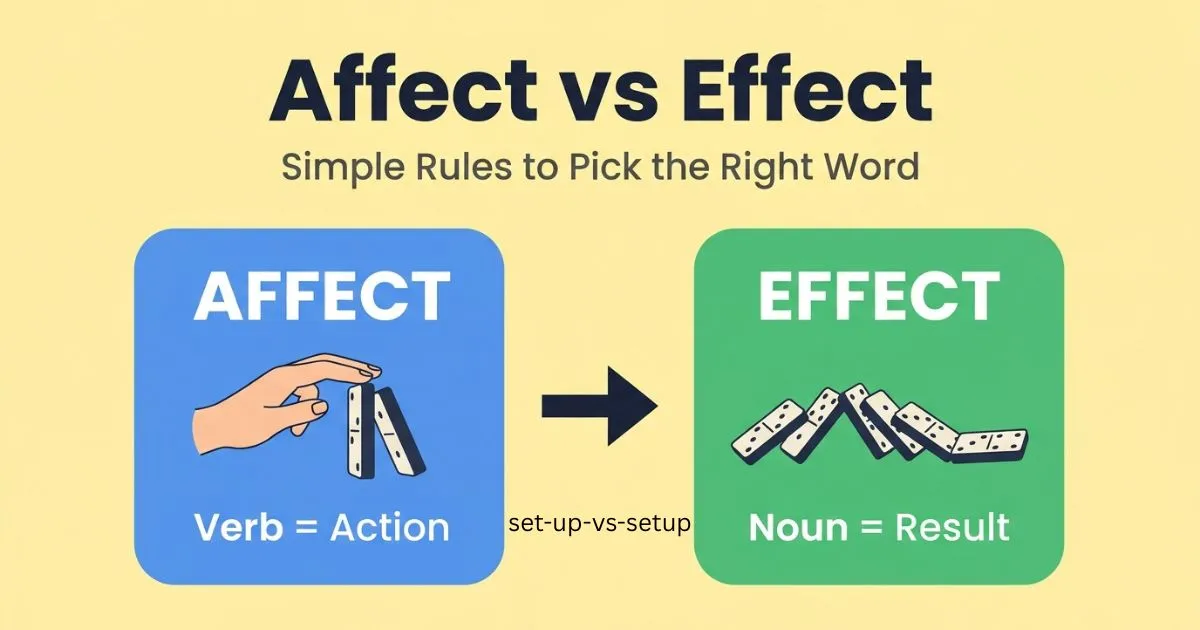
- Affect is usually a verb. It means to influence or change something.
- Effect is usually a noun. It means the result of that influence.
Here they are together: Heavy rain can affect traffic. The effect is a long, slow jam.
The rain does the action (affect). The jam is the result (effect). If you remember only one idea from this article, make it this: affect is the action, effect is the result.
Want a fast check? Swap in a synonym. If influence fits, you need affect. If result fits, you need effect.
“Usually” matters here. The exceptions are covered below.
Read More: Will or Would: How to Choose the Right One Every Time
What Does Affect Mean?
Affect is most often a verb meaning to act on or change someone or something. It has three uses, and only the first two are common.
Affect as “to change or influence”
This is the one you’ll use most.
- Lack of sleep can affect your concentration.
- The new policy will affect many employees.
- Construction work will affect traffic near the school.
Affect as “to touch someone’s emotions”
- Her speech affected everyone in the room.
- The news affected him deeply.
Affect as “to pretend” (rare)
Here, affect means to put on a false appearance.
- She affected a calm smile, though she was nervous.
- He affected an accent he didn’t really have.
Useful synonyms: influence, change, alter, sway, modify.
What Does Effect Mean?
Effect is most often a noun. It means a change or result caused by something. It can also mean a feeling or mood that something creates.
- Exercise has a positive effect on your health.
- The medicine had no effect.
- The soft lighting created a calming effect.
An effect can be good, bad, or neutral. It’s simply what happens afterward.
Useful synonyms: result, outcome, consequence, reaction, repercussion.
Effect vs Affect: Quick Comparison Table
| Affect | Effect | |
| Usual role | Verb | Noun |
| Core meaning | To influence or change | A result or outcome |
| Think | Action | End result |
| Swap-in word | Influence | Result |
| Example | Noise affects sleep. | Noise has an effect on sleep. |
| Rare role | Noun (emotional expression) | Verb (to bring about) |
Affect or Effect? A 3-Step Test for Any Sentence
When you’re stuck, run these steps in order.
Step 1: Look at the word before it
If a, an, or the comes right before the blank, you almost certainly need effect. The same goes for describing words like positive, harmful, lasting, or side: a lasting effect, the effect.
One small catch: psychologists do say things like “a flat affect.” You’ll rarely meet that outside psychology.
Step 2: Try the swap
Replace the word with influence or result. “Noise can influence your sleep” works, so you need affect. “Noise has a bad result on your sleep” works, so you need effect.
Step 3: Ask what job the word does
If it’s doing something to another thing (a verb), choose affect. If it’s the thing that happened (a noun), choose effect. Words like to, can, will, may, and might before the blank usually signal a verb.
Before you send an important document, search it for “affect” and “effect” and run each one through these steps. It takes about a minute.
Will This Affect Me or Effect Me?
It’s affect me. Will this affect me? asks whether something will change or influence you, and that needs a verb.
If you prefer the noun, rebuild the sentence: What effect will this have on me? Now “effect” is the thing that will happen.
More tricky sentences, solved
- “How does this affect you?” Affect. You’re asking how something changes you, so you need the verb.
- “What is the effect?” Effect. The word the signals a noun, and you’re asking for a result.
- “Your advice had an effect on my decision.” Effect. An signals a noun. You can say the same thing with the verb: Your advice affected my decision.
That last pair is a handy trick. If you’re unsure which noun or verb to use, rewrite the sentence the other way and check that both versions mean the same thing.
Four Words, Not Two: The Exceptions
Writing teachers sometimes point out that affect and effect are really four words, because each can be both a noun and a verb. You’ll rarely need the less common two. Knowing them just stops you from “correcting” a sentence that was already right.
Effect as a verb
Here, effect means to bring about or cause to exist. It’s formal and often sits next to “change.”
- Activists want to effect change in the industry.
- The new manager hopes to effect real improvements.
Affect as a noun
In psychology, affect is a person’s observable emotional expression.
- The patient showed a flat affect.
- Her affect did not change when she heard the news.
Affect change vs effect change
- Affect change means to influence a change that’s already happening, such as speeding it up, slowing it down, or altering it.
- Effect change means to create a change that wasn’t there before.
So The new rules will affect the company means the rules influence it. The new rules will effect change in the company means the rules produce change. If “bring about” fits, use effect.
Memory Tricks That Actually Stick
Pick whichever one clicks for you.
- A is for Action, E is for End result. Affect is the action. Effect is the end result.
- RAVEN. Remember: Affect is a Verb, Effect is a Noun.
- Alphabetical order. A comes before E, and an action has to happen before you get a result.
- A&E. When you’re affected by an accident, the effect is an emergency. (This works best where hospitals call the emergency room “A&E.”)
- Cause and effect. The common phrase already has the right word in it. A cause leads to an effect.
Other Forms: Affects, Affected, Effected and More
- Affects, affected, affecting are forms of the verb: Stress affects sleep. Stress affected his work. Your mood is affecting your judgment.
- Effects is the plural noun: the effects of sleep loss.
- Effected, effecting come from the rare verb: She effected change.
- Affected can also be an adjective. It can mean “involved,” as in all affected customers, or “not genuine,” as in an affected accent.
- Affective vs effective: affective relates to emotion, while effective means successful.
Read More: Acknowledgement or Acknowledgment? Pick the Right One
Fixed Phrases That Always Use Effect
These are worth memorizing as chunks.
- Take effect: to start working. The new rules take effect next month.
- Go into effect: the same idea. The law goes into effect next week.
- In effect: in practice.
- Side effect: an extra or unwanted result, often from medicine.
- Personal effects: belongings a person wears or carries, such as jewelry.
- Knock-on effect: an indirect result. A factory closing can have a knock-on effect on local shops.
- For effect: to create an impression. He added a scarf to the outfit for effect.
Why Not Just Say “Impact”?
Vocabulary.com points out that this confusion has led some people to use “impact” as a verb just to avoid the choice. You don’t need that workaround. With the three-step test, you can pick the right word in seconds and keep your writing precise.
Common Mistakes and Fixes
| Incorrect | Correct | Why |
| The weather had a bad affect on me. | The weather had a bad effect on me. | “A bad ___” needs a noun. |
| Noise can effect your sleep. | Noise can affect your sleep. | “Can” is followed by a verb. |
| What affect did it have? | What effect did it have? | You’re asking for a result. |
| The medicine had no side affects. | The medicine had no side effects. | Fixed phrase. |
| The rule will take affect Monday. | The rule will take effect Monday. | Fixed phrase. |
| The affect of the treatment was big. | The effect of the treatment was big. | “The” signals a noun. |
Effect vs Affect in Everyday Writing
The same pattern works in every setting. The first sentence in each pair shows the action. The second names the result.
At school
- Skipping revision can affect your exam results.
- Regular practice has a positive effect on your grades.
At work
- The new deadline may affect our launch plan.
- The updated process had an immediate effect on productivity.
Around health
- Smoking can affect your lungs.
- Smoking has harmful effects on the body.
When something is doing, changing, or influencing, reach for affect. When you’re naming what it did, reach for effect.
Quick Practice Quiz
Fill in each blank with a form of affect or effect. Answers are below.
- Heavy traffic will ___ our arrival time.
- The new law takes ___ on Monday.
- Her kind words had a calming ___.
- Skipping breakfast can ___ your focus.
- The doctor asked if I had any side ___.
- The leaders want to ___ real change.
Answers: 1. affect (verb). 2. effect (take effect). 3. effect (a describing word plus a noun). 4. affect (can plus a verb). 5. effects (side effects). 6. effect (here it means “bring about”).
A Small Pronunciation Tip
In speech, the two words start differently. Effect begins with a longer “eh” sound, while the verb affect begins with a short “uh.” The psychology noun affect shifts the stress to the first syllable (AFF-ect).
FAQs
1. What is the main difference between affect and effect?
Affect is usually a verb meaning to influence or change something. Effect is usually a noun meaning the result of that change. For example, stress can affect your sleep, and poor sleep is one effect of stress. Affect is the action; effect is the result.
2. Can affect be a noun and effect be a verb?
Yes, but both uses are uncommon. Affect as a noun describes visible emotional expression, mostly in psychology, as in “a flat affect.” Effect as a verb means to bring about, as in “effect change.” In everyday writing, you will almost always need affect as a verb and effect as a noun.
3. Is it “positive effect” or “positive affect”?
Positive effect is correct in nearly every situation, because positive describes a noun and effect is the noun meaning result. Positive affect appears mainly in psychology, where it refers to a person’s emotional state or expression. If you’re not writing about psychology, choose effect.
4. Is it “side effects” or “side affects”?
Side effects is correct. It’s a fixed phrase meaning extra or unwanted results, often from medicine. Because side describes a noun, you need the noun effect. Side affects is always a mistake in standard English.
5. Is it “take effect” or “take affect”?
Take effect is correct. It means to begin working or producing results, as in “The new rules take effect next month.” It’s a fixed phrase built on the noun effect, so take affect is always wrong.
6. What is the difference between “affect change” and “effect change”?
To affect change is to influence a change that’s already underway. To effect change is to bring about something new. Effect change is more formal and common in business, politics, and activism. If you mean “create change,” use effect.
7. What is the easiest way to remember affect vs effect?
Use RAVEN: Remember, Affect is a Verb, Effect is a Noun. Or think “Action” and “End result.” If you can put a, an, or the before the word, you almost certainly need effect. Run the three-step test whenever you’re unsure.
Conclusion:
Affect vs effect gets much easier once you stop treating the two words as twins. Affect is the action.
Effect is the result. The rare exceptions, affect as an emotion and effect as “bring about,” are worth knowing but seldom needed.
Your next step takes two minutes. Redo the quiz without looking at the answers.
Then scan your latest email or assignment for either word and run the three-step test. After a few rounds, you’ll stop pausing at the keyboard.

I’m Sophia Mitchell, an English grammar and writing enthusiast. I create simple, easy-to-understand content to help learners improve their English. My goal is to make grammar clear, practical, and enjoyable for everyone.







2 thoughts on “Affect vs Effect: Simple Rules to Pick the Right Word”