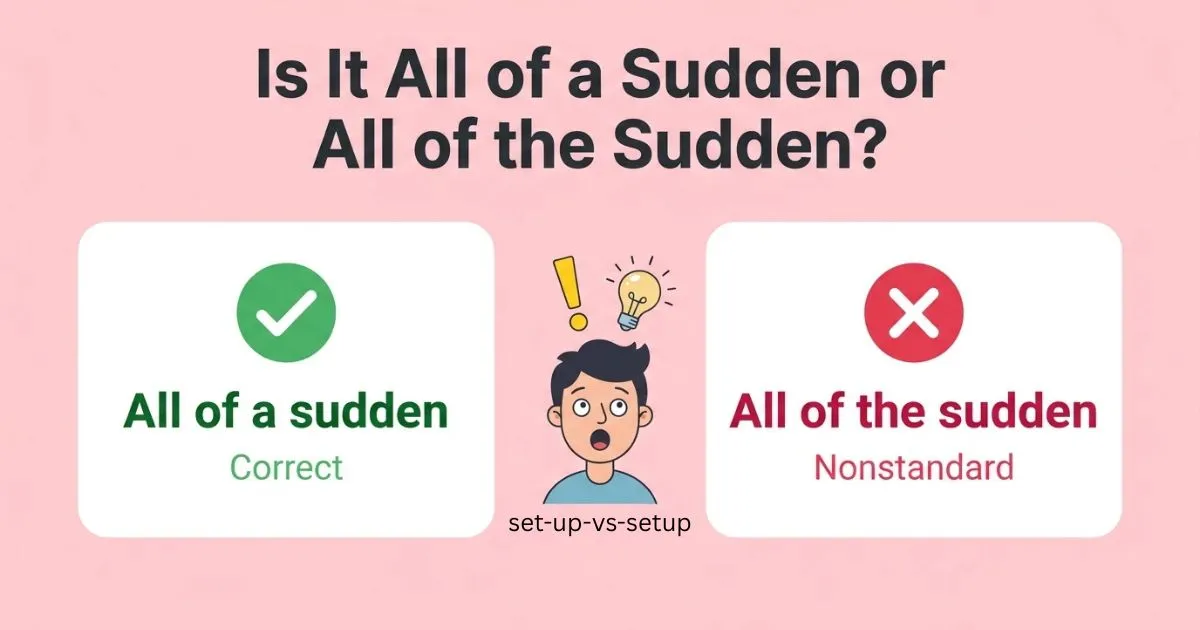
You’re halfway through an email when you stop. All of a sudden or all of the sudden? You’ve heard both a hundred times, and both sound fine out loud.
Here’s the short version: all of a sudden is the standard phrase. All of the sudden is common in speech, but style guides treat it as nonstandard.
There’s a catch, though. Nobody can give you a neat grammar rule that explains why, and “all of the sudden” is perfectly correct in a few sentences.
So, is it all of a sudden or all of the sudden? This guide settles it. You’ll get the meaning, the reasons people mix the two up, what usage data shows, the one situation where “the” works, and a quick proofreading routine you can use today.
The Quick Answer
Use all of a sudden whenever you mean “suddenly” or “unexpectedly.”
- ✅ All of a sudden, the lights went out.
- ❌ All of the sudden, the lights went out.
Both versions are understood instantly, so this isn’t about clarity. It’s about convention. All of a sudden is the wording English settled on, and readers, teachers and editors expect it. Choosing it costs you nothing and keeps your writing looking polished.
Want the shortest safe option? “Suddenly” always works too.
What “All of a Sudden” Means
All of a sudden means quickly and without warning. Grammatically, it works as an adverbial phrase: it tells us how or when something happened, just like “suddenly” does.
Think of it as a spotlight on surprise. Things were calm, normal or predictable, and then they weren’t.
- I was folding laundry when all of a sudden the doorbell rang.
- The room went silent all of a sudden.
- She looked fine at breakfast, but all of a sudden she felt dizzy.
Where it can go in a sentence
The phrase is flexible. You can place it:
- At the start: All of a sudden, the screen froze.
- In the middle: The crowd all of a sudden started clapping.
- At the end: The music stopped all of a sudden.
When it opens a sentence, a comma usually follows. In the middle or at the end, you typically don’t need one.
Why So Many People Say “All of the Sudden”
The mix-up has simple causes, and none of them mean the speaker is careless.
It sounds almost identical. In fast speech, “of a” and “of the” blur together. GrammarBook notes that the “the” version is close in pronunciation and may even be easier to say, and that many people simply repeat what they’ve heard from others without realizing it.
Language spreads by ear. Once a variant is common in conversation, it stops sounding wrong. Wordvice describes “all of the sudden” as common in casual talk but nonstandard, and possibly a regional variation. QuillBot goes further and calls it an increasingly common error.
The grammar gives you no anchor. If both “a” and “the” seem logical, there’s no rule to settle the argument in your head. (More on that in a moment.)
What about “all the sudden”?
Some speakers drop “of” altogether and say all the sudden. It’s another variant of the same idiom, and it’s the one most likely to get flagged. QuillBot labels it an incorrect version of “all of a sudden.” If you spot it in your draft, fix it the same way.
Read More: Rythm or Rhythm: Why One H Isn’t Enough
Is There a Grammar Reason Behind “A”?
Honest answer: not a satisfying one. QuillBot states plainly that no grammatical rule explains why “a sudden” is preferred over “the sudden.” It’s an idiom, and idioms are fixed by habit, not by logic.
History does offer a few clues:
- Grammarly points out that older English used the shorter form “of a sudden.” Shakespeare used it in The Taming of the Shrew (1594), and Daniel Defoe used “on a sudden” in Robinson Crusoe (1719).
- A common explanation is that “sudden” once worked as a noun, roughly meaning “a sudden moment.” That would explain why an article sits in front of it.
- The word “all” came along later. Grammarly suggests it may stress how completely sudden something was, though it admits the real reason is hard to pin down.
The takeaway is practical: don’t try to untangle the phrase word by word. Learn it as one block.
What the Usage Data Shows
Opinions are cheap, so here is some evidence. A commenter on a long-running language forum shared counts from three text collections: the Corpus of Contemporary American English (COCA), the British National Corpus (BNC), and a set of student essays.
| Phrase | COCA (American) | BNC (British) | Student essays |
| all of a sudden | 5,225 | 393 | 45 |
| all of the sudden | 204 | 0 | 10 |
| all the sudden | 56 | 0 | 1 |
Treat this as a snapshot, not a formal study. It comes from an older forum post, so the numbers would differ today. Still, the pattern is clear:
- “All of a sudden” wins everywhere. It leads by a wide margin in every collection.
- The “the” versions looked mostly American. In that search, neither one appeared in the British corpus.
- “All the sudden” looked fairly recent. In the American data, the commenter saw it peak in 2007, though the sample was small.
Is “All of the Sudden” Ever Correct?
Yes, just not as a stand-in for “suddenly.”
The words can sit together legitimately when “sudden” describes a noun that comes right after it, and “all of” refers to the whole group:
- All of the sudden changes to the schedule frustrated the team.
- All of the sudden noises in the night made the dog nervous.
Here, “sudden” is an ordinary adjective, “the” points to specific things, and nothing is being described as happening unexpectedly. Grammarly makes the same point with its own example.
The one-second swap test
Try replacing the phrase with “suddenly.”
- The sentence still works → use all of a sudden.
- The sentence breaks, and a noun follows “sudden” → all of the sudden may be correct.
For example, “Suddenly, the lights went out” works, so you want all of a sudden. But “Suddenly changes frustrated the team” falls apart, so all of the sudden changes is the right construction.
Practical Examples You Can Copy
Seeing the phrase in real settings makes it easier to use without thinking.
At work
- We were on track for launch when all of a sudden the client changed the brief.
- The server went down without warning. (Or, tighter: Suddenly, the server went down.)
At school
- The classroom was quiet, but all of a sudden the fire alarm started ringing.
- In essays, keep all of a sudden for narrative or descriptive writing. In analytical writing, “suddenly” or “abruptly” usually sounds more formal.
In texts and social posts
- Was cooking dinner and all of a sudden the power cut out.
Before and after
Before: All of the sudden, my laptop shut down, and all of the sudden I couldn’t find my file.
After: All of a sudden, my laptop shut down, and I couldn’t find my file.
Notice the second fix: once the phrase is correct, you often don’t need it twice in one sentence. One well-placed “all of a sudden” per paragraph is plenty, because repeating it drains the surprise it’s meant to create.
Speech vs. Writing: What Should You Do?
Context decides how careful you need to be.
| Situation | Best choice |
| Email, essay, report, article | All of a sudden or suddenly |
| Casual conversation | Aim for “of a,” but either will be understood |
| Dialogue in a story or memoir | Keep the speaker’s real voice |
| Editing someone else’s formal text | Change to all of a sudden |
| Exam or English test | All of a sudden |
Grammarly’s advice is relaxed: if “the” slips out in conversation, it’s no big deal, just edit it out of anything you write. The one exception worth knowing is dialogue. If a character, or the author of a chatty memoir, genuinely talks that way, you may want to leave it as spoken.
All of a Sudden vs. Suddenly
The two mean nearly the same thing, and most sentences work with either. Grammarly describes all of a sudden as the more poetic way to say “suddenly.”
- Suddenly is shorter and tidier. It’s the better pick for business emails, reports and anywhere you want tight sentences.
- All of a sudden has a storytelling rhythm. It suits narration, casual writing and anecdotes.
One thing to avoid is stacking them: “All of a sudden, suddenly, the power cut out” says the same thing twice.
Common Mistakes to Avoid
- Swapping the article. Write all of a sudden, not all of the sudden, when you mean “unexpectedly.”
- Dropping “of.” All the sudden is a variant to edit out.
- Doubling the meaning. Don’t add “suddenly” or “unexpectedly” right next to the phrase.
- Using “sudden” as an adverb. “The engine stopped sudden” is wrong in standard English. The adverb is suddenly.
- Skipping the comma at the start. “All of a sudden, the lights went out” reads more smoothly than the version without it.
Other Ways to Say It
If you’ve used the phrase twice already, switch things up:
- Suddenly: the closest match.
- Unexpectedly: neutral and formal.
- Without warning: good for accidents and bad news.
- Out of nowhere: informal and vivid.
- Out of the blue: perfect for surprise calls, messages and news.
- In an instant: puts the focus on speed.
- All at once: careful, this can also mean “everything together,” not just “suddenly.”
Read More: Cancellation or Cancelation: Which Spelling Is Correct?
A 30-Second Proofreading Routine
Before you hit publish or send, do this:
- Search your draft (Ctrl+F or Cmd+F) for “of the sudden” and “all the sudden.”
- For each result, look at the next word. If it’s a noun, “the” may be fine. If not, change it to all of a sudden.
- Ask whether “suddenly” would read cleaner.
- Check that you have a comma when the phrase opens the sentence.
A simple memory trick: picture “a sudden surprise.” One surprise, one “a.” That small image is enough to bring all of a sudden back to mind.
FAQs
Is it all of a sudden or all of the sudden?
All of a sudden is the standard form. Use it whenever you mean “unexpectedly” or “without warning.” All of the sudden is common in casual speech, but dictionaries and grammar guides treat it as nonstandard, so it’s best avoided in writing.
Is “all of the sudden” grammatically wrong?
Not always. As a replacement for “suddenly,” it’s nonstandard. But it’s correct when “sudden” describes a noun that follows, as in “all of the sudden changes.” Use the swap test: if “suddenly” fits the sentence, choose all of a sudden.
Is “all the sudden” correct?
No. It’s a shortened variant of the idiom, and QuillBot lists it as an incorrect version. It may pop up in casual speech, but you should change it to all of a sudden in anything you write, including emails and school work.
Can I use “all of a sudden” in formal writing?
Yes, it’s the accepted form. That said, “suddenly” is shorter and often reads better in reports and professional emails. Save all of a sudden for narration, storytelling and a conversational tone where its rhythm adds something.
Do I need a comma after “all of a sudden”?
When the phrase starts a sentence, a comma usually follows it: “All of a sudden, the power went out.” In the middle or at the end of a sentence, you typically don’t need one, as in “The power went out all of a sudden.”
Why do people say “all of the sudden”?
Mostly because it sounds nearly identical to the correct phrase. Many people learn idioms by ear, and “of the” can be easier to say than “of a.” Hearing the variant from friends and colleagues makes it feel normal, so it gets repeated.
Conclusion:
Is it all of a sudden or all of the sudden? For anything meaning “unexpectedly,” the answer is all of a sudden.
“All of the sudden” is a widespread spoken variant, and “all the sudden” is the one most likely to be marked as an error. The only time “the” belongs is when “sudden” describes a noun that follows.
Your next step is simple: run the search from the proofreading routine on your latest draft. It takes half a minute and catches the mistake before anyone else does.

I’m Sophia Mitchell, an English grammar and writing enthusiast. I create simple, easy-to-understand content to help learners improve their English. My goal is to make grammar clear, practical, and enjoyable for everyone.








1 thought on “Is It All of a Sudden or All of the Sudden? Get It Right”