You reread your email twice, press send, and then you spot it: “Their going to love there new office.” Two tiny words, two mistakes, and a reader who now trusts your writing a little less.
If you have ever stopped mid-sentence to wonder whether it should be there or their, you are in good company.
The two words sound identical, which is exactly why even native English speakers swap them by accident.
This guide to there vs. their keeps things practical. You will learn what each word really does, run three quick tests that settle almost any sentence, see the mistakes people make most often, and finish with a short practice set. The troublemaker cousin, they’re, gets its own section too.
There vs. Their at a Glance
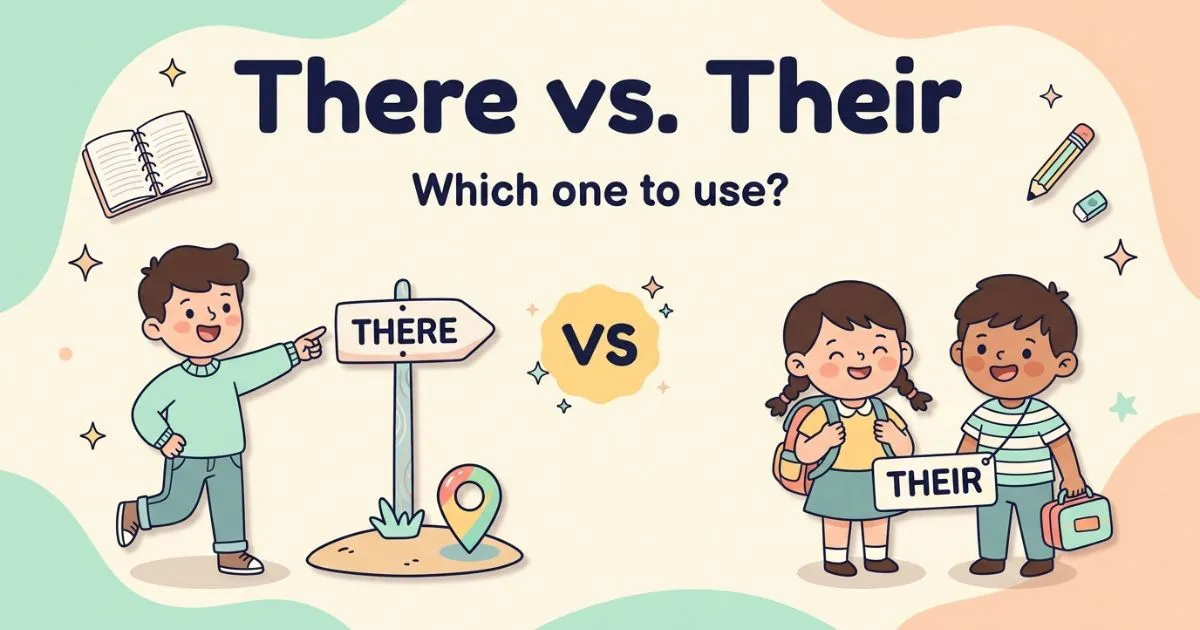
There points to a place or announces that something exists. Their shows that something belongs to, or is connected with, a person or a group.
That is the whole difference. Everything below is about applying it without hesitation.
| There | Their | |
| Main job | Place, or “something exists” | Ownership or connection |
| Word type | Adverb or pronoun (plus a few other roles) | Possessive adjective |
| Followed by a noun? | Not necessarily | Almost always |
| Example | The keys are over there. | Their keys are on the table. |
| Memory clue | Hides the word here | Hides the word heir |
What Does “There” Mean?
There is one of the most common words in English, and it wears several hats. Two of them cover most of what you will write.
There points to a place
In its best-known job, there is an adverb meaning “in or at that place.” Think of it as the opposite of here.
- The pharmacy is just over there.
- I have never been there, but I would love to go.
- Park behind the building and I will meet you there.
- We flew to Lisbon last spring and stayed there for a week.
The last example shows a handy habit: there often stands in for a place you have already mentioned, so you do not have to repeat it.
There says something exists
The second job is less obvious. At the start of a sentence, there works as a place-holder that introduces something that exists or happens. You cannot point to a spot on a map, yet there is still the right word.
- There is a spare charger in the drawer.
- Is there any milk left?
- There will be a short quiz on Friday.
- There are two ways to solve this problem.
Notice the pattern: these sentences usually continue with is, are, was, were or will be. When you see one of those right after the word, there is almost always correct.
A few other jobs worth knowing
There also appears in expressions that have nothing to do with maps:
- As an interjection: “There, all fixed!”
- For “at that point”: “Let me stop you there.”
- For “available”: “My support is there if you need it.”
You do not need to memorize these. Just remember that there does not always mean a physical place.
Read More: Lose vs. Loose: 3 Quick Tests to Pick the Right Word
What Does “Their” Mean?
Their is a possessive adjective. It works like my, your, our, his and her: it sits in front of a noun and tells you whose noun it is. It matches the pronoun they. If you can ask “do they own it?” or “is it connected to them?”, their is in play.
Their shows ownership or connection
Ownership is the obvious case:
- The twins repaired their bikes.
- Their flight lands at noon.
- The neighbors painted their gate.
But their also covers looser connections, where nobody legally owns anything:
- We met their teacher at the school fair.
- The committee announced their decision.
- Everyone shared their ideas.
In every example, a noun follows their. That is your biggest clue.
Their can refer to one person
Their is usually plural, but modern English also uses it for a single person when the gender is unknown or does not matter. You will see it in sentences like these:
- Someone left their umbrella in the hall.
- Each applicant must bring their certificates.
- Nobody wanted to share their notes.
This use is widely accepted, and many academic style guides, including APA, now endorse singular they and their. So if you spot it in a sentence, it is not an error.
Why These Words Get Mixed Up
There, their and they’re are homophones: words that sound the same but differ in spelling and meaning. Other well-known pairs include for and four, weather and whether, and our and hour.
When you speak, the sound does all the work and nobody can tell which spelling you meant. When you write, your brain has to pick the spelling, and it often grabs the one that “feels” familiar. That is why the habit of choosing by sound is risky.
The fix is simple: choose by meaning and grammar, never by sound. The next section shows you how.
There or Their: Three Quick Tests That Settle It
Run these in order. Most sentences are solved by the second test.
Test 1: Can you say “they are”?
Replace the word with they are. If the sentence still makes sense, the spelling you need is they’re. If it does not, move on to Test 2.
- “Their late again.” becomes “They are late again.” It works, so write They’re late again.
- “Put the box over their.” becomes “Put the box over they are.” It fails, so keep going.
Test 2: Does it show whose something is?
Try swapping in our or my. The meaning may change, but if the grammar still works, you need their.
- “The twins repaired ___ bikes.” Swap in our: “The twins repaired our bikes.” The grammar holds, so write their.
- “___ are two seats left.” Swap in our: “Our are two seats left.” That is not even a sentence, so their is wrong here.
A second check: is there a noun straight after the word, and does it tell you whose noun it is? If yes, their is your answer.
Test 3: Does it point to a place or say something exists?
If Tests 1 and 2 both fail, the answer is there. It is also the word you want when you can answer “where?” or when the sentence announces that something exists.
A small memory trick backs this up. There has here hiding inside it, and both words talk about location. Their has heir inside it, and an heir is someone who ends up owning something. The trick is not a definition, just a hook for your memory.
Putting the tests to work
Take the sentence from the start of this article: “Their going to love there new office.”
- Their going: swap in they are. “They are going to love…” works, so it becomes They’re.
- There new office: swap in our. “Our new office” works, and the office belongs to them, so it becomes their.
The corrected sentence: “They’re going to love their new office.”
One more: “Leave the parcel over their.”
- Swap in they are: “over they are.” That fails.
- Swap in our: “over our” has no noun after it, so it fails.
- It tells you where to leave the parcel, so the answer is there.
Don’t Forget “They’re”
They’re is a contraction of they are. It turns up mostly in speech and informal writing.
| Word | Meaning | Example |
| There | Place or existence | There is a bus at six. |
| Their | Belonging to them | Their bus is late. |
| They’re | They are | They’re waiting at the stop. |
Because it carries an apostrophe, they’re is the easiest of the three to test: just expand it. If “they are” fits, it fits.
One extra point for formal writing. Contractions are generally avoided in academic writing, so in an essay or a formal report you would write they are in full. That sidesteps the they’re question entirely.
Common Mistakes and How to Fix Them
Almost every error comes down to choosing by sound. Here are the six you will meet most often.
1. There instead of their
- Incorrect: The kids lost there gloves.
- Correct: The kids lost their gloves.
- Why: the gloves belong to the kids, and a noun follows.
2. Their instead of there
- Incorrect: Leave your shoes over their.
- Correct: Leave your shoes over there.
- Why: the word answers “where?”
3. “Their are” instead of “there are”
- Incorrect: Their are many reasons to start early.
- Correct: There are many reasons to start early.
- Why: the sentence announces that reasons exist. Test 2 also fails: “Our are many reasons” makes no sense.
4. Their instead of they’re
- Incorrect: Their ready to begin.
- Correct: They’re ready to begin.
- Why: “They are ready” works.
5. There instead of they’re
- Incorrect: There planning a surprise.
- Correct: They’re planning a surprise.
- Why: again, “they are planning” fits perfectly.
6. Treating singular their as a mistake
- Fine as written: Someone forgot their keys.
- Why: their is accepted for one person when gender is unknown or not important.
Tricky Situations
There’s, theirs and other look-alikes
There’s is simply there is squeezed together: “There’s a seat free.” Theirs, with an s, is a separate word that stands on its own: “The red car is theirs.” Neither one changes the rules above.
Both words in one sentence
Using there and their together is perfectly normal, as long as each does its own job.
- Their luggage is over there.
- There is a problem with their account.
- The coach says their team is waiting there.
Which verb follows “there”?
After there, the verb usually agrees with the thing that comes next: “There is a pen on the desk,” but “There are pens on the desk.” Check the noun, then pick is or are.
A Five-Minute Proofreading Routine
Spell checkers only check spelling, and there, their and they’re are all real words. A wrong choice can slip straight past them. Some grammar tools do flag these mix-ups, but treat that as a second opinion rather than a guarantee. A short manual routine works better.
- Search your document. Use Find (Ctrl+F or Cmd+F) for “there”, then “their”, then “they”. Jump from hit to hit.
- Test every hit. Run Test 1, then Test 2, then Test 3. Each check takes seconds.
- Fix and move on. Correct it, then read the sentence once more with the new word.
Reading aloud will not help here, because all three words sound the same. Use the tests instead. If you send a lot of email, do this pass before important messages, applications and assignments.
Quick Practice
Fill each gap with there, their or they’re. Answers follow the list.
- ___ going to announce the winners tomorrow.
- The museum is just over ___.
- ___ is a spare key under the mat.
- The students handed in ___ essays early.
- Do you know whether ___ ready yet?
- We admired ___ garden.
- I left my charger ___.
- If ___ late, we will start without them.
- ___ are three ways to fix this.
- The company changed ___ logo, and ___ happy with the result.
Answers
- They’re (they are going)
- there (place)
- There (something exists)
- their (whose essays?)
- they’re (they are ready)
- their (a noun follows and shows whose garden)
- there (where I left it)
- they’re (they are late)
- There (announces that ways exist)
- their, they’re (their logo; they are happy)
If you scored eight or more, the three tests are already working for you. If not, reread the section above and try again in a day or two.
FAQs
What is the difference between there and their?
There refers to a place or introduces the idea that something exists, as in “There is a bus stop nearby.” Their is a possessive adjective that shows something belongs to, or relates to, other people, as in “Their bus is late.” One answers “where” or “is there one,” the other answers “whose.”
How can I remember when to use there and when to use their?
Look inside the words. There contains here, so it connects to place. Their contains heir, someone who owns or inherits things, so it connects to ownership. If a noun follows and you can swap in our, choose their. It is a memory hook rather than a definition, but it works.
Is it “there is” or “their is”?
It is “there is.” Here, the word introduces the idea that something exists, so you need there. Their only appear before a noun to show possession, and “is” is not a noun. A quick check: “Our is a pen on the desk” is nonsense, so their cannot fit.
Can their be used for one person?
Yes. Their is often plural, but modern English also uses it for one person when gender is unknown or irrelevant, as in “Someone left their bag here.” It is also used for people who use they/them pronouns. Many academic style guides, including APA, accept singular they and their.
What is the difference between their and they’re?
Their is a possessive adjective and needs a noun after it: “Their house is blue.” They’re short for they are: “They’re home.” To check, expand the word. If “they are” fits the sentence, write they’re. If it does not, you probably need their or there.
Are there, their and they’re homophones?
Yes. They are pronounced the same but have different spellings and meanings. Other familiar homophone pairs include for and four, weather and whether, and our and hour. Because the sound gives no clue, you have to decide by meaning and grammar when you write.
Can I use there and their in the same sentence?
Yes, as long as each word keeps its own job. For example: “Their luggage is over there.” Here, their shows whose luggage it is, and there gives the location. You can also combine all three: “They’re sure their keys are there.” Test each word separately and you will be fine.
Conclusion:
The difference between there vs. their comes down to meaning.
Use there for a place or to say that something exists. Use their when something belongs to, or is connected with, other people.
Your next step takes two minutes. Open the last email or document you wrote, search for “there”, “their” and “they’re”, and run the three tests on each result.
Do that a few times and the right word will start to feel automatic.

As an American English writer, I specialize in creating clear and engaging content that makes grammar and language learning accessible to everyone. I enjoy breaking down complex English concepts into simple, practical lessons that readers can apply with confidence. My mission is to help learners strengthen their communication skills through easy and reliable content.










2 thoughts on “There vs. Their: 3 Quick Tests to Choose the Right Word”