You’re typing a quick update for your team: “Our manager publicly apologized for the delay.” Then the red squiggle appears and you freeze.
Should it be publicly or publically? Plenty of writers stall at exactly this spot, because most adverbs built from -ic words take -ally, and publically seems to follow that logic.
It doesn’t. In this guide, you’ll get the short answer, the real reason behind the odd spelling, and what major dictionaries actually say.
You’ll also get simple tricks to get it right every time. As a bonus, we’ll untangle another confusing pair: affect and effect.
Publicly or Publically: The Short Answer
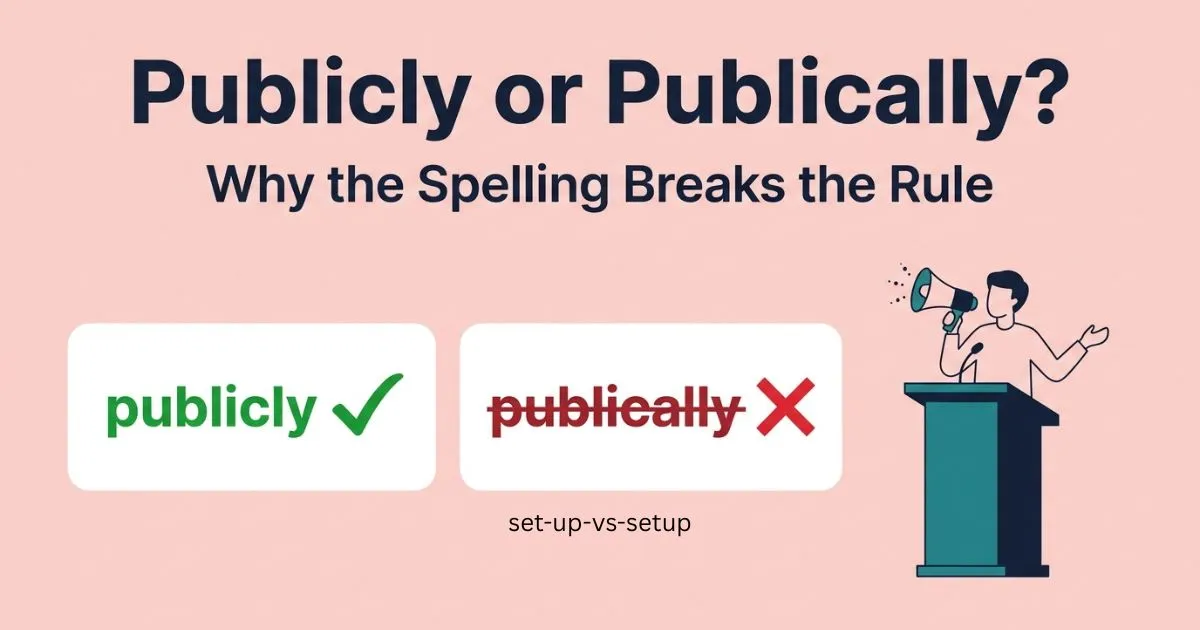
Write publicly. It’s the standard spelling and the safe choice for essays, emails, reports, and news writing.
Publically does exist. Several dictionaries have added it as a variant spelling because it became so common, but other references label it nonstandard or disputed. Both spellings mean exactly the same thing, so there’s no benefit in choosing the riskier one.
Here’s the one-line rule: public + ly = publicly. No extra “a.”
- ✅ The company publicly announced the new schedule.
- ❌ The company publically announced the new schedule.
What Does Publicly Mean?
Publicly means in a way that is open and visible to the general public, so others can witness or know about it. If a minister publicly explains a decision, she does it in front of an audience instead of behind closed doors.
Publicly Is an Adverb
Public is an adjective, so it describes a noun. Publicly is the adverb made from it, so it describes an action.
- Public: This is a public event.
- Publicly: They publicly supported the event.
A common slip is using the adjective where the adverb belongs: “She spoke public about the issue.” The fix is “She spoke publicly about the issue.” If the word explains how someone does something, you need the -ly form.
Phrases You’ll See Everywhere
Some phrases are easiest to learn as ready-made chunks:
- publicly available: information anyone can access
- publicly funded: paid for with public money
- publicly traded: bought and sold on a public stock market
- publicly announced / acknowledged / apologized: said openly, in front of others
Publicity, by the way, is a separate word and not an alternative spelling of publicly.
Read More: Affect vs Effect: Simple Rules to Pick the Right Word
Why Publically Looks Right (and Why So Many People Write It)
Your instinct isn’t random. English has a strong habit: adjectives ending in -ic usually become adverbs with -ically.
- hectic → hectically
- tragic → tragically
- poetic → poetically
- dramatic → dramatically
- scientific → scientifically
Next to that list, public → publically feels like the natural next line. You’re applying a real rule to a word that happens to be the exception.
Grammarphobia describes publicly as the notable exception to the -ically pattern. Another source points out it’s technically the only dictionary word ending in -icly. The same Grammarphobia post adds that “frantically” is the usual adverb, even though some dictionaries accept “franticly” as a variant.
Why Publicly Breaks the Pattern
Most spelling guides just say “it’s an exception” and stop there. The history is more interesting, and it helps you remember the spelling.
The -ical Connection
Long ago, many adjectives had two forms, one ending in -ic and one in -ical, such as rustic/rustical and romantic/romantical. Adverbs were built from the -ical versions by adding -ly, which gave us rustically and romantically. Many of those -ical adjectives have since died out, but the adverbs kept their -ically endings.
Public is different. Merriam-Webster’s usage guide says publically is based either on the obsolete word “publical” or, more likely, simply on analogy with other -ically adverbs. In other words, publicly stayed simple, and publically probably arrived later by imitation.
Even experts can’t always trace these words perfectly. The Oxford English Dictionary admits it can frequently be unclear how an -ically adverb was formed.
A Quick Timeline
- 1534: The OED records the first use of “publicly.”
- Late 18th century: “Publically” first shows up in writing, more than 250 years later.
So publicly isn’t a modern rule-breaker. It’s the original form, and publically is the latecomer.
What Do Dictionaries Say About Publically?
Is publically a real word? The honest answer is “yes, but.” Dictionaries disagree, and that’s why so many guides oversimplify it.
- American Heritage Dictionary (5th ed.): labels publically a nonstandard variant of publicly.
- Merriam-Webster’s Collegiate Dictionary (11th ed.): lists “publicly, also publically,” which treats the variant as standard English that appears appreciably less often.
- Merriam-Webster’s usage guide: says you can use it if you like, but doesn’t recommend it because it will look unfamiliar to many readers.
On popularity, Grammarphobia reported in 2015 that publicly beat publically by more than 100 to 1 in Google searches. That’s a 2015 figure, so today’s exact ratio may differ. Still, tutors describe the same picture: publicly is the most common and accepted form, while publically is fairly rare.
The lesson: a dictionary listing a variant is not a recommendation. Check the usage label, not just whether the entry exists.
Publicly vs Publically at a Glance
| Publicly | Publically | |
| Status | Standard, preferred | Variant; some dictionaries call it nonstandard |
| Meaning | Openly, before the public | Same |
| Part of speech | Adverb | Adverb |
| First recorded | 1534 | Late 18th century |
| How common | Far more common | Much rarer |
| Safe for formal writing? | Yes | Risky; some editors will correct it |
Is There a US vs UK Difference?
No, and this is where many writers get tripped up. It isn’t like color and colour. You shouldn’t assume publically is the British spelling and publicly the American one, because dictionary evidence doesn’t support that split. Australians spell it publicly too.
Publicly works everywhere, which makes it the practical choice for international readers. If a publisher or employer has a style guide that mentions variant spellings, follow that. Otherwise, use publicly.
How to Use Publicly in Real Sentences
Publicly pairs naturally with verbs of saying, sharing, and showing support. Here are a few examples by situation.
At School
- The professor publicly announced the exam schedule.
- The college publicly shared its admission requirements.
At Work
- The CEO publicly thanked the support team.
- The company’s financial reports are publicly available.
In the News
- The mayor publicly addressed residents’ concerns.
- The spokesperson publicly denied the claim.
In Daily Life
- She publicly apologized for the misunderstanding.
- He publicly supported his friend’s fundraiser.
Common Mistakes and Quick Fixes
- Adding an extra “a.” Don’t build the word from a general pattern. Memorize publicly as one complete word.
- Using “public” as an adverb. Ask yourself whether the word describes an action. If yes, you need publicly.
- Assuming publically is British. There’s no such rule. Use publicly in both American and British writing.
- Thinking the meanings differ. They don’t. The difference is spelling preference, not meaning.
- Mixing both spellings in one document. Pick publicly and keep it throughout.
Easy Ways to Remember
- The formula: public + ly = publicly.
- The “rebel” label: Most -ic words add -ally. Public is the rebel that doesn’t. Tag it that way in your head.
- An anchor sentence: “She spoke publicly about the public event.” Both words share a root, so the spelling sticks.
- Chunk learning: Practice publicly available, publicly funded, and publicly traded until they look automatic.
Read More: Cancellation or Cancelation: Which Spelling Is Correct?
Affect or Effect? Another Pair That Trips Writers Up
If publicly vs publically made you pause, affect vs effect probably has too. They differ by one letter, most people pronounce them the same, and both describe change, which makes them even trickier.
The Basic Rule
Affect is usually a verb meaning to influence or produce a change, while effect is usually a noun for a change that results from something. Here’s the idea in one pair of sentences: rain affects plants, and one effect of rain is faster growth.
If A affects B, then B experiences the effect of A’s action.
Memory Tricks
- A is for Action. Verbs are about action, and affect starts with an “a” and is a verb.
- Cause and effect. Cause ends with an “e” and effect begins with one, so a cause leads to an effect.
- Action vs end result. Another handy shortcut is to think of affect as the action and effect as the end result.
The Tricky Exceptions
- Effect as a verb: It means to bring something about, and it usually appears with nouns like “change” or “solutions.” Example: Voters hoped to effect change on the school board.
- Affect as a verb (pretend): It can mean to put on an act, and today it’s most familiar in the adjective “affected,” meaning pretentious or artificial.
- Affect as a noun: This has a specific psychological meaning, the observable signs of someone’s emotional state, and it rarely comes up in everyday writing.
Both in One Sentence
The new rule will affect attendance, and its effect on grades could be big.
A 30-Second Proofreading Checklist
Before you publish or submit anything, run this quick check:
- Search your draft (Ctrl+F or Cmd+F) for “publically.”
- Replace every instance with “publicly.”
- Keep the original spelling only if you’re quoting someone or an older document word for word.
- Scan for “public” used where an adverb is needed.
- Check any affect/effect pairs using the “action vs end result” trick.
FAQs
Is it publicly or publically?
Publicly is the standard, preferred spelling. Publically is a rarer variant that some dictionaries list and others label nonstandard. Since both mean the same thing, choose publicly in essays, emails, reports, and professional writing. It’s the safest option for any audience.
Is publically a real word?
Sort of. Some dictionaries record it as a variant of publicly, while others call it nonstandard. Merriam-Webster accepts it but advises against it because it looks unfamiliar to many readers. For everyday and formal writing, publicly is the better choice.
Is publically a British spelling?
No. Publicly is standard in both British and American English, and Australians use it too. Publically is simply a less common variant in all of them. There’s no regional rule that makes publically the British form.
Why isn’t publicly spelled “publically”?
Most -ic adjectives take -ically, but publicly is the exception. It’s the older form, first recorded in 1534. Publically appeared in the late 18th century, probably by analogy with other -ically adverbs, and it never replaced the original.
Is publicly an adjective or an adverb?
Publicly is an adverb. It describes how an action happens, as in “The information is publicly available.” The adjective is public, as in “a public event.” Using public where an adverb belongs is a common mistake: say “spoke publicly,” not “spoke public.”
Can I ever use publically?
Only when you’re quoting a source or older document that uses it, since quotations should stay exactly as written. Also follow your publisher’s style guide if it addresses variants. In all your own writing, replace it with publicly.
Does publicly mean the same as openly?
Often, yes. Publicly means in a way that others can see, hear, or know about, so “publicly apologized” is close to “openly apologized.” But it isn’t always interchangeable. In “publicly funded,” the meaning is about public money, so “openly funded” would say something different.
Conclusion:
So, publicly or publically? Publicly is the one to use. It’s the older, far more common, and widely preferred spelling, and it works in American, British, and Australian English alike.
Publically is a rare variant that some dictionaries record and others reject, and it means exactly the same thing. That’s a lot of risk for no reward.
Remember the story behind it: most -ic words take -ally, but public stayed simple. Your next step is easy.
Open your latest draft, search for “publically,” and fix it in 30 seconds. Then save the “A is for Action” trick for the next time affect and effect show up.

I am an English language writer passionate about grammar and clear communication. I create simple, easy-to-understand content that helps readers improve their English skills. My goal is to make learning English both practical and enjoyable.




1 thought on “Publicly or Publically? Why the Spelling Breaks the Rule”