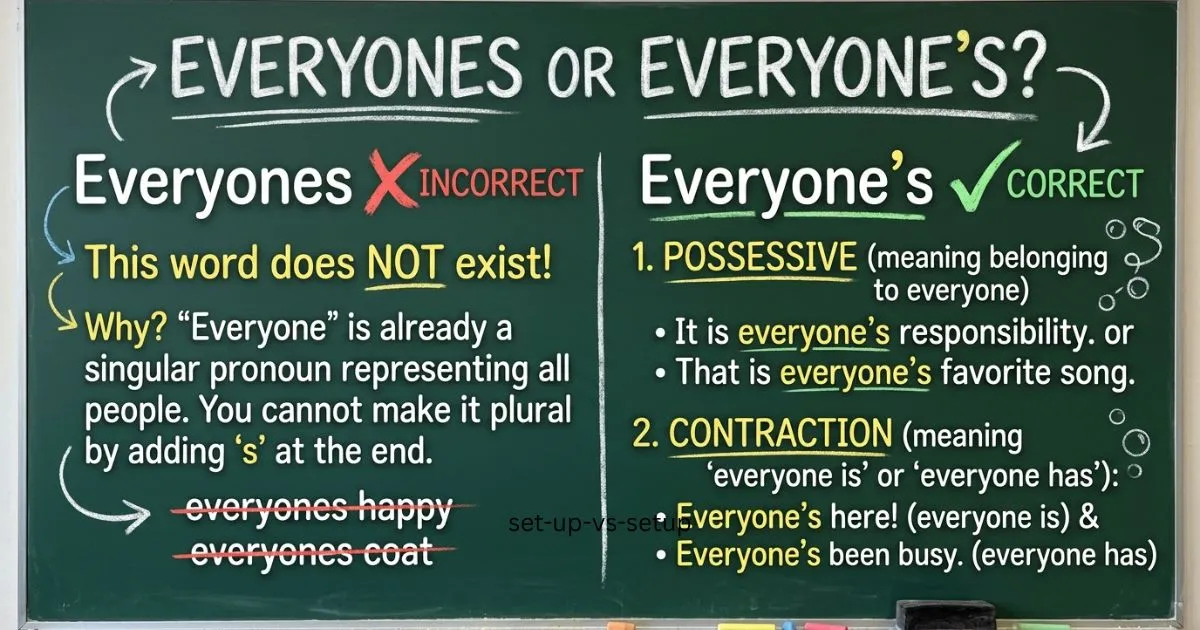
Only “everyone’s” is correct. “Everyones” is a typo, because “everyone” never takes a plural s.
Picture a group chat at work. Someone types, “Thanks for everyones help today!” Three people notice the typo. Nobody says a word. Everyone just feels a tiny wince.
That wince is why this question matters. “Everyone’s” is the correct way to show that something belongs to the whole group.
Use it for help, ideas, time, and attention. This guide gives you the rule, the reason behind it, and a simple trick so you never mix them up again.
Quick Answer Box
Quick Answer: Write everyone’s. The word “everyone” is singular, so it has no plural form. To show ownership, add an apostrophe and an s. “Everyones” is not a real word, and “everyones’” is also wrong. This rule is the same in American and British English.
⚡ Quick Rule in 1 Line
Everyone is singular, so add an apostrophe and s: everyone’s, never everyones — in the US and UK.
Everyone’s vs Everyones: What Is the Difference?
“Everyone’s” is a real, correct word form. “Everyones” is a spelling mistake. The difference is the apostrophe. Without it, the word looks like a plural, but “everyone” cannot be made plural.
Here is the short version:
- Everyone’s = belonging to everyone, or the short form of “everyone is” or “everyone has.”
- Everyones = not a word in standard English.
The mistake is easy to make. Many English nouns end in s when there is more than one. Think of “friends,” “students,” or “teachers.” Your brain expects the same pattern here.
But “everyone” is not a normal noun. It is a pronoun. It already means “all people in the group.” Adding an s does not make it more plural. It just makes it wrong.
The Grammar Rule: Why Everyone Has No Plural
“Everyone” is an indefinite pronoun. It points to a whole group without naming anyone. Grammar treats it as singular, so it takes a singular verb and has no plural form.
Let’s break that down in plain steps.
Step 1: “Everyone” is an indefinite pronoun. Pronouns like “he” and “she” point to a specific person. “Everyone” does not. It points to a group in a general way. That is why it is called indefinite.
Step 2: It is grammatically singular. We say “Everyone is here,” not “Everyone are here.” The verb is singular. That tells you the word itself is singular.
Step 3: Singular words have no plural to add. The meaning feels plural because many people are involved. But the grammar is singular. So there is no “everyones.”
Step 4: Possession follows the normal rule. To show ownership with a singular word, add an apostrophe and s. That gives you “everyone’s.”
Other indefinite pronouns work the same way:
- everybody → everybody’s
- someone → someone’s
- anyone → anyone’s
- no one → no one’s
- nobody → nobody’s
If you learn the rule once, you can use it for all of them.
Read More: Everyones or Everyone’s? Which Is Correct?
The Two Jobs of Everyone’s
“Everyone’s” does two different jobs. It can show possession, or it can be a contraction. Both use the same spelling, and the sentence tells you which one you mean.
This is a common source of confusion, so let’s look at each job.
Job 1: Possession
Possession means something belongs to the group. A noun usually follows it.
- Everyone’s opinion matters.
- I need everyone’s attention.
- We value everyone’s time.
Job 2: Contraction
A contraction squeezes two words into one. “Everyone’s” can mean “everyone is” or “everyone has.”
- Everyone’s here. (Everyone is here.)
- Everyone’s finished the test. (Everyone has finished the test.)
How to tell them apart
Try this quick test. Replace “everyone’s” with “everyone is” or “everyone has.” If the sentence still makes sense, it is a contraction. If not, it is a possessive.
- “Everyone’s coming” → “Everyone is coming.” Works, so it is a contraction.
- “Everyone’s coat” → “Everyone is coat.” Does not work, so it is a possessive.
The apostrophe stays in both cases. That is why “everyones” never works in either job.
This is the same pattern you see with it’s and its. We cover that in our guide on Its vs It’s.
Comparison Table
This table shows every form side by side. Only one is correct. The others are common typing mistakes.
| Form | Correct? | What it means | Example |
| everyone’s | ✅ Yes | Possessive, or “everyone is / has” | Everyone’s opinion counts. |
| everyones | ❌ No | Not a word | |
| everyones’ | ❌ No | Not a word | |
| everyone | ✅ Yes | The base pronoun (no ownership) | Everyone agreed. |
| every one’s | ⚠️ Rare | “Every single one’s” (special case) | Every one’s turn will come. |
Takeaway: If you want to show ownership with “everyone,” only the first row works.
Is There a US or UK Difference?
No. American and British English both use “everyone’s.” This is not a spelling split like color and colour. “Everyones” is wrong in every country.
Many words on this site follow a clean US vs UK pattern. Think of color and colour, or gray and grey. This one does not.
The apostrophe rule for possession is the same everywhere. Writers in the US, UK, Canada, and Australia all write “everyone’s.” If you see “everyones” anywhere, it is a typo.
This is useful for you. You do not need to switch spellings when your audience changes. One rule covers every reader.
What About Everyones’?
“Everyones’” is also wrong. The apostrophe after the s marks a plural owner, such as “students’ books.” Since “everyone” is not plural, that pattern does not apply.
Some writers know that plural possessives put the apostrophe after the s. So they try “everyones’.” It looks logical, but it breaks the rule at the first step.
Here is the pattern for plural nouns:
- one student → student’s book
- many students → students’ books
Now check “everyone.” It has no “many everyones” form. So you cannot use the plural pattern. You stay with the singular pattern: add an apostrophe and s.
So the full set of wrong forms is:
- ❌ everyones
- ❌ everyones’
- ✅ everyone’s
Memory Trick
Think “one.” The word ends in one, and one is singular. A singular owner always gets apostrophe-s. So it is everyone’s.
Here are three quick tricks you can use.
Trick 1: The “one” trick. Look at the last three letters: o-n-e. One means a single thing. Single owners take ’s.
Trick 2: The swap test. Replace “everyone” with “my friend.” You would write “my friend’s help,” not “my friends help.” The same pattern gives you “everyone’s help.”
Trick 3: The “is” test. Say the sentence out loud with “everyone is.” If it fits, you need the apostrophe. This works for the contraction job.
20 Real Example Sentences
These examples show correct use in everyday writing. The first group shows possession. The second group shows contractions. The third group shows the base word “everyone” for comparison.
Possessive (belonging to everyone)
- I appreciate everyone’s patience this week.
- Everyone’s feedback helped us improve the plan.
- The teacher asked for everyone’s attention.
- We respect everyone’s right to speak.
- Her joke made everyone’s day better.
- Please check everyone’s name on the list.
- This project needs everyone’s effort.
- Safety is everyone’s responsibility.
- Thanks for taking everyone’s calls so quickly.
- The coach noticed everyone’s hard work.
Contraction (everyone is / everyone has)
- Everyone’s waiting outside. (everyone is)
- Everyone’s finished the quiz. (everyone has)
- I think everyone’s ready to start. (everyone is)
- Everyone’s been so kind to me. (everyone has)
- Tell me when everyone’s arrived. (everyone has)
Base word “everyone” (no apostrophe needed)
- Everyone loves a good story.
- I emailed everyone on the team.
- Everyone was late because of the rain.
- She wants everyone to feel welcome.
- Does everyone understand the rule now?
Notice that sentences 16 to 20 do not show ownership. They also do not shorten “is” or “has.” So they need no apostrophe at all.
Common Mistakes
Most errors come from three habits: adding a plain s, moving the apostrophe, or dropping it. Here are the mistakes we see most, with simple fixes.
Mistake 1: Writing “everyones”
❌ Thanks for everyones help. ✅ Thanks for everyone’s help.
This is the most common error. It happens when typing fast.
Mistake 2: Writing “everyones’”
❌ We value everyones’ time. ✅ We value everyone’s time.
The apostrophe after the s is for plural owners. “Everyone” is not plural.
Mistake 3: Adding an apostrophe when you do not need one
❌ Everyone’s invited, and everyone’s welcome to bring a friend. (Fine here, but see the next one.) ❌ I told everyone’s about the party. ✅ I told everyone about the party.
If there is no ownership and no “is” or “has,” leave the apostrophe out.
Mistake 4: Trusting autocorrect blindly
Spell checkers can get confused by contractions. They may skip “everyones” without a warning. Always read your sentence once more before you hit send.
Mistake 5: Mixing up “everyday” and “every day”
This is a different mistake, but it often shows up in the same sentences. “Everyday” is an adjective. “Every day” means each day. See our guide on Everyday vs Every Day.
When to Use Each Form
Use “everyone’s” when something belongs to the group or when you mean “everyone is” or “everyone has.” Use “everyone” when you need neither. Never use “everyones” or “everyones’.”
Here is a simple decision guide:
- Does something belong to the group? → Use everyone’s. (Everyone’s ideas matter.)
- Can you say “everyone is” or “everyone has”? → Use everyone’s. (Everyone’s here.)
- Do you just mean all the people? → Use everyone. (Everyone is here.)
- Are you tempted to write “everyones”? → Stop. Go back to step 1.
A note on formal writing
In formal writing, such as essays, reports, and cover letters, many writers avoid contractions. In that case, write “everyone is” or “everyone has” in full. For possession, you still use “everyone’s.” There is no way around the apostrophe there
Key Takeaways
- ✅ Everyone’s is the only correct form for ownership.
- ❌ Everyones and everyones’ are not real words.
- “Everyone” is a singular indefinite pronoun with no plural.
- “Everyone’s” can mean “everyone is” or “everyone has.”
- There is no US vs UK difference for this word.
- Same rule for everybody’s, someone’s, anyone’s, and no one’s.
- Use the swap test: try “everyone is” or “everyone has.”
- Proofread, because autocorrect can miss this error.
FAQs
1. Is “everyones” a word?
No. “Everyones” is not a word in standard English. The pronoun “everyone” has no plural form, so adding an s creates a spelling error. Use “everyone’s” when you need to show ownership.
2. Which is correct: everyones or everyone’s?
“Everyone’s” is correct. It shows possession, as in “everyone’s opinion.” It can also be the short form of “everyone is” or “everyone has.” “Everyones” is only a typo.
3. Is “everyones’” ever correct?
No. An apostrophe after the s marks a plural owner. “Everyone” is not plural, so the form does not apply. The only correct possessive is “everyone’s.”
4. What is the plural of everyone?
“Everyone” has no plural form. It is a singular pronoun that refers to a whole group. If you need to talk about several groups, use another phrase, such as “all the groups.”
5. Is everyone singular or plural?
“Everyone” is grammatically singular. It takes a singular verb: “Everyone is here.” The meaning involves many people, but the grammar treats it as one unit.
6. Is it “everyone’s” or “everybody’s”?
Both are correct. “Everyone” and “everybody” mean the same thing. Their possessive forms work the same way: add an apostrophe and s. Choose whichever sounds natural to you.
7. Does “everyone’s” always show possession?
No. It can also be a contraction of “everyone is” or “everyone has.” Replace it with those words to test. If the sentence still makes sense, it is a contraction.
8. Is there a difference in US and UK English?
No. Both varieties use “everyone’s.” Unlike words such as color and colour, this rule does not change by region. “Everyones” is incorrect everywhere.
9. Can I use “their” after “everyone”?
Many writers do, as in “Everyone did their best.” Some strict style guides prefer rewording. Check your teacher’s, editor’s, or company’s style guide, and follow it for consistency.
10. Why does autocorrect miss “everyones”?
Spell checkers often struggle with apostrophes and contractions. They may treat “everyones” as an acceptable variant. Always proofread, especially emails, resumes, and school work.
Conclusion:
The answer is simple: write everyone’s. The word “everyone” is singular, so it has no plural form. That means “everyones” and “everyones’” are both wrong.
To show ownership, add an apostrophe and s. To shorten “everyone is” or “everyone has,” use the same spelling. If you mean neither, write plain “everyone.”
This rule is the same in the US and UK, so you can use it with any audience. Keep the “one” trick in mind, and you will get it right every time.

I am an English language writer passionate about grammar and clear communication. I create simple, easy-to-understand content that helps readers improve their English skills. My goal is to make learning English both practical and enjoyable.





2 thoughts on “Everyones vs Everyone’s: Which Is Correct? (Simple Rule + Examples)”