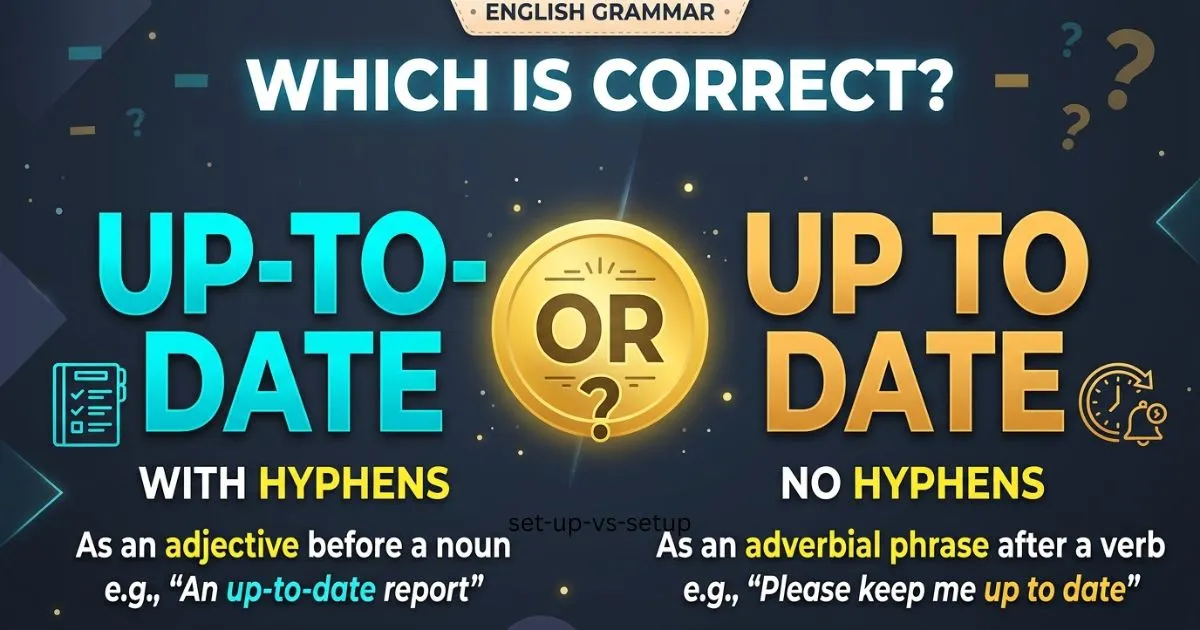
Use up-to-date before a noun, like an up-to-date map. Use up to date after a verb, like the map is up to date.
Maybe you once typed, “Please send your up to date resume,” and felt something was off. Or you added hyphens to a sentence that did not need them. You are not alone.
The phrase looks almost the same both ways. Only its job in the sentence changes. Before a noun, the hyphens glue the words into one adjective. After a verb, the words stand apart.
This guide gives you the rule, a two-second test, and 20 examples. It also shows where two big style authorities differ.
Quick Answer
Up-to-date (with hyphens) is an adjective placed before a noun: an up-to-date report. Up to date (no hyphens) comes after a verb: the report is up to date. Chicago style follows this split. Merriam-Webster lists the hyphenated form as the adjective.
⚡ Quick Rule in 1 Line
“Before a noun, hyphens hold the phrase together; after a verb, the words stand apart.”
The Difference Between Up-to-Date and Up to Date
The difference is position. Write up-to-date with hyphens when it comes right before the noun it describes. Write up to date without hyphens when it follows a verb such as is, stays, or keeps. The meaning stays the same: current, with the latest information.
Both forms mean the same thing. Something that is up to date includes the newest facts or the newest version. Merriam-Webster defines the adjective as extending up to the present time and including the latest information. It also gives a second meaning: abreast of the times, or modern.
So you do not pick a different meaning. You pick a different spelling for a different spot in the sentence.
Here is the quick view:
- Before a noun: an up-to-date calendar, an up-to-date list, up-to-date news.
- After a verb: the calendar is up to date, the list stays up to date, keep me up to date.
The word comes from the 1800s. Merriam-Webster dates the first known use of up-to-date to 1887. It is an old, well-settled phrase. The only real question is the hyphens.
The Grammar Rule Behind the Hyphens
Hyphens join several words into one adjective when that adjective comes before a noun. After the noun, the same words sit in a normal phrase, so no hyphens are needed. Up-to-date follows the same pattern as well-known, long-term, and over-the-counter.
This kind of adjective has a name: a compound modifier. It is a group of words that work together as one describing word.
Before the noun, the hyphens help the reader. They show that the words belong together. Without them, a reader might pause and wonder what goes with what.
After the verb, the phrase is easy to read on its own. The hyphens add nothing. So most style guides leave them out.
Here is the same pattern with other phrases:
- a hard-to-find book → the book is hard to find
- a well-known author → the author is well known
- an up-to-date file → the file is up to date
Some sources call up to date an adverb phrase when it follows a verb, as in “bring the file up to date.” Others call it a predicate adjective, as in “the file is up to date.” You do not need to settle that debate. In both cases, you leave out the hyphens.
Read More: Everyones vs Everyone’s: Which Is Correct? (Simple Rule + Examples)
A Memory Trick: The Move-It Test
Move the phrase after the verb is. If the sentence still sounds natural, drop the hyphens. If the phrase sits before a noun, keep them. This takes about two seconds and works for most compound adjectives.
Here is how it works in three steps.
- Look at where the phrase sits. Is a noun right after it?
- If yes, keep the hyphens: an up-to-date guide.
- If the phrase comes after a verb, drop them: the guide is up to date.
Try it on a messy sentence: “Our up to date price list is ready.”
The phrase sits before the noun price list. So it needs hyphens. The fixed version is: “Our up-to-date price list is ready.”
Now try another: “Our price list is up-to-date.”
The phrase follows the verb is. So the hyphens come out: “Our price list is up to date.”
There is also a shortcut. If the hyphens feel like a hassle, rewrite the sentence. Swap in current or the latest. “Please send the latest report” has no hyphen problem at all.
Comparison Table
The table below shows both forms side by side. Use it as a quick check. The rule never changes: hyphens go before a noun, and spaces go after a verb.
| Feature | up-to-date | up to date |
| Hyphens | Yes | No |
| Where it goes | Right before a noun | After a verb or after the object |
| Job in the sentence | Adjective (compound modifier) | Predicate adjective or adverb phrase |
| Sample sentence | We use an up-to-date app. | Our app is up to date. |
| Common partner verbs | None (it describes a noun) | is, stay, keep, bring, get, remain |
| Quick test | A noun follows it | A verb comes before it |
20 Example Sentences
These examples are grouped by position. Read each one out loud. Notice that the phrase before a noun always has hyphens. The phrase after a verb never does.
Before a noun (use up-to-date)
- Please send me an up-to-date resume.
- The clinic needs up-to-date contact details for every patient.
- She keeps an up-to-date list of her passwords.
- We all want the most up-to-date information before the trip.
- An up-to-date map helped us find the hotel.
- The school shares up-to-date news with parents every week.
- He bought an up-to-date laptop for his new job.
- Use an up-to-date version of your browser.
- The teacher gave us an up-to-date reading list.
- A good manager has up-to-date knowledge of the team’s work.
After a verb (use up to date)
- Your resume is up to date.
- My phone stays up to date because I allow automatic updates.
- Please keep me up to date about the schedule.
- The software is not up to date, so it keeps crashing.
- She brought the budget up to date before the meeting.
- Is your child up to date on school vaccines?
- Our records are up to date as of Monday.
- I try to stay up to date with the news.
- We will get the website up to date this week.
- The map looks up to date, but check the road signs anyway.
Do Dictionaries and Style Guides Agree?
Mostly yes, with one wrinkle. Merriam-Webster lists the adjective as up-to-date, with hyphens. The Chicago Manual of Style keeps the phrase open after a verb. When the two differ, Chicago’s own editors say to follow Chicago’s rule.
This is where readers get confused. Merriam-Webster is a dictionary. It lists up-to-date as a hyphenated adjective, and its news examples sometimes show hyphens even after a verb. For example, one example says a child should be up-to-date on routine vaccines.
The Chicago Manual of Style gives a clear split. It says the phrase gets hyphens before a noun, as in an up-to-date solution. It stays open after a verb, as in his equipment was up to date. A Chicago editor was asked which to follow. The answer was to follow Chicago.
The Microsoft Writing Style Guide gives similar advice for technical writing. It lists up-to-date information with hyphens before a noun. It also says not to hyphenate a predicate adjective unless the guide says so.
So what should you do?
- For most writers: Follow the position rule in this article. It matches Chicago style.
- If your school or company has a style guide: Follow that guide.
- Whatever you choose: Be consistent in the same document.
This is also not a US vs UK spelling split. The sources checked treat it as a general hyphenation rule, not a regional difference.
Common Mistakes
The most common mistake is skipping the hyphens before a noun. The second is adding hyphens after a verb. A few smaller slips also show up often. Here are six to watch for, with the fix for each.
1. No hyphens before a noun
- ❌ We need an up to date software list.
- ✅ We need an up-to-date software list.
2. Hyphens after a verb
- ❌ The list is up-to-date.
- ✅ The list is up to date.
Note: Merriam-Webster’s news examples sometimes show the hyphenated form here. But Chicago style keeps it open, so that is the safer choice for most writing.
3. Hyphenating only part of the phrase
- ❌ an up-to date report, an up to-date report
- ✅ an up-to-date report
Both hyphens are needed. Using one looks like a typo.
4. Spaces around the hyphens
- ❌ up – to – date
- ✅ up-to-date
A hyphen has no spaces on either side. Underscores, as in up_to_date, are for computer code, not for normal writing.
5. Using “up to date” as a verb
- ❌ Please up to date the file.
- ✅ Please update the file.
6. Forgetting the hyphens after most
- ❌ the most up to date information
- ✅ the most up-to-date information
The phrase still sits before the noun information. The word most does not change the rule.
When to Use Each Form
Choose the form by looking at the sentence, not at the topic. If a noun follows the phrase, use up-to-date. If a verb comes before it, use up to date. Here is how that looks in real situations.
Resumes and job applications
- “Attach an up-to-date resume.” (noun follows)
- “Keep your resume up to date.” (verb comes before)
Software and tech
- “Install the up-to-date version.” (noun follows)
- “Your device is up to date.” (verb comes before)
Health and school forms
- “Bring up-to-date vaccine records.” (noun follows)
- “Make sure your child is up to date.” (verb comes before)
News, blogs, and business writing
- “We share up-to-date market news.” (noun follows)
- “We keep readers up to date.” (verb comes before)
Phrases that follow the same logic
Many other phrases follow this same rule:
- well-known / well known
- long-term / long term
- state-of-the-art / state of the art
- user-friendly / user friendly
- out-of-date / out of date
So if you learn the rule once, you can use it again and again.
Update vs Up to Date
Update is one word. It is a verb and a noun, and it is not the same as up to date. As a verb, it means to bring something up to date. As a noun, it means new information or a newer version.
Here is a simple way to tell them apart:
- Update (verb): I need to update my address book.
- Update (noun): Did you read the weather update?
- Up to date (after a verb): My address book is up to date.
- Up-to-date (before a noun): I keep an up-to-date address book.
Never write up-date with a hyphen. Merriam-Webster lists update as one word.
One handy way to remember: you update a file so that it becomes up to date.
Key Takeaways
- Use up-to-date (hyphens) before a noun: an up-to-date report.
- Use up to date (no hyphens) after a verb: the report is up to date.
- Both forms mean current, with the latest information.
- The Move-It Test: if the phrase sounds natural after is, drop the hyphens.
- Chicago style keeps the phrase open after a verb. Merriam-Webster lists the hyphenated adjective.
- This is a position rule, not a US vs UK spelling difference.
- Update is a separate word. Never write up-date.
- Rewrite with current or the latest if the hyphens feel awkward.
FAQs
1. Is it up to date or up-to-date?
Both are correct, but not in the same place. Use up-to-date with hyphens before a noun, as in an up-to-date map. Use up to date without hyphens after a verb, as in the map is up to date.
2. Should I hyphenate “up to date” after “is”?
No. After a linking verb like is, seems, or looks, write up to date with no hyphens. The Chicago Manual of Style gives the example “his equipment was up to date.” Merriam-Webster’s news examples sometimes differ, but Chicago’s rule is the safer pick.
3. Is “up-to-date” one word?
No. It is a hyphenated compound adjective. The hyphens tie three words into one describing word. Do not write it as uptodate or up to-date.
4. Is “keep me up to date” correct?
Yes. The phrase follows the verb keep, so it stays open with no hyphens. You can also say “keep me informed” or “keep me posted” if you want a shorter option.
5. Is “up to date” ever an adverb?
Some sources treat it as an adverb phrase after a verb. Example: “She brought the budget up to date.” Others call it a predicate adjective. The label does not matter for spelling. In both cases, you leave out the hyphens.
6. Does the UK use a different rule?
The sources checked do not describe a US vs UK split for this phrase. They explain it as a general hyphenation rule based on position in the sentence. If you follow a UK style guide at work or school, check that guide.
7. Is it “the most up-to-date information” or “the most up to date information”?
Use hyphens: the most up-to-date information. The phrase sits before the noun information, so it acts as a compound modifier. The word most does not change that.
8. Why does Merriam-Webster show hyphens everywhere?
A dictionary lists the adjective form, which has hyphens. Its example sentences come from news sites, and they follow different house styles. Chicago style, which many writers follow, says to leave the phrase open after a verb.
9. How do I write it on a resume or in an email?
Use the position rule. Write “an up-to-date resume” before a noun. Write “my resume is up to date” after a verb. If hyphens feel awkward, rewrite with current or the latest.
Conclusion:
The rule is short. Put hyphens in up-to-date when it comes before a noun. Leave them out of up to date when it follows a verb.
Use the move-it test if you are unsure. Shift the phrase after is. If it sounds natural there, drop the hyphens.
Merriam-Webster lists the hyphenated adjective, but Chicago style keeps the phrase open after a verb. For most writing, the position rule is the safest choice.
Pick one style and use it the same way in every document.

As an American English writer, I specialize in creating clear and engaging content that makes grammar and language learning accessible to everyone. I enjoy breaking down complex English concepts into simple, practical lessons that readers can apply with confidence. My mission is to help learners strengthen their communication skills through easy and reliable content.


1 thought on “Up-to-Date or Up to Date? The Simple Hyphen Rule (With 20 Examples)”