You are writing an email, and you want to say something surprising happened. Your fingers type “Funny enough,” and then you stop. Does it look wrong? Should it be “Funnily enough”?
You are not alone. Even native speakers disagree here. One side says “funny enough” sounds natural, the other says it sounds off.
The confusion is real, and the answer is more interesting than “one is right, one is wrong.”
In this guide, you will learn what each phrase means, why they look so alike, how usage differs between American and British English, and a simple test to choose the right one every time.
Funny Enough or Funnily Enough: The Short Answer
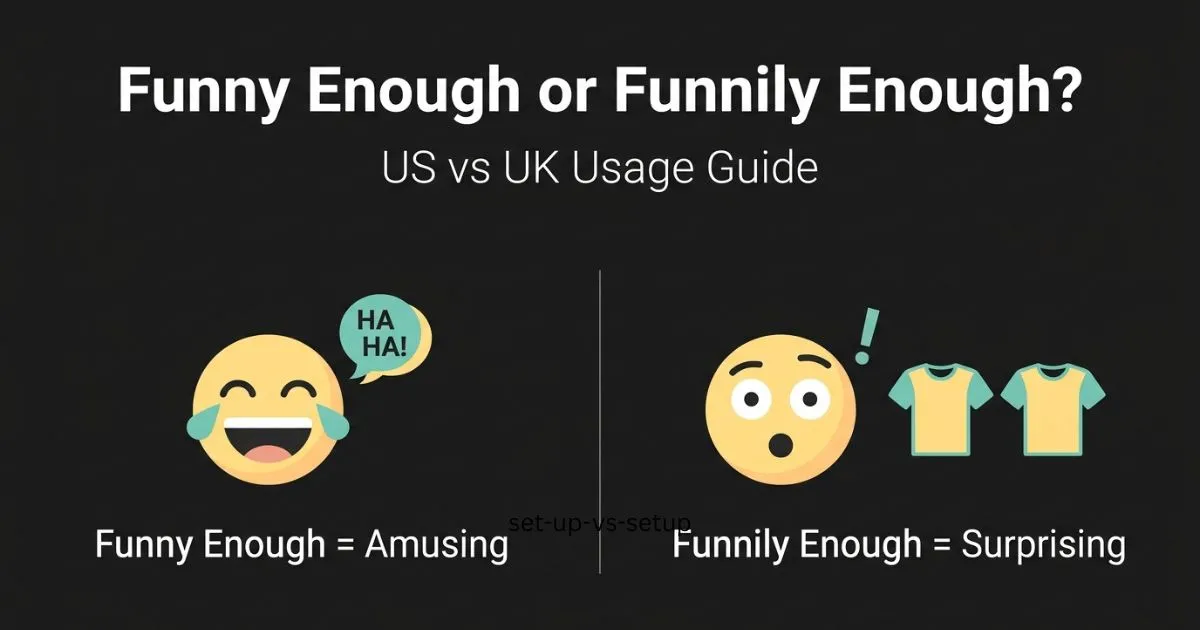
Both are correct English, but they are not always doing the same job.
- Funny enough is fully correct when it means “amusing enough,” as in “That joke wasn’t funny enough.”
- Funnily enough is the traditional phrase for introducing something surprising or coincidental.
- “Funny enough” as a sentence opener is common in casual speech, especially in American English, but some listeners, especially in the UK, find it wrong.
Safe rule: when you want to say “oddly” or “surprisingly,” choose funnily enough. Nobody will question it.
What Does “Funny Enough” Mean?
In its clearest use, “funny enough” means “humorous to a sufficient degree.” Here, funny is an adjective and enough tells us how much.
- The speech was funny enough to relax the room.
- I don’t think that meme is funny enough to post.
- Is the ending funny enough, or should we rewrite it?
This pattern works just like “tall enough,” “loud enough” or “good enough.” Enough comes after the adjective, and often leads into “to + verb.”
An italki learner asked about exactly this, and a helpful answerer gave a neat example: asked whether to include an elephant joke in a speech, you might say, “No, it isn’t funny enough.” That is the standard use, and nobody objects to it.
The second use: “funny enough” as a sentence opener
Many people also say things like, “Funny enough, I ran into her at the airport.” Here the phrase has nothing to do with humor. It means “oddly” or “strangely.”
This use is very common in everyday American speech, and some usage sites list it as acceptable. But it is where the disagreement starts, so we will come back to it below.
Read More: Will or Would: How to Choose the Right One Every Time
What Does “Funnily Enough” Mean?
Funnily enough introduces a fact the speaker finds odd, ironic or coincidental. It is not about being amusing. It is about being unexpected.
- Funnily enough, the shop I was looking for was right behind me.
- She hates coffee. Funnily enough, she works in a café.
- I was about to call you, funnily enough.
Grammar writers have pointed out that it is built like other “-ly enough” phrases: oddly enough, curiously enough, strangely enough. Some people find it clumsy to say, but the Grammarphobia blog notes that it does a job no other phrase does exactly. That is probably why it has survived.
Where can it go in a sentence?
It is flexible:
- Start: Funnily enough, the answer was in the first chapter.
- Middle: The answer was, funnily enough, in the first chapter.
- End: The answer was in the first chapter, funnily enough.
Use commas to separate it from the rest of the sentence.
Funny Enough vs Funnily Enough
Here is the whole difference in one place:
| Funny enough | Funnily enough | |
| Core meaning | Amusing to a sufficient degree | Oddly, surprisingly, coincidentally |
| Grammar | Adjective + enough | Adverb + enough, used as a sentence comment |
| Typical sentence | “The joke was funny enough to repeat.” | “Funnily enough, he called just then.” |
| Opens a sentence? | Only informally, to mean “oddly” | Yes, this is its normal job |
| Safe in formal writing? | Yes, for the “amusing” meaning | Yes, for the “surprising” meaning |
| More common in | The US (as a sentence opener) | The UK |
The key idea: the two phrases overlap only when “funny enough” is used as an opener. Everywhere else, they live in separate territory.
Why the Confusion Happens: Funny vs Funnily
The two words come from the same root, which is why they look interchangeable.
Funny is an adjective. It describes a noun: a funny story, a funny smell, a funny feeling. It can mean “amusing” or “strange.”
Funnily is an adverb. It describes an action or comments on a whole statement: he walked funnily, she smiled funnily.
Now the grammar puzzle. When someone opens a sentence with “Funny enough, …”, what is funny describing? There is no noun for it to attach to. That is why many grammar-minded speakers say an adverb is needed here, and why “funnily enough” feels logically tidy.
On the other side, some people read “funny enough” as a shortened comment, something like “it’s funny enough that…” or simply “funny thing is…”. Whatever the exact origin, the usage exists, and people do say it. The question is not “does it exist?” but “who will notice, and does it matter in your context?”
Funny Enough or Funnily Enough in American vs British English
This is the part most guides skip, and it explains a lot of the arguments you will see online.
According to GrammarHow, which draws on Google Ngram data, “funny enough” is more popular than “funnily enough” in the United States, though the gap has narrowed. In the UK, “funnily enough” is clearly more popular, and the gap has grown.
So the practical picture looks like this:
- Writing for a UK audience (or for IELTS, British schools, UK publications): use funnily enough.
- Writing for a US audience in a relaxed setting: funny enough will not raise eyebrows for most readers.
- Writing for an international audience, or you are not sure: use funnily enough. It is accepted everywhere.
One caveat: Ngram data tells you what people publish, not what editors prefer. Treat it as a guide to habit, not a ruling.
A Simple Two-Question Test
Not sure which to use? Ask yourself two things.
Question 1: Am I describing how amusing something is?
If yes, write funny enough, usually followed by “to + verb.”
The video was funny enough to send to my sister.
Question 2: Am I flagging that something is odd or surprising?
If yes, write funnily enough.
Funnily enough, my sister had already sent it to me.
Bonus check: swap in “oddly enough.” If the sentence still works, you want funnily enough.
- “Oddly enough, I met him at the airport.” ✔ → Funnily enough, I met him at the airport.
- “The joke was oddly enough to make us laugh.” ✘ → That one needs funny enough.
Read More: Cancelled or Canceled? US vs UK Spelling in 30 Seconds
Examples You Can Copy
Funny enough (amusing)
- The teacher’s example was funny enough to wake up the whole class.
- His presentation wasn’t serious, but it was funny enough to be memorable.
- Is this caption funny enough, or is it trying too hard?
Funnily enough (surprising)
- Funnily enough, the student who studied least scored highest.
- Both managers, funnily enough, suggested the same fix.
- We were wearing the same shirt, funnily enough.
Funny enough as an informal opener (casual speech)
- Funny enough, I had that exact thought this morning.
This last line is fine in a chat with friends. In an exam essay or a job application, swap it for funnily enough and move on.
Common Mistakes to Avoid
1. Using “funnily” before an adjective meaning “sufficiently.”
✘ The joke was funnily enough to make us laugh.
✔ The joke was funny enough to make us laugh.
2. Using “funny enough” in formal writing when you mean “oddly.”
Not an outright error, but it can distract readers who dislike it.
Safer: Funnily enough, the results matched.
3. Forgetting the comma.
✘ Funnily enough I agreed.
✔ Funnily enough, I agreed.
4. Overusing it.
These phrases signal “here comes something surprising.” If every paragraph has one, nothing feels surprising anymore. One per page is plenty.
5. Using it when nothing is actually surprising.
“Funnily enough, I went to school today” is odd, because there is nothing to be surprised about.
Alternatives When You Want Variety
If you keep reaching for the same phrase, these are close options:
| Phrase | Best when you want to say |
| Oddly enough | Something is strange |
| Strangely enough | Something is unusual or unexplained |
| Curiously enough | Something sparks interest |
| Interestingly enough | Something is worth noticing |
| Surprisingly | The result was unexpected |
| Coincidentally | Two things lined up by chance |
For formal writing, a plain “surprisingly” or “unexpectedly” is often cleaner than any “-ly enough” phrase.
Quick Checklist Before You Publish
- Does the sentence describe humor? → use funny enough.
- Does it introduce something odd or coincidental? → use funnily enough.
- Is the audience British or international? → choose funnily enough.
- Is there a comma after the opener?
- Have you used it more than once or twice in the piece?
FAQs
1. Is it “funny enough” or “funnily enough”?
Both exist, but they differ. “Funny enough” means amusing enough (“The joke was funny enough”). “Funnily enough” introduces something surprising. If you mean “oddly,” choose “funnily enough,” the version that is accepted in every region and register.
2. Is “funnily enough” grammatically correct?
Yes. It is an adverb phrase built like “oddly enough” and “curiously enough.” Some people find it a little awkward to say, but dictionaries and usage sites list it as correct and common, especially in British English.
3. Can I start a sentence with “funny enough”?
In casual speech, many people do, especially in American English. Some listeners, particularly in the UK, find it wrong. For essays, exams and business writing, “funnily enough” avoids the debate entirely.
4. Is “funnily” a real word?
Yes. It is the adverb form of “funny,” meaning “in an amusing way” or “in a strange way.” Example: “He walked funnily after the fall.” It also forms the phrase “funnily enough.”
5. Which is more common, US or UK?
According to GrammarHow’s reading of Ngram data, “funny enough” is more popular in the US, though the gap has narrowed. In the UK, “funnily enough” is clearly more popular. Ngram shows published habit, not a formal rule.
6. Is “funnily enough” formal or informal?
It sits in the middle. It is fine in articles, emails and essays, but it has a conversational feel. For very formal writing, “surprisingly,” “unexpectedly” or “interestingly” is often a cleaner choice.
Conclusion:
So, funny enough or funnily enough? Use funny enough when something is amusing enough to laugh at.
Use funnily enough when you want to introduce something odd, ironic or coincidental.
Casual American speakers also use “funny enough” as an opener, but when you want zero risk, funnily enough is the answer.
Your next step: look at the last email or paragraph you wrote. If you opened a sentence with “Funny enough,” try the “oddly enough” swap.
If it fits, change it to funnily enough, and you are done.

As an American English writer, I specialize in creating clear and engaging content that makes grammar and language learning accessible to everyone. I enjoy breaking down complex English concepts into simple, practical lessons that readers can apply with confidence. My mission is to help learners strengthen their communication skills through easy and reliable content.