You type the word, and your spell-checker stays silent. No red line, no hint, nothing. Then you wonder: did I just spell it wrong?
Here is the relief. You probably didn’t. The question of acknowledgement or acknowledgment trips up confident writers because both spellings are real, and the right one depends on who is reading.
In this guide, you’ll get the quick answer, the reason behind it, a simple way to choose, and sample sentences you can borrow for a thesis, an email, or a cover letter.
The Quick Answer: Both Spellings Are Correct
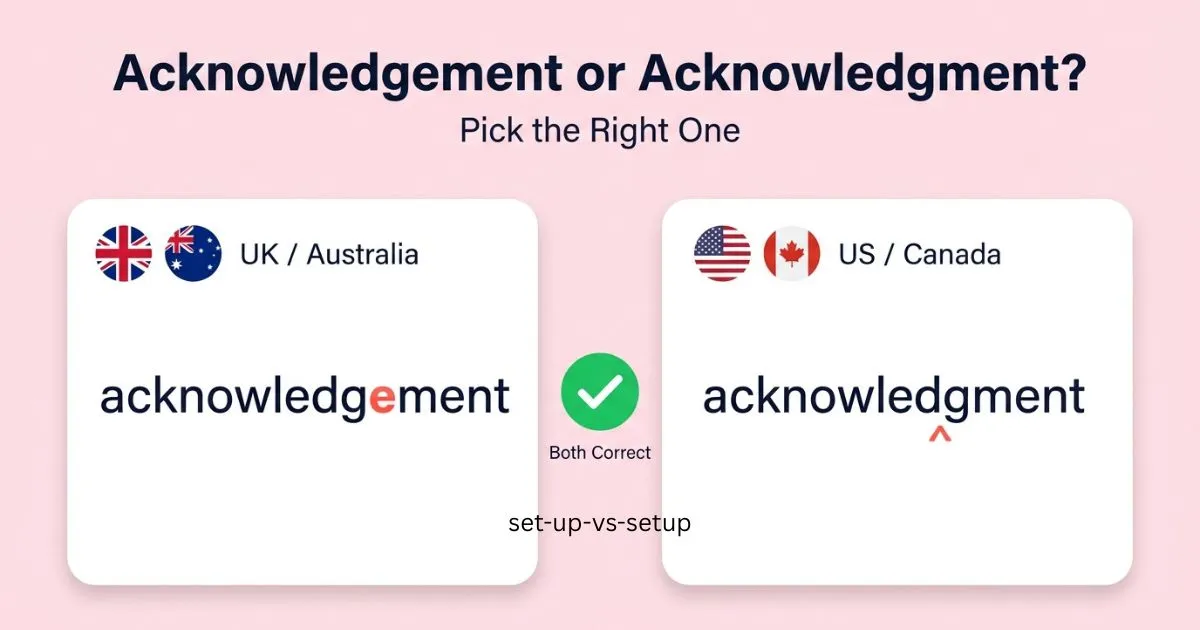
Both forms are standard English. The difference is regional:
- Acknowledgment (no middle “e”) is preferred in the United States and Canada.
- Acknowledgement (with the “e”) is preferred in the UK, Australia, and most of the Commonwealth.
The meaning, the grammar, and the pronunciation are identical. Nobody will misunderstand you because of this single letter.
So the real job is not finding the “correct” spelling. It is choosing the one your reader expects, then using it every time.
| Spelling | Where it is preferred | Example |
| Acknowledgment | U.S., Canada | We received an acknowledgment of our application. |
| Acknowledgement | UK, Australia, Commonwealth | She thanked her supervisor in the acknowledgements. |
Acknowledgement vs Acknowledgment: What’s the Difference?
Honestly, there is no difference in meaning. It is one letter and one regional habit.
The word comes from the verb acknowledge plus the ending -ment. British English usually keeps the silent “e” when the ending is added. American English usually drops it.
That is the whole story. Think of it as two accents written down instead of spoken.
A few more points that help:
- Pronunciation is the same. You can’t hear the difference, so this is purely a writing question.
- Both are accepted in many places. Even where one spelling is preferred, the other is rarely treated as a mistake.
- Only the noun has two spellings. The verb forms are acknowledge, acknowledging, and acknowledged everywhere.
One more small trap: the related adjective is knowledgeable, never “knowledgable.” Dropping that “e” would change how the word sounds.
Read More: Is It All of a Sudden or All of the Sudden? Get It Right
Why Two Spellings Exist
This part surprised me. You would expect the shorter spelling to be a modern American shortcut. But it is not that simple.
According to writing coach Kris Spisak, “acknowledgment” was first recorded in 1567, and it was once the preferred form everywhere, including Britain. Then, in the 1960s, British English moved toward the longer spelling and stayed there. Grammarist adds that both spellings can be found in texts going back to the 16th century.
So the “e” version is not an old British tradition. It is a fairly recent British preference.
The “-ment” pattern
The same split shows up in other words. In each pair below, the first is the usual British choice and the second is the usual American one:
| British | American |
| acknowledgement | acknowledgment |
| judgement | judgment |
| abridgement | abridgment |
| lodgement | lodgment |
| likeable | likable |
| sizeable | sizable |
If you already write judgment the American way, you already know the logic. One tip: UK legal writing uses “judgment” in some specific contexts, so check your field’s conventions before changing it.
Which Spelling Should You Use?
Your audience decides. Here is how to apply that in real situations.
Writing for a U.S. or Canadian audience
Use acknowledgment. This is also the form favored by APA, MLA, and Chicago style, according to Preply.
Writing for a UK or Australian audience
Use acknowledgement. Preply notes that Oxford, Cambridge, Collins, and UK government writing guidance generally lean this way.
Writing under a style guide
Follow it, even if it differs from your habit. A university, journal, or employer that names a style guide has already made the decision for you.
Writing for readers around the world
This is common for bloggers and marketers. The practical advice from LiveXP is to choose the spelling your target readers are most comfortable with. If your audience is mixed, pick one and stay with it.
“But Which One Is More Popular?”
You may see statistics claiming one spelling “wins” online. Be careful here, because sources disagree.
Wordvice reports that “acknowledgment” is the more popular form across the web. YourDictionary, on the other hand, points to Google Trends data showing “acknowledgement” ahead worldwide, and even in the United States.
Grammarist offers a more measured picture. In U.S. and Canadian writing, the “e” version appears about once for every two uses of the no-“e” version. In British and Australian publications, the ratio runs the other way.
What does this tell us? Popularity is messy, but regional preference is stable. Don’t choose by trend. Choose by audience.
What Does “Acknowledgment” Actually Mean?
The word is used in four main ways, based on Grammarist’s breakdown. Examples below use the American spelling, but the British one works identically.
1. Admitting something
- Her acknowledgment of the mistake helped solve the problem quickly.
2. Recognizing someone or something
- He nodded in acknowledgment of her point.
3. A thank-you or token of appreciation
- The team gave her a small gift in acknowledgment of her hard work.
4. Confirmation that something was received
- Please send an acknowledgment once the invoice arrives.
The fourth meaning is especially common in business and legal settings. Preply gives two examples: an acknowledgment of debt and an acknowledgement of receipt. Only the spelling follows the local convention. The meaning stays the same.
Singular, Plural, and the Acknowledgments Page
Grammarist explains that the noun can be uncountable or countable, depending on how you use it.
Uncountable (singular): when you mean the general act of acknowledging.
- The registrar sent an acknowledgment that your documents arrived.
Countable (plural): when you mean separate thank-yous, or the section of a book or paper.
- You are the first person in my book’s acknowledgments.
So when you title the section of your thesis or book, you will usually write Acknowledgments (US) or Acknowledgements (UK). The plural follows the same spelling rule as the singular. If you use “acknowledgements” once, use it everywhere in that document.
Copy-Ready Examples for Real Situations
Reading rules is one thing. Seeing them in use is easier. Here are samples you can adapt. I wrote the same lines in both spellings so you can pick your version.
A thesis or dissertation
- UK / Australia: I owe my deepest thanks to my supervisor, whose patience shaped every chapter. These acknowledgements are a small way to say thank you.
- U.S. / Canada: I owe my deepest thanks to my supervisor, whose patience shaped every chapter. These acknowledgments are a small way to say thank you.
Tip: Keep the section short and specific. Name the person, then say what they actually did.
A book
- UK / Australia: My editor deserves special acknowledgement for believing in this project early on.
- U.S. / Canada: My editor deserves special acknowledgment for believing in this project early on.
A confirmation email
- UK / Australia: This email is an acknowledgement that we have received your application.
- U.S. / Canada: This email is an acknowledgment that we have received your application.
Tip: In professional emails, a clear receipt message saves the sender from worrying and from chasing you.
A cover letter or CV
Here the rule is simple: match the country of the employer. If you are applying to a UK company, use the “e.” For a U.S. company, drop it. If a company has its own style page, follow that.
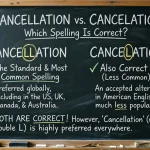
Read More: Cancellation or Cancelation: Which Spelling Is Correct?
Common Mistakes to Avoid
Most problems with this word come down to three things.
1. Calling one spelling a mistake.
Neither form is a misspelling. Each is correct in its own region.
2. Mixing both in one document.
Using “acknowledgment” in paragraph one and “acknowledgement” in paragraph four looks careless to editors, examiners, and hiring managers. Both Preply and LiveXP stress this point.
3. Inventing a new spelling.
Forms like “acknowledgemente” or “acknowledgmente” are not words in any variety of English.
How to Remember Which Is Which
You don’t need to memorize anything complicated. Pick any trick below that clicks.
- The letter trick: American English often uses fewer letters (color vs colour, for instance). QuillBot calls this a good starting point, not a perfect rule, but it does work here.
- The “E” trick: England starts with “E,” and so does the British acknowledgement with its extra “e.” YourDictionary and LiveXP both suggest this one.
- The label trick: Before you start a draft, write “U.S. English” or “UK English” at the top. Preply recommends this habit, and it prevents slips before they happen.
A Simple 4-Step Checklist
Use this the next time you are unsure:
- Check for a style guide. If your school, journal, or employer names one, follow it.
- Identify your reader. North America means no “e.” UK, Australia, and similar regions mean add the “e.”
- Pick one and write it down. Note it at the top of your draft.
- Search before you submit. Look up both versions separately and fix any stray one. A search-and-replace takes seconds.
Why Your Spell-Checker Stays Quiet
Because both spellings are standard, most spell-checkers accept both without complaint. That is why this problem hides so well.
The fix is simple. Set your document’s language to U.S. English or UK English, as Preply suggests. The tool can then flag a switch for you. It won’t catch every slip, so the final search in step 4 is still worth doing.
FAQs
Is it acknowledgement or acknowledgment?
Both are correct. Use “acknowledgment” for American and Canadian readers, and “acknowledgement” for British, Australian, and other Commonwealth readers. The meaning is identical. Choose by audience, and stay consistent throughout your document.
Which spelling is more common?
It depends on the source. One site reports “acknowledgment” as the most popular online, while another cites Google Trends favoring “acknowledgement.” Regional preference is the reliable guide: no “e” in North America, with “e” elsewhere.
Do the two spellings sound different?
No. They are pronounced exactly the same, with the stress on the second syllable. The difference exists only in writing, so you can speak the word confidently whichever spelling you use on paper.
Should I write acknowledgements or acknowledgments in a thesis?
Follow your university’s style guide first. If none is given, match your institution’s region: “acknowledgments” for the U.S. and Canada, “acknowledgements” for the UK and Australia. Use the same form in the heading and the text.
Why does my spell-checker accept both?
Both are standard English spellings, so most tools flag neither. Set your document language to U.S. or UK English so the checker can catch any inconsistency, then do a quick manual search before submitting.
Can I use both spellings in one document?
Avoid it. Mixing spellings looks careless to editors, teachers, and employers, even though each form is correct on its own. Pick one at the start and search for the other before you finish.
Conclusion
The debate over acknowledgement or acknowledgment is smaller than it feels. Both are correct, they mean the same thing, and they sound the same. The only question is who is reading.
Use acknowledgment for North American readers and acknowledgement for readers in the UK, Australia, and similar regions. Follow any required style guide. Then keep your choice consistent from the first line to the last.
Your next step: open your current draft, search for both spellings, and make sure only one survives.

I am an English language writer passionate about grammar and clear communication. I create simple, easy-to-understand content that helps readers improve their English skills. My goal is to make learning English both practical and enjoyable.





3 thoughts on “Acknowledgement or Acknowledgment? Pick the Right One”