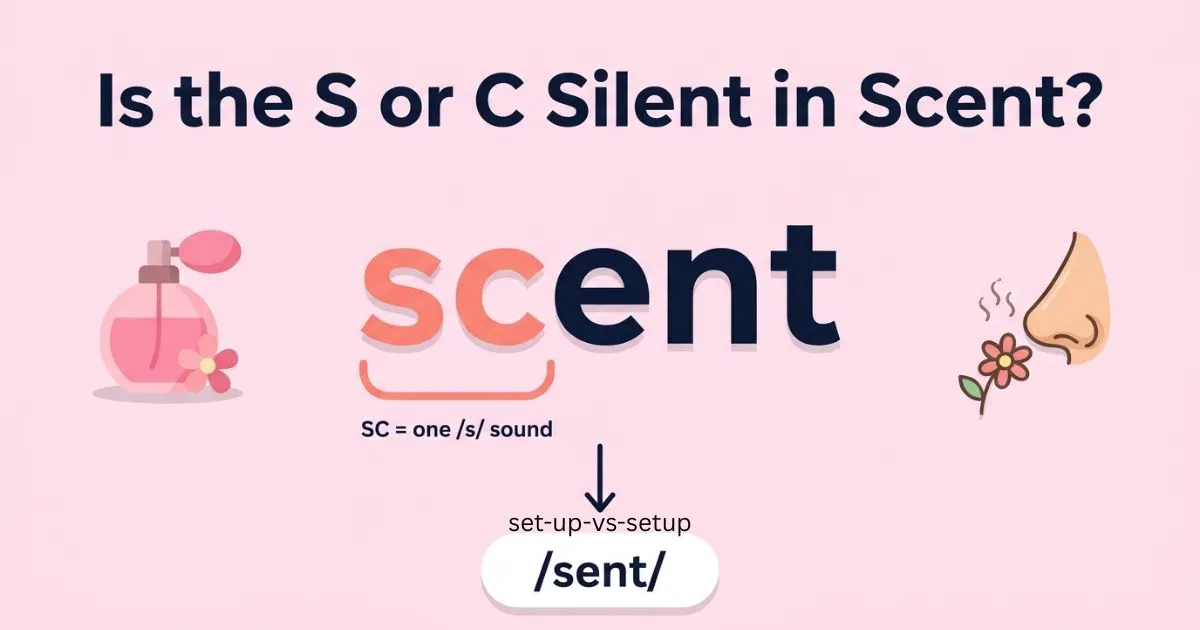
You see the word scent and your brain stalls for a second. Do you say the S? The C? Both?
Maybe you’ve even heard someone say “skent” and wondered whether they had a point.
They didn’t, but the confusion is fair. Scent sounds exactly like sent and cent, yet it carries an extra letter that never gets a sound of its own.
So, is the S or C silent in scent? This guide gives you the short answer, then the real story behind it: how to say the word, where the odd spelling came from, why “sc” behaves differently across English, and how to stop mixing up scent, sent, and cent.
Quick Answer: Is the S or C Silent in Scent?
Say scent as /sent/. It has one syllable and one /s/ sound at the start, with no separate /k/ sound anywhere.
As for which letter is “silent,” the answer depends on how you look at it:
- Phonics view: Neither letter is silent. S and C work together as a digraph, a pair of letters that spells one sound.
- History view: The C is the silent one. It was a latecomer, added to a word that used to be spelled sent.
Both views are fair, and the pronunciation is identical either way. Say /sent/ and you’re right.
How Do You Pronounce Scent?
Scent has five letters but only four sounds:
- /s/ as in sun
- /e/ as in bed
- /n/ as in net
- /t/ as the last sound in cat
Blend them together and you get /sent/. The word is one syllable and rhymes with sent, cent, rent, and went.
English spelling often uses more letters than sounds. The word ship, for example, has four letters but only three sounds, because S and H team up to make one sound. In scent, S and C team up in a similar way.
A quick self-check: say sent out loud, then say scent. If the two sound identical, you’ve got it. Both American and British English pronounce the word this way.
Which Letter Is Really Silent? Three Ways to Look at It
People disagree about this one, and the disagreement is more interesting than it sounds. Here are the three common answers.
The Phonics Answer: Neither Letter Is Silent
Some language experts describe SC in scent as a single unit that spells the /s/ sound. Grammar Girl’s explanation compares it to the SH in shin: some sounds are written with one letter, and others take a combination.
YourDictionary adds a second argument. Before an E, the letter C normally makes an /s/ sound, so in their view the C is doing its usual job rather than staying silent.
The History Answer: The C Is the Uninvited Guest
The Oxford English Dictionary, as quoted by the Boston College Libraries’ Answer Wall, says the sc spelling appears from the mid-1500s and seems to copy words like scene and sceptre. The French word sentir, which scent came from, had no C at all.
From this angle, the C is an uninvited guest that arrived by imitation.
The Practical Answer: It Depends Who’s Asking
If you’re speaking, it doesn’t matter, because you say one /s/ either way. If you’re answering a quiz, check the context. A phonics lesson usually wants “digraph, neither is silent,” while a history-of-English question may want “the C.”
When in doubt, give the pronunciation and the reason. That covers both views.
Read More: Acknowledgement or Acknowledgment? Pick the Right One
Where Did the Extra C Come From?
The story of scent starts with a simple idea: smelling is a kind of sensing. Here’s the path the word took:
- Latin: sentire, to feel or perceive.
- French: sentir, meaning to feel, perceive, or smell.
- Middle English: sent, spelled like sense, with no C.
- Modern English: scent, with the C added hundreds of years after Middle English.
Sources don’t agree on the exact date. The OED note points to the mid-1500s, while YourDictionary says the 17th century. “16th to 17th century” is the safest way to put it.
Why Was the C Added?
Nobody knows for certain, but there are three popular theories:
- Copying scene and sceptre. This is the OED’s suggestion.
- Copying ascent, descent, and ascend. Both YourDictionary and Grammar Girl mention these.
- The rise of science. YourDictionary notes that the word became more influential in 1600s Europe.
Notice what all three theories share: the C came from the way other words looked. It never came from a new sound. That’s why the pronunciation stayed /sent/ while the spelling changed.
Scissors followed a similar path. YourDictionary explains that the word comes from Old French cisoires, and an sc was added in the 15th century to match the Latin root sciss-, meaning “to cut.” Scent isn’t the only word that picked up extra letters later.
Why Does SC Sound Different in Different Words?
If scent is /sent/, why does school start with /sk/? The answer is that sc has had a long and messy history.
Grammar Girl points out that in Old English, sc was usually pronounced like our modern sh. The word shin was spelled scin, and sheath was spelled sceath. Over the centuries, different words took different paths, and borrowings from French, Greek, German, and Yiddish added more variety.
The result is three common outcomes:
| Sound | Example words | Typical background |
| /s/ | scent, scene, science, scissors, discipline, scion, descent, rescind | Often French or Greek roots |
| /sh/ | conscious, fascism, luscious, schnauzer, schtick | Often Italian, Germanic, or Yiddish origins |
| /sk/ | scar, school, scheme, scone, screen | Many came from Greek through French |
A few words wobble between sounds. Schedule is one: the British pronunciation uses /sh/.
A Rule of Thumb That Works Most of the Time
Use these patterns as a guide, not a law:
- SC before E or I usually makes /s/: scent, scene, science, scissors.
- SC before A, O, or U usually makes /sk/: scan, score, scuba.
- SCH is usually /sk/ in words like school, scheme, and schism, but /sh/ in German and Yiddish borrowings like schnauzer and schtick.
- Exceptions exist: conscious and conscientious have /sh/ even though SC is followed by I or E.
When a word feels unfamiliar, don’t guess. A reliable dictionary takes ten seconds and saves the awkward moment.
Scent vs. Sent vs. Cent
These three words are homophones: they sound the same but differ in spelling and meaning. Pronunciation alone can’t tell you which one to write. Meaning has to do that job.
| Word | Meaning | Example |
| scent | a smell or fragrance (as a verb: to detect or give off a smell) | The scent of fresh bread filled the kitchen. |
| sent | past tense of send | She sent me a message. |
| cent | a unit of money | The candy costs fifty cents. |
Three Quick Tests
- Is it about smell? If the sentence involves an aroma, a perfume, or an animal’s trail, use scent.
- Is it about sending? If the present-tense version would be send, use sent.
- Is it about money? If you’re talking about coins or prices, use cent.
A memory trick: scent is just s + cent. Because cent already sounds like /sent/, the extra S adds nothing to the sound. Cover the S and you’re left with cent. Cover the C and you’re left with sent. Either way, the sound doesn’t change.
Common Mistakes (and How to Fix Them)
1. Saying “skent”
Drop the /k/. The word is /sent/, never /skent/.
2. Assuming every SC word has a silent letter
School, scan, and score all have a clear /k/ sound. Check the letter after SC, then check a dictionary.
3. Writing sent when you mean scent
Incorrect: I love the sent of flowers.
Correct: I love the scent of flowers.
Run the three quick tests above if you’re unsure.
4. Looking for a different British pronunciation
There isn’t one for this word. American and British English both say /sent/.
5. Expecting one official answer to the silent-letter question
As you’ve seen, experts frame it differently. Give the pronunciation, then explain your reasoning.
Read More: Students’ or Student’s? The Correct Possessive Form Explained
Practice: Lock It In in Four Steps
- Say the trio. Repeat scent, sent, cent five times. Notice that nothing changes.
- Read aloud. Say each sentence in the next section out loud without pausing on the C.
- Sort ten words. Write scene, school, science, scar, scissors, conscious, scheme, scent, discipline, and screen into three columns: /s/, /sh/, /sk/.
- Look up the leftovers. For any word you’re unsure about, check a dictionary.
Answer key: /s/: scene, science, scissors, scent, discipline. /sh/: conscious. /sk/: school, scar, scheme, screen.
Scent in Real Sentences
As a noun:
- The scent of fresh roses filled the garden.
- She recognized her mother’s familiar scent.
- This candle has a strong vanilla scent.
- The dog followed the scent through the woods.
As a verb:
- The hunter scented a deer nearby.
- She scented the room with fresh flowers.
Scent, sent, and cent together:
- I sent her a perfume with a lovely scent.
- The scented candle cost fifty cents.
Notice how the context tells you which spelling to use.
FAQs
1. Is the S or C silent in scent?
Neither letter has a separate sound. Together, SC spells one /s/, so scent is pronounced /sent/. Some sources call the C silent because it was added to the spelling later, while others call SC a digraph. Both explanations lead to the same pronunciation.
2. How do you pronounce scent?
Say /sent/: one syllable, starting with an /s/ sound and ending with /nt/. It rhymes with sent, cent, rent, and went. Don’t add a /k/ sound, because “skent” is a common mistake. Saying sent slowly, then scent, helps you hear that they’re identical.
3. Why is there a C in scent?
Scent came from French sentir and was first spelled sent, like sense. The C appeared later, probably copied from words like scene, ascent, and descent, or influenced by science. Sources place the change between the mid-1500s and the 1600s, and the exact reason is uncertain.
4. Are scent, sent, and cent homophones?
Yes. All three are pronounced /sent/, but each has its own spelling and meaning. Scent means a smell, sent is the past tense of send, and cent is a unit of money. Use the meaning of the sentence, not the sound, to choose the spelling.
5. Does SC always make an S sound?
No. SC makes /s/ in scent, scene, and science, but /sk/ in school, scan, and score. In a few words, such as conscious and fascism, it makes /sh/. The next letter and the word’s origin both matter, so treat patterns as guides and check a dictionary.
6. Why do some SC words sound like SH?
Grammar Girl notes that Old English sc was usually pronounced like modern sh. YourDictionary adds that /sh/ words such as fascism and schnauzer often come from Italian or Germanic origins. So the sound reflects a word’s history, not a single spelling rule.
7. Is scent pronounced differently in American and British English?
No. Both varieties pronounce it /sent/, so there’s only one version to learn. A few SC words do vary, such as schedule, where the British pronunciation uses /sh/, but that doesn’t affect scent.
Conclusion:
So, is the S or C silent in scent? Pronounce it /sent/ and you’ll always be right. If you want to explain why, say that SC spells one /s/ sound, or that the C is a later addition that never changed how the word sounds.
The bigger lesson is that English spelling carries its history with it. Letters get added, borrowed, and copied, and the sounds don’t always follow.
Your next step: do the ten-word sorting exercise above, then pick three SC words you meet this week and check their pronunciation in a dictionary. That habit will help you far more than memorizing any single rule.

I’m Sophia Mitchell, an English grammar and writing enthusiast. I create simple, easy-to-understand content to help learners improve their English. My goal is to make grammar clear, practical, and enjoyable for everyone.








1 thought on “Is the S or C Silent in Scent? Why It Sounds Like Sent”