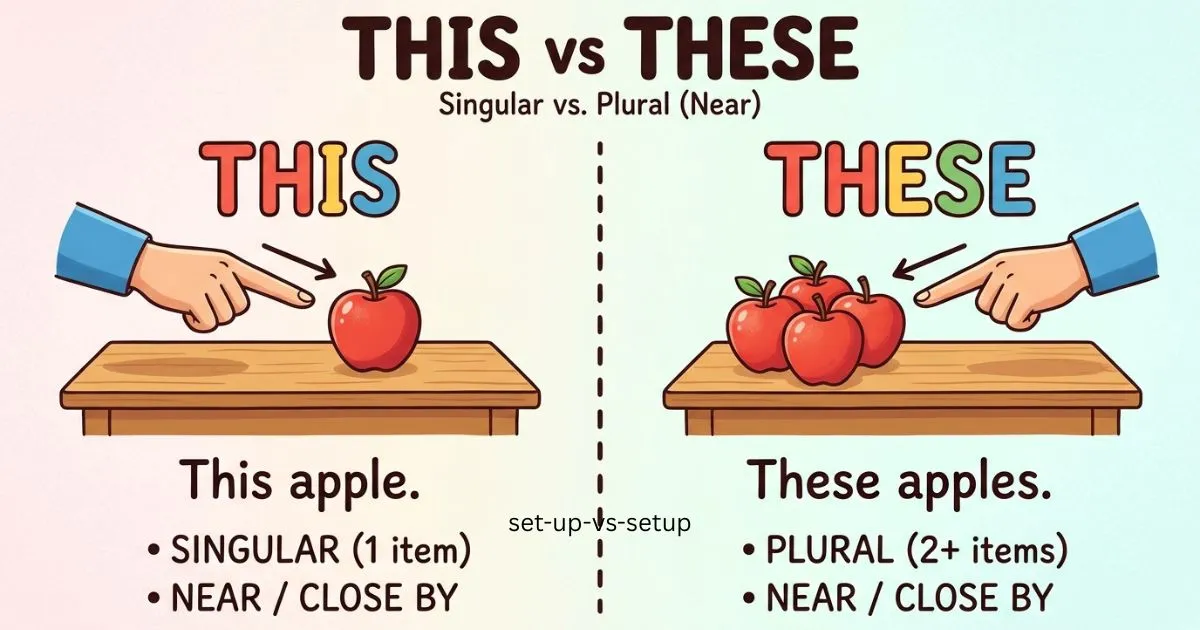
Use this for one thing and these for more than one thing. That is the whole difference.
Picture a text to your new boss: “These is the report you asked for.” One tiny word, and the message sounds off. It happens to everyone, because both words point to something close. Only the number changes.
This points to one thing, like this report. These points to many things, like these reports. A wrong pick can look careless in an email, an essay, or a job application.
Below, you will get the rule, a simple memory trick, and one tricky case, “these kind of,” that trips up even careful writers.
Quick Answer
This is the singular word. Use it for one person, one thing, or an uncountable noun, like “this water.” These is the plural word. Use it for two or more things, like “these books.” Both point to something near you in space, time, or thought.
⚡ One thing gets this, many things get these, and both point to what is near.
What Is the Difference Between This and These?
The difference is number. This is singular and points to one person, one thing, or one idea that is near. These is plural and points to two or more. Both are demonstratives, which means they point out a specific noun.
Think of a demonstrative as a pointing finger. It tells the reader which noun you mean and how many there are. Pick up a pen and you say, “This pen is blue.” Hold three pens and you say, “These pens are blue.”
This and these are the “near” pair. That and those are the “far” pair. Near does not only mean close in space. It can also mean close in time or close in feeling:
- Space: This chair is comfortable. (You are sitting on it.)
- Time: I am busy this week. (The week you are in now.)
- Thought: This idea is new. (The idea you just mentioned.)
Both words can work in two ways. Before a noun, they are determiners, like this phone and these phones. Some books still call them demonstrative adjectives. On their own, they are pronouns, like This is mine and These are mine.
Either way, the number rule stays the same.
Read More: Its vs. It’s: A 5-Second Test to Choose Correctly
The Grammar Rule: Number Decides
Match the word to the noun. Use this with a singular countable noun, like this book. Use these with a plural countable noun, like these books. When the noun is left out, the same rule applies: This is mine. These are mine.
Use three quick steps:
- Find the noun. Look for the person, place, or thing you mean.
- Count it. Is it one, or more than one?
- Pick the word. One gets this. More than one gets these.
The verb must agree too. Use is or was after this. Use are or were after these.
- This phone is new.
- These phones are new.
- This was a good idea.
- These were good ideas.
The same rule works when you introduce people. Say “This is my sister” for one person. Say “These are my cousins” for a group.
This vs These Comparison Table
This and these are near words that differ only in number. This points to one noun, and these points to many. The table below shows how they differ in use, verbs, and examples, plus their far partners that and those.
| This | These | |
|---|---|---|
| Number | Singular | Plural |
| Distance | Near | Near |
| Far partner | That | Those |
| Goes with | One countable noun or an uncountable noun | Plural countable nouns |
| Verb after it | is, was, has | are, were, have |
| Before a noun | This coat | These coats |
| Standing alone | This is warm. | These are warm. |
| Introducing people | This is Sam. | These are my cousins. |
Uncountable Nouns and Special Plurals
Use this with uncountable nouns, which have no plural, like this water or this advice. Use these with nouns that only come in plural form, like these jeans or these scissors. The word follows the noun’s grammar, not the size of what it describes.
Uncountable nouns are things you cannot count one by one. You cannot say “two advices,” so you cannot say “these advice.”
- Correct: This information is useful.
- Wrong: These information are useful.
- Correct: This news is good.
- Wrong: These news are good.
Some nouns are always plural, even when you mean one item. You wear one pair of jeans, but the noun is still plural.
- Correct: These jeans are too long.
- Correct: This pair of jeans is too long.
- Wrong: This jeans is too long.
Two more traps are worth knowing:
- Many small parts, one mass. Rice is uncountable, so say “this rice.” Say “these grains” if you count them.
- The word data. You will see both “this data” and “these data.” Check the style guide your school or company uses.
This Kind Of vs These Kinds Of
Use this kind of or these kinds of. Both patterns are correct. Kind is singular, so it takes this. Kinds is plural, so it takes these. In careful writing, avoid mixing them, as in these kind of.
This is the most common slip with these two words. Many writers match the word to the noun at the end of the phrase. The word actually points at kind, type, or sort.
- This kind of book is rare. (one kind)
- These kinds of books are rare. (more than one kind)
- This type of problem is common.
- These types of problems are common.
| Safe in any writing | Avoid in formal writing |
|---|---|
| this kind of dog | these kind of dogs |
| these kinds of dogs | this kinds of dog |
| this type of problem | these type of problems |
| these sorts of problems | these sort of problems |
You may think “these kind of” is just a modern mistake. It is not. Dictionary.com says it is an old pattern that still appears in informal speech and writing. In edited, formal prose, though, this kind of and these kinds of are more common.
For tests, essays, and work emails, pick the safe column.
Here is a trick for tricky sentences. Flip the phrase: “Problems of this kind are common.” It avoids the choice completely.
Memory Tricks
Link each word to its verb: this is, these are. Say the pair out loud until it sounds natural. If you can replace the noun with it, use this. If you can replace it with they, use these.
Try these three tricks:
- The verb pair. Say “this is” and “these are” ten times. Your ear will start to catch “these is” as wrong.
- The swap test. Replace the noun with a pronoun. “This pen” becomes it. “These pens” becomes they. The pronoun tells you which word to use.
- The touch test. Touch one object and say this. Wave at a group and say these.
One more clue sits in the spelling. This ends in is, and is is the singular verb. These is the longer word, and it points to the longer list.
20 Example Sentences With This and These
Good examples show the rule in action. Read each pair out loud. Notice how the noun and the verb change with the pointing word. The sentences below are grouped by how the words are used.
This before a noun
- This jacket is warm.
- I love this song.
- Please read this email before the meeting.
- This answer is correct.
- My brother lives in this city.
These before a noun
- These jackets are on sale.
- These songs remind me of school.
- Please read these emails before the meeting.
- These answers are correct.
- These cities are very busy.
Standing alone as pronouns
- This is my teacher, Ms. Lee.
- These are my notes from class.
- Did you write this?
- I bought these yesterday.
Uncountable and plural-only nouns
- This advice saved my job.
- This news made her smile.
- These scissors are sharp.
Time, habits, and kinds
- I am studying hard this month.
- These days, most people read the news online.
- This kind of mistake is easy to fix, and these kinds of mistakes are common.
Common Mistakes
The top mistakes are using these with a singular noun, using this with a plural noun, and mixing kind with these. Also watch for uncountable nouns like advice and news. Each mistake comes from matching the word to the wrong noun.
| Wrong | Right | Why |
|---|---|---|
| These is my bag. | This is my bag. | Bag is one thing. |
| This books are old. | These books are old. | Books is plural. |
| These kind of movies | These kinds of movies | Kinds is plural. |
| These advice helped me. | This advice helped me. | Advice is uncountable. |
| This jeans are new. | These jeans are new. | Jeans is always plural. |
| This news are bad. | This news is bad. | News is uncountable. |
A sound mix-up can also cause errors. This has a short i and ends with an s sound. These has a long ee sound and ends with a z sound. If you hear the long ee, think plural.
Finally, do not add s to the noun after this. “This books” is always wrong. Say “this book” or “these books.”
When to Use Each Form
Use this when you mean one person, one thing, one idea, or an uncountable mass. Use these when you mean two or more countable things. When unsure, count the noun or try the it-or-they swap test.
Use this when you are pointing to:
- One item you can see or touch: this cup
- One idea you just mentioned: This is why we moved.
- A period of time that includes now: this year
- An uncountable noun: this music, this water, this help
Use these when you are pointing to:
- Two or more items you can see or touch: these cups
- Several ideas you just listed: These are the reasons we moved.
- A plural-only noun: these glasses, these pants
- A group of people: these students, these customers
If the thing is far away, switch to the far pair. Use that for one thing and those for many: that house, those houses. This and these are for what feels near. That and those are for what feels far.
Key Takeaways
- This is singular. These is plural.
- Both are “near” words. That and those are the “far” pair.
- Match the verb: this is, these are.
- Uncountable nouns take this: this advice, this news, this water.
- Plural-only nouns take these: these jeans, these scissors.
- Write this kind of or these kinds of. Avoid these kind of in formal writing.
- Use the swap test: it means this, and they means these.
FAQs
What is the difference between this and these?
This is singular, and these is plural. Use this for one person, thing, or idea that is near. Use these for two or more. Both are demonstratives, so they point out a specific noun. Example: “This pen is mine. These pens are yours.”
Is it “this is” or “these is”?
Say “this is” for one thing and “these are” for more than one. “These is” is a grammar error, because these is plural and is is singular. Fix it by matching the verb: “This is my bag. These are my bags.”
Can I use this with a plural noun?
Not usually. This goes with singular and uncountable nouns, like this book or this advice. Plural nouns take these, as in these books. A singular noun that names a group, like this team or this class, still takes this.
Is “these kind of” correct?
It is common in speech, but careful writers avoid it. Kind is singular, so match it with this: “this kind of movie.” Or make both plural: “these kinds of movies.” Dictionary.com says the mixed form is old but is often seen as informal.
What is the difference between these and those?
Both are plural. These points to things that are near, and those points to things that are far. Say “these shoes” for the pair on your feet. Say “those shoes” for the pair across the room.
Are this and these pronouns or adjectives?
They can be both. On their own, they are demonstrative pronouns: “This is mine.” Before a noun, they are often called demonstrative adjectives or determiners: “This phone is mine.” The number rule is the same in both roles.
Do I say “this people” or “these people”?
Say “these people.” People is a plural noun, so it takes these. Use “this person” for one individual.
Is it “this data” or “these data”?
Both appear in real writing. Some style guides treat data as plural and prefer “these data.” Others treat it as a mass noun and accept “this data.” Follow the guide your school, journal, or company uses, and stay consistent.
What do “these days” and “those days” mean?
“These days” means the present time, like “nowadays.” “Those days” points back to a past period, like “In those days, we had no phones.” Use these for now and those for then.
Can this point to a whole idea or sentence?
Yes. This often points back to an idea you just stated. For example: “Prices rose again. This is why many people shop online.” Use these when you point back to a list of ideas: “These are the main reasons.”
Conclusion:
Use this for one thing and these for more than one. Keep the verb pair in mind: this is, these are. Use this with uncountable nouns like advice and news.
Use these with plural-only nouns like jeans and scissors. With kind, type, or sort, match the pointing word to that noun: this kind of, these kinds of.
When you are unsure, count the noun or swap in it or they. That check settles almost every sentence.

As an American English writer, I specialize in creating clear and engaging content that makes grammar and language learning accessible to everyone. I enjoy breaking down complex English concepts into simple, practical lessons that readers can apply with confidence. My mission is to help learners strengthen their communication skills through easy and reliable content.