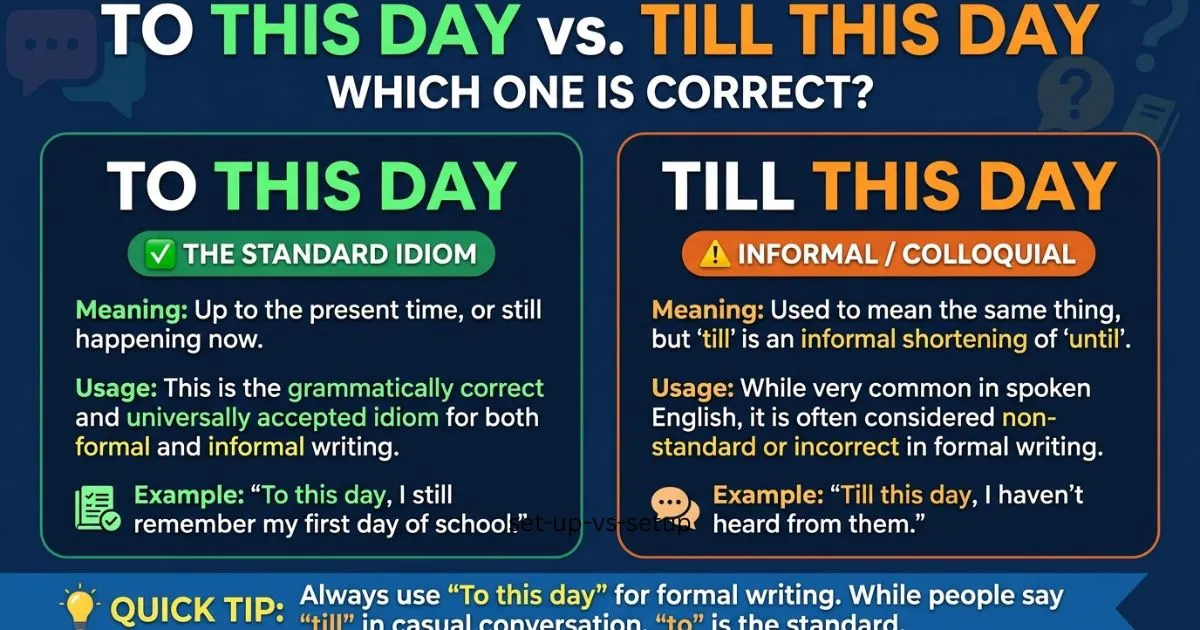
Use “to this day.” “Till this day” is understood, but it is not the standard phrase.
Maya wrote a college essay about her grandmother’s kitchen. Her last line read, “Till this day, I can smell her bread.” Her tutor circled “till” and wrote one word: “to.”
Was the tutor right? Mostly, yes. “Till” is a real word. It means “until.” So “till this day” is not a grammar error.
The problem is the phrase itself. English speakers lock this idea into one fixed idiom: “to this day.” This guide shows why, when “till” works, and how to pick the right form in seconds.
Quick Answer
“To this day” is the standard idiom. It means “up to now” and shows that something is still true. “Till this day” uses “till” as a synonym of “until.” It is grammatical and easy to understand, but it sounds unusual to many readers. In essays, emails, and exams, choose “to this day.”
⚡ Quick Rule in 1 Line
Write “to this day” and your reader never blinks; “till this day” makes them pause.
To This Day vs Till This Day: The Short Difference
“To this day” is the standard idiom for “up to now.” “Till this day” swaps in “till,” a real word that means “until.” The grammar holds up, but the phrase is not the form readers expect.
Think of “fish and chips.” You could say “chips and fish,” and people would understand. But the first version is the one everyone knows. Fixed phrases work the same way.
Merriam-Webster lists “to this day” as an idiom. We found no major dictionary that lists “till this day” as its own idiom. That gap is the whole story.
Here is a side-by-side look.
| Feature | To this day | Till this day |
|---|---|---|
| Meaning | Up to now | Up to now |
| Standard idiom? | Yes, listed by Merriam-Webster | No dictionary entry found |
| Grammar | Correct | Correct (till = until) |
| Tone | Neutral, works anywhere | Informal, can look like a slip |
| Best use | Essays, emails, exams, stories | Casual speech, quick chat |
| Safe for tests and formal work? | Yes | Not recommended |
The meaning is the same in both. The difference is how natural each one sounds.
This is not a US vs UK spelling issue. We found no sign that the choice changes by region. Use “to this day” everywhere.
Read More: Till This Day or To This Day? The Answer + 20 Examples
What “To This Day” Means
“To this day” means “up to now” or “even now.” It tells readers that something started in the past and is still true. It often shows a lasting effect, such as a memory, a habit, or an unsolved mystery.
The phrase links the past to the present in three common ways.
- Memories: “To this day, I remember the smell of her kitchen.”
- Habits: “He still wears his father’s watch to this day.”
- Open questions: “To this day, nobody knows who sent the letter.”
In each case, something began long ago. It has not stopped.
You can place the phrase at the start or the end of a sentence. At the start, add a comma after it. At the end, no comma is needed.
- Start: “To this day, she writes him a card every year.”
- End: “She writes him a card every year to this day.”
The phrase also pairs well with “even.” “Even to this day” adds extra weight. It says, “This is still true, and that may surprise you.”
Is “Till This Day” Wrong?
Not exactly. “Till” is a real word that means “until,” so the grammar is fine. The trouble is idiom, not grammar. “To this day” is the set phrase, and a different word in the middle can look like a slip.
Merriam-Webster says “until” and “till” can be used freely and interchangeably. So “till this day” breaks down to “until this day.” That is a clear, correct phrase.
So why does it sound off? Because we learn idioms as one chunk. We do not build them word by word. When one word changes, the chunk breaks.
You will still see “till this day” in casual talk and online posts. In those places, nobody minds. The risk shows up when a teacher, editor, or hiring manager reads your work.
Here is a simple test. If a reader might pause or smile, change it. “To this day” never causes that pause.
Till vs Until vs ’Til
“Till” and “until” mean the same thing. Both mean “up to a point in time.” Merriam-Webster says you can use them freely. Avoid “’till.” Use “’til” only in casual writing.
Many people think “till” is a short form of “until.” It is not. “Till” is actually the older word. That is why it needs no apostrophe.
Grammarly notes that “until” often feels slightly more formal. But “till” is still correct, even in formal writing.
| Form | Status | Example |
|---|---|---|
| until | Standard, slightly more formal | “Wait here until the bell rings.” |
| till | Standard, older, feels more casual | “We practiced till our hands hurt.” |
| ’til | Informal shortening | “See you ’til then.” |
| ’till | Avoid | Not recommended |
So “till” is not the problem in “till this day.” The problem is that this idiom already has a fixed form.
Why “To” Works in This Idiom
In this idiom, “to” means “up to the point of.” It works like “to date,” “to the end,” and “to the present.” The phrase points at today as the end of a long line of time.
Think of a road. The past is the start. Today is the end. “To” draws the line between them.
Other common phrases use “to” the same way.
- to date
- to the present
- to this very moment
- from start to finish
They all treat “to” as an endpoint marker. So “to this day” fits a pattern English already uses.
Now compare “till.” In most sentences, “till” marks a time limit. “Wait till five.” “Stay till you finish.” It sets a deadline or a stopping point.
“To this day” does a different job. It does not set a limit. It shows that something is still true. That is why the idiom stays with “to.”
Related Phrases Compared
Several phrases mean “up to now.” “To this day” is the strongest for lasting effects. “Until now” and “so far” are plainer. “To date” suits reports and data. Pick the phrase that matches your tone and topic.
| Phrase | Meaning | Tone | Verdict |
|---|---|---|---|
| to this day | Up to now, still true | Neutral | Best for stories, essays, emails |
| until this day | Up to now | Plain | Correct, but not the set idiom |
| up to this day | Up to now | Plain | Correct |
| up till this day | Up to now | Casual | Correct, informal |
| till today | Up to now | Casual | Correct, informal |
| to date | Up to now | Formal | Best for reports and résumés |
| till date | Up to now | Casual | Many editors prefer “to date” |
| so far | Up to now | Casual | Good for progress updates |
Notice the pattern. “To this day” carries feeling. “To date” carries facts.
A résumé line shows the difference. “I have led 12 projects to date” sounds right. “I have led 12 projects to this day” sounds dramatic.
And “till date” is common in some regions. Many editors still prefer “to date,” so it is the safer choice in professional writing.
Memory Trick
Ask one question: is this a time limit or a lasting effect? A time limit takes “till” or “until.” A lasting effect takes the fixed idiom “to this day.” Say it as one chunk, and you will not mix it up.
Here is a quick way to remember it.
- Clock words: “Wait till five.” Use till or until.
- Lasting-effect words: “To this day, I remember.” Use the idiom.
Another trick: say the idiom out loud three times. “To this day. To this day. To this day.” Idioms stick through sound, not rules.
Or picture a road sign. It reads, “To This Day.” You never see a sign that reads “Till This Day.”
20 Real Example Sentences
These examples show the standard idiom, the informal version, and the normal time-limit use of “till” and “until.” Read them aloud. The right pattern is easy to hear.
A. “To this day” (the standard idiom)
- To this day, I still keep her first letter.
- The recipe stays a secret to this day.
- He has never forgiven the mistake, even to this day.
- The old bridge stands to this day.
- To this day, nobody knows who sent the package.
- My brother sleeps with a night light to this day.
- The town holds the festival to this day.
- To this day, she thanks her first teacher.
- The rule has not changed to this day.
- We laugh about that trip to this day.
B. “Till this day” (understood, but informal)
- Till this day, I can’t hear that song without smiling.
- She has kept that coat till this day.
- Till this day, they haven’t called back.
- He remembers the smell till this day.
All four are understandable. For essays, work, or tests, switch each one to “to this day.”
C. “Till” and “until” as time limits
- Wait here until the bell rings.
- We practiced till our hands hurt.
- The store stays open until 9 p.m.
- I will not stop till I finish.
- Please stay seated until further notice.
- They danced till midnight.
Notice the difference. In group C, each sentence sets an end point. In group A, each sentence shows something still true now.
Common Mistakes
Most mistakes come from mixing the idiom with other time words. Keep the phrase whole, keep the verb ongoing, and check your commas. These six slips come up again and again.
1. Using “till this day” in formal writing
- Risky: “Till this day, the policy remains in place.”
- Better: “To this day, the policy remains in place.”
2. Using “’till” or “’til” in serious writing
Merriam-Webster advises avoiding “’till.” Use “until” or “till” instead.
- Wrong: “We waited ’till noon.”
- Right: “We waited until noon.”
3. Stacking time words
Do not add a second time word to the idiom.
- Wrong: “Until to this day, he is angry.”
- Right: “To this day, he is angry.”
4. Using the idiom for a finished event
“To this day” needs something still true now. It does not fit a one-time event that ended.
- Wrong: “She visited Paris to this day.”
- Right: “She has never visited Paris, even to this day.”
5. Changing “day” to “days”
Learners sometimes write “to these days.” The idiom uses the singular: “to this day.”
6. Forgetting the comma at the start
When the phrase opens a sentence, a comma helps the reader.
- Better: “To this day, I still remember.”
- Weaker: “To this day I still remember.”
When to Use Each Form
Use “to this day” in almost every setting. Save “till this day” for casual talk or for dialogue in fiction, where a speaker sounds relaxed. When time is a limit, choose “until” or “till.”
| Situation | Best choice | Why |
|---|---|---|
| School essay or exam | To this day | Standard idiom, no risk |
| Work email or report | To this day or to date | Neutral and clear |
| Blog post or story | To this day | Natural and familiar |
| Text message or chat | Either one | Readers will understand |
| Fiction dialogue (casual speaker) | Till this day | Matches how some people talk |
| Saying a deadline | Until or till | Marks a time limit |
If you are unsure, pick “to this day.” It works everywhere.
One more tip for ESL learners. Learn idioms as whole chunks. Write “to this day” on a flashcard as one unit. That way you never rebuild it word by word.
Key Takeaways
- “To this day” is the standard idiom for “up to now.”
- “Till this day” is understood and grammatical, but not the set phrase.
- “Till” and “until” mean the same thing. “Till” is the older word.
- Avoid “’till.” Use “’til” only in casual writing.
- Use “to this day” for lasting effects. Use “until” or “till” for time limits.
- Add a comma when the phrase opens a sentence.
- For reports and résumés, “to date” often works better.
- When unsure, choose “to this day.”
FAQs
1. Is it “to this day” or “till this day”?
Use “to this day.” It is the standard idiom listed by Merriam-Webster. “Till this day” is understood but less natural.
2. Is “till this day” grammatically correct?
Yes, the grammar works. “Till” means “until.” But the phrase is not the set idiom, so it can look like a mistake.
3. What does “to this day” mean?
It means “up to now” or “even now.” It shows that something from the past is still true.
4. Can I say “until this day”?
Yes. It is correct and clear. But “to this day” is still the idiom most readers expect.
5. Is “till” short for “until”?
No. “Till” is actually the older word. It is a full word on its own and needs no apostrophe.
6. Is “’til” correct?
It is an informal shortening. Merriam-Webster says to use it with care and avoid “’till.” In serious writing, choose “until” or “till.”
7. Do I need a comma after “to this day”?
Usually yes, when the phrase starts a sentence. At the end of a sentence, no comma is needed.
8. What is the difference between “till today” and “to this day”?
“Till today” marks a plain time limit. “To this day” stresses that something is still true now.
9. Is “to this day” formal or informal?
It is neutral. It works in essays, emails, stories, and speech.
10. Is “till date” correct, or should I write “to date”?
Many editors prefer “to date.” It is the safer choice for reports, résumés, and professional emails.
Conclusion:
The answer is simple. Use “to this day.” It is the standard idiom, and readers recognize it right away.
“Till this day” is not a grammar disaster. “Till” really does mean “until.” But idioms live as fixed chunks, and this one has a fixed form.
So save “till” and “until” for time limits. Use “to this day” when something is still true now. That one habit keeps your writing clean and natural.

I am an English language writer passionate about grammar and clear communication. I create simple, easy-to-understand content that helps readers improve their English skills. My goal is to make learning English both practical and enjoyable.






1 thought on “To This Day vs Till This Day: Which One Is Correct?”