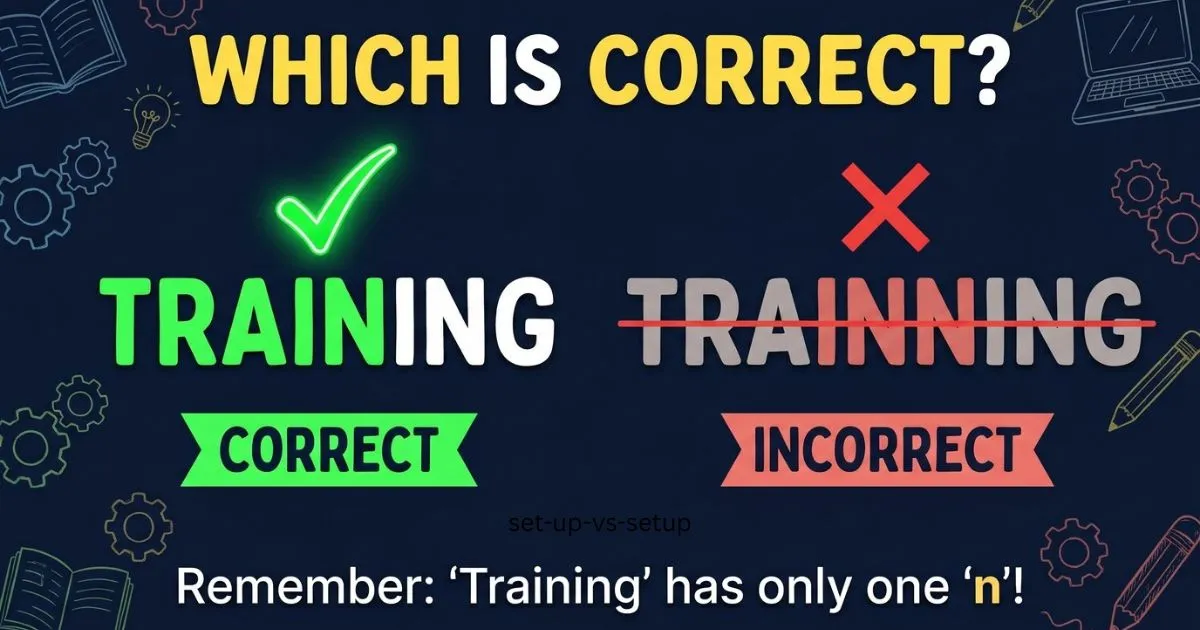
Training is the only correct spelling. “Trainning” with a double N is always a typo, in both US and UK English.
Picture a job application that says, “Completed trainning in customer service.” The hiring manager spots the extra N right away. Now she wonders what else was missed.
It is a tiny slip, but it is easy to make. Many words double their last letter before -ing, so your brain guesses that “train” does too. It does not.
In this guide, you will learn why “training” has one N, how the doubling rule works, and how to never mix it up again.
Quick Answer
The correct spelling is training, with one N in the middle. It comes from the verb train plus the ending -ing. Trainning is a misspelling in both American and British English. There is no regional spelling difference for this word, so use training everywhere.
⚡ Quick Rule in 1 Line
Train already has two vowels in the middle, so just add -ing and keep one N: training.
Training vs Trainning: What Is the Difference?
“Training” is a real English word. “Trainning” is not a word at all. It is a spelling mistake. No major dictionary lists it, so you should never use it in school, work, or online writing.
This makes “training” different from many other US and UK spelling pairs. With words like color and colour, both spellings are correct somewhere. Here, only one spelling is correct everywhere.
Merriam-Webster defines training as the act, process, or method of teaching someone a skill. It also covers the skill or knowledge a person gains. Oxford Learner’s Dictionary describes it as the process of learning the skills you need to do a job.
So what does the word mean in daily life? Here are the most common uses:
- Job training: learning the skills needed for work, such as first aid or customer service.
- Sports training: preparing the body for a game or race.
- Animal training: teaching a pet or working animal new behavior.
- Training as an adjective: words like training shoes, training manual, or training session.
In all these cases, the spelling stays the same: t-r-a-i-n-i-n-g. Eight letters, one N in the middle.
Why Training Has Only One N (The Grammar Rule)
The word training is the verb train plus the ending -ing. English only doubles the last letter in certain cases. The word train does not fit those cases, so the N stays single.
Here is the rule most spelling guides teach. Double the last consonant before -ing when all three things are true:
- The word has one syllable (or the stress falls on the last syllable).
- The word ends in one vowel followed by one consonant.
- The ending starts with a vowel, like -ing or -ed.
Let us test a few words:
- run → running (one vowel u, one consonant n. Double it.)
- sit → sitting (one vowel i, one consonant t. Double it.)
- stop → stopping (one vowel o, one consonant p. Double it.)
Now test train. It ends in a-i-n. That is two vowels followed by one consonant. The rule only works for one vowel. So you do not double the N.
The same is true for many similar words:
- rain → raining
- wait → waiting
- explain → explaining
- remain → remaining
- gain → gaining
- complain → complaining
None of these have a double N. “Training” follows the exact same pattern.
Why Do People Still Write “Trainning”?
There are three common reasons.
First, the sound. Say the word out loud: TRAY-ning. Some people stress the middle sound, which makes it feel like it needs two Ns.
Second, the pattern of other words. We write running, winning, and planning with double letters. The brain copies that pattern without checking the vowels.
Third, typing speed. The N key is easy to hit twice. Autocorrect usually fixes it, but not always.
Is Training Spelled Differently in US and UK English?
No. American and British English both spell it training. Dictionaries that show both versions list the same word with the same letters. Only the way people say it can differ slightly.
This matters because many spelling pairs on this site do change by region. Examples are color and colour, or gray and grey. Learners often assume every tricky word follows that split.
“Training” does not. If you see “trainning,” it is not a UK spelling. It is simply an error.
There is one small US vs UK note linked to this word. The Oxford Learner’s Dictionary shows that program is the North American spelling and programme is the British one for a learning plan. So you may see:
- US: a training program
- UK: a training programme
The word training stays the same in both. Only the word next to it changes.
According to Cambridge English, either American or British spelling is accepted in its writing tests. You just need to stay consistent in one piece of writing. For training, that choice does not even come up.
Comparison Table
| Spelling | Correct? | Why | Example |
|---|---|---|---|
| training | ✅ Yes | Train + -ing. No doubled N. | She starts training on Monday. |
| trainning | ❌ No | The N is doubled by mistake. | |
| trainings | ✅ Yes (plural) | Used for separate sessions or courses. | We run two trainings each month. |
| traning | ❌ No | The letter I is missing. | |
| trainig | ❌ No | The letter N is missing before G. | |
| trainer | ✅ Yes | A person who trains others. | My trainer is very kind. |
| trainor | ❌ No (surname only) | Not the standard spelling for the noun. |
US vs UK check: training is identical in both. Only program (US) and programme (UK) differ nearby.
Easy Memory Tricks
The easiest way to remember is to look at the middle of the word. Training has one N after the letters A and I. Use one of these quick tricks and the spelling will stick.
Trick 1: The AI rule. Whenever you see ai before the last consonant, do not double it. Think: rain, wait, train. All stay single.
Trick 2: Count the Ns. Training has only one N between “trai” and “ing.” Think of it as TRAIN + ING. You are only adding three letters at the end.
Trick 3: Say it in two parts. Say “train” and then “ing.” Write each part. You will not add a second N because “train” is already complete.
Trick 4: A train has one engine. A train pulls cars on a track. In the same way, this word has one N pulling the ending along. Silly, but it works.
Trick 5: Compare with run. Run becomes running because the vowel is alone. Train has a vowel buddy (the A and I travel together), so it stays single.
Pick the one that feels natural. Say it out loud twice, then write the word three times. That is usually enough.
20 Example Sentences
Seeing the word in real sentences helps your eyes and brain remember it. Read these out loud, and notice the single N every time.
General and US Usage
- I signed up for safety training at work.
- She is in training for her first marathon.
- The new hires start training on Monday.
- Our training program lasts six weeks.
- He went to flight training in Texas.
- Online training saves our team a lot of time.
- The coach changed the training plan.
- Dog training takes patience and treats.
- Her training as a nurse began in 2019.
- We offer free training for volunteers.
UK Usage
- The training programme runs every autumn.
- He is in training for the London Marathon.
- She finished her teacher training last year.
- The firm paid for his training course.
- Our training college is near the station.
Related Forms
- The company runs three trainings each month.
- The trainer gave clear instructions.
- Every trainee gets a printed manual.
- They train every morning before work.
- She was training her puppy to sit.
Notice that sentences 1 to 15 all use the same spelling. The region changes only words like program and programme. The word training never changes.
Common Mistakes
The most common mistake is writing “trainning” with two Ns. But it is not the only one. Here are the errors writers make most often, and how to fix each one.
Mistake 1: Doubling the N
- ❌ The trainning starts at 9 a.m.
- ✅ The training starts at 9 a.m.
Fix: Remember the AI rule. Words ending in ai + consonant do not double.
Mistake 2: Dropping a Letter
- ❌ Her traning was excellent.
- ✅ Her training was excellent.
Fix: Say the word slowly. You can hear the “ay” sound, so keep the A and the I.
Mistake 3: Writing “Trainig”
- ❌ Fire safety trainig is required.
- ✅ Fire safety training is required.
Fix: Both letters N and I come before G. Think train + ing.
Mistake 4: Mixing Up Trainer and Trainor
- ❌ The trainor will arrive at noon.
- ✅ The trainer will arrive at noon.
Fix: The standard noun is trainer. Trainor is mostly seen as a surname. Neither trainer nor trainee has the letter O.
Mistake 5: Using “Trainings” Without Need
The word training is usually uncountable, like advice or information. So “We need more training” sounds natural. However, trainings is accepted when you mean separate sessions or courses, such as “Two trainings are scheduled this week.”
If you are unsure, use training sessions or training courses. This is always safe.
Mistake 6: Trusting Spell Check Too Much
Most word processors catch “trainning.” But a text message, a social media post, or a hand-written note may not. Always give important writing a quick final read.
When to Use Each Form: Train, Training, Trainings, Trainer, Trainee
Use train as the verb, training as the noun or adjective, trainer for the teacher, and trainee for the learner. All of these keep the same base: t-r-a-i-n. Only the ending changes.
Train (verb)
Use it when someone is doing the action. Examples: I train every day. They train new staff.
Training (noun or adjective)
Use it for the process or the skill. It can also describe another noun. Examples: The training was useful. Bring your training shoes.
Training (verb form, present participle)
Use it with is, are, or was. Example: She is training for a race.
Trainings (plural noun)
Use it when you mean separate events. Example: The HR team held two trainings last month. In formal writing, training sessions is often clearer.
Trainer (person)
This is the person who gives the training. It can be a coach, a teacher, or a fitness expert. In British English, trainers can also mean sneakers.
Trainee (person)
This is the person who receives the training. Example: Every trainee must sign the form.
Key Takeaways
- Training is the only correct spelling. Trainning is always wrong.
- The spelling is the same in American and British English.
- Train has two vowels (ai), so the N is not doubled before -ing.
- Doubling only happens with one vowel plus one consonant, like run → running.
- Similar words stay single: rain → raining, wait → waiting.
- Use trainer for the teacher and trainee for the learner. Avoid trainor.
- Program is the US spelling and programme is the UK spelling for a learning plan.
- Trainings is acceptable for separate sessions, but training sessions is clearer.
FAQs
1. Is it training or trainning?
The correct spelling is training, with one N in the middle. “Trainning” is a common typo. It is not accepted in American English, British English, or any other major form of English.
2. Does training have one N or two?
Training has one N in the middle and one N at the end of “train.” You see it written as t-r-a-i-n-i-n-g. The ending -ing adds the second N sound, but there is no double N in the middle.
3. Why is training not spelled with a double N?
The doubling rule only works for words that end in one vowel plus one consonant, like run or sit. The word train has two vowels before the N (ai). So the N stays single when you add -ing.
4. Is trainning a British spelling?
No. British English also spells the word as training. Dictionaries that list both American and British entries show the same spelling. “Trainning” is a mistake in every region.
5. What is the difference between training and trainings?
Training is the normal form and is usually uncountable. Trainings is a plural used for separate sessions or courses. Many style guides prefer training sessions in formal writing, because it avoids any doubt.
6. Is it “training program” or “training programme”?
Both are correct, depending on region. Program is the North American spelling. Programme is the British one. The word training itself stays the same in both.
7. Is training a noun or a verb?
It can be both. As a noun it means the process of learning a skill: “The training was helpful.” As a verb form, it follows is or was: “She is training her dog.” It can also act like an adjective, as in training shoes.
8. How do you spell trainer and trainee?
The correct spellings are trainer (the teacher) and trainee (the learner). Both start with train. A common mistake is trainor, which is mainly a surname and not the standard spelling for the noun.
9. How can I remember how to spell training?
Think TRAIN + ING. The word train already has two vowels (ai), so you do not double the N. Compare it with rain → raining and wait → waiting. They follow the same pattern.
10. Will spell check catch trainning?
Most word processors will mark it, but you should not rely on them alone. Text messages, social posts, and handwritten notes often have no spell check. A quick final read is the safest way to catch it.
Conclusion:
The answer is simple: training is correct, and trainning is always a mistake. It does not matter if you write for a US or UK audience. The spelling is the same.
The word is just train plus -ing. Because train has two vowels before the final N, you do not double it. Think of rain → raining and you will get it right every time.

As an American English writer, I specialize in creating clear and engaging content that makes grammar and language learning accessible to everyone. I enjoy breaking down complex English concepts into simple, practical lessons that readers can apply with confidence. My mission is to help learners strengthen their communication skills through easy and reliable content.







1 thought on “Training or Trainning? Which Spelling Is Correct?”