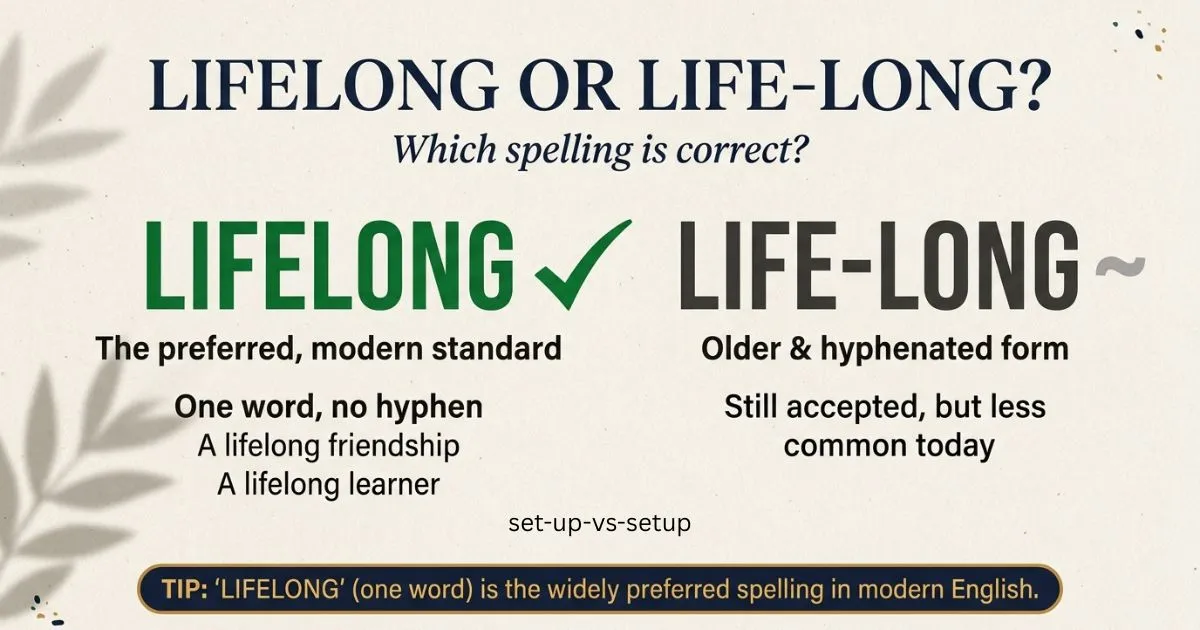
You typed “a life-long dream” on your resume, and something still looked off. Use lifelong, one word, with no hyphen and no space. It is the standard spelling in both US and UK English.
Here is why people get stuck. English has many compound words, such as everyday, long-term, and yearlong.
There is no tidy rule for all of them. But this one is easy. Merriam-Webster lists lifelong as the main entry. The hyphenated life-long is a rare variant. The two-word life long is an error.
This guide gives you the rule, the reason behind it, and plenty of examples.
Quick Answer
Write lifelong as one word. It is an adjective that means lasting through a whole life, as in “a lifelong friend.” Merriam-Webster’s entry is lifelong. Life-long is a rare variant, and life long is a spelling error. US and UK English use the same spelling.
⚡ Quick Rule in 1 Line
“If it lasts your whole life, write one word: lifelong, with no hyphen and no space.”
What Does Lifelong Mean?
Lifelong is an adjective. It means lasting or continuing through a whole life. Merriam-Webster gives the example “a lifelong friendship.” You use it before a noun to show something began early and never stopped.
The word is built from two small words: life and long. Put them together, and you get “long as a life.”
We use lifelong for things that last from a point in time until the end of a person’s life. That point can be birth. It can also be a moment later on.
Here are three quick cases:
- A lifelong resident has lived in one place all their life.
- A lifelong fan has cheered for a team since childhood.
- A lifelong promise is one a person keeps until they die.
The word often shows warm feelings. Think of friends, hobbies, and dreams. It can also describe less happy things, such as a lifelong fear or a lifelong health condition.
It works for people, but it also works for ideas, habits, and goals.
Read More: Training or Trainning? Which Spelling Is Correct?
Lifelong vs. Life-Long vs. Life Long
Only lifelong is standard. Life-long shows up as a variant in some references and in older writing. Life long, with a space, is an error when you mean “lasting a lifetime.” Pick the one-word form and use it everywhere.
Let’s look at all three forms.
Lifelong (one word). This is the form in Merriam-Webster. It is the one you should use in school papers, business writing, blogs, and emails.
Life-long (hyphenated). Some references list this as an alternative spelling. Older books and poems often use it. Today it looks dated to many readers.
Life long (two words). This is wrong for the “whole life” meaning. The space turns one adjective into two separate words.
Why does the wrong form feel right? Because we often write long-term and long-lasting with a hyphen. So a hyphen in life-long seems natural.
But lifelong has been used as a single word for so long that the hyphen faded away. English does this often. Compounds start as two words, become hyphenated, and then close up.
You can see the same path in words like website and email. They once had more breaks than they do now.
Is There a US vs. UK Difference?
No. Unlike color and colour, lifelong has no regional split. American and British writers both use the one-word form. You do not need to change the spelling for different readers.
Many spelling questions on this site are about US and UK pairs. Think of gray and grey, or canceled and cancelled.
This one is different. The only question is how the word is joined. That is a matter of hyphens and spaces, not of region.
No switching is needed.
One note for editors: some companies and publishers set their own house style. A house style may ask for a hyphen in rare cases. If you have one, follow it. If you do not, use the dictionary form.
Comparison Table
This table shows all three forms side by side. It tells you which one to choose and why.
| Form | Status | Example | Verdict |
|---|---|---|---|
| lifelong | Standard in US and UK English | She has a lifelong love of books. | ✅ Use this |
| life-long | Rare variant, often seen in older writing | She has a life-long love of books. | ⚠️ Avoid, unless a style guide asks for it |
| life long | Spelling error for this meaning | She has a life long love of books. | ❌ Do not use |
Grammar Rule: Lifelong Is an Adjective
Lifelong is an adjective, so it describes a noun. It usually sits right before that noun: a lifelong habit, a lifelong goal. It is not an adverb, so you cannot use it to describe a verb.
That last point trips people up. Look at these two sentences.
- ❌ I have studied music lifelong.
- ✅ I have studied music all my life.
- ✅ I am a lifelong student of music.
In the first sentence, lifelong tries to describe the verb “studied.” Adjectives cannot do that job. You can fix it two ways. Use a phrase like “all my life.” Or move lifelong in front of a noun.
Pattern to remember: lifelong + noun.
Here are more matches: lifelong friend, lifelong learner, lifelong dream, lifelong passion, lifelong member, lifelong habit, lifelong goal.
Noun + long often makes one word. English builds many time words this way, such as daylong, weeklong, and yearlong. Lifelong follows the same pattern.
Lifelong is not a noun. If you need a noun, use lifetime. For example: “It took a lifetime to learn.” You would not write “It took a lifelong.”
Writers rarely put it after the noun. You can say “Their friendship was lifelong,” and people will understand. But “a lifelong friendship” sounds more natural to most readers.
Memory Trick
Think of one life as one piece. If the thing lasts your whole life, the word should stay in one piece too. Glue life and long together, and you get lifelong every time.
Here are two simple tricks you can use.
Trick 1: One life, one word. You only get one life. So the word has one part, with no gap and no hyphen.
Trick 2: The replacement test. Swap the word with “for the rest of my life” or “lasting a lifetime.” If the sentence still works, write lifelong.
For example:
- “She is my lifelong friend.” → “She is my friend for the rest of my life.” ✅ Works.
So the correct form is lifelong.
20 Example Sentences
These sentences use lifelong the right way. The spelling is the same in US and UK English, so one set covers both.
Friends and Family
- Maria and Tom became lifelong friends in first grade.
- He kept a lifelong promise to his grandmother.
- They share a lifelong bond that distance cannot break.
- My uncle was a lifelong resident of Ohio.
- Their lifelong friendship started on a school bus.
Learning and Work
- Good teachers are lifelong learners.
- She built a lifelong career in nursing.
- A lifelong love of reading began in her local library.
- He is a lifelong member of the writers’ club.
- Learning English can become a lifelong goal.
Health and Habits
- Brushing your teeth is a lifelong habit worth keeping.
- Asthma was a lifelong challenge for him.
- She has had a lifelong fear of heights.
- Regular exercise supports lifelong health.
- His doctor said the condition needs lifelong care.
Dreams and Passions
- Visiting Japan was her lifelong dream.
- Painting became his lifelong passion.
- The team has a lifelong fan in every house on our street.
- A lifelong gardener, she knew every plant by name.
- His lifelong goal was to write a novel.
Lifelong vs. Lifetime vs. Livelong vs. Lifeline
Lifelong is an adjective, lifetime is a noun, lifeline is a different noun, and livelong is a rare poetic word. They look alike but do different jobs. Mixing them changes your meaning.
Let’s separate them.
Lifelong is an adjective. It describes something that lasts through life. Example: a lifelong friend.
Lifetime is mainly a noun. It means the length of a person’s life. Example: “It was the trip of a lifetime.” It can also work like an adjective in set phrases, such as a lifetime achievement award.
Lifeline is a noun with its own meaning. It is a line that a person in danger can hold on to. It can also mean anything that helps someone survive a hard time. Example: “The loan was a lifeline for the shop.”
Livelong is rare. Merriam-Webster notes that poets still like it, but it does not mean the same thing as lifelong. You may see it in the phrase “the livelong day.” Do not use it in place of lifelong.
| Word | Part of Speech | Meaning | Example |
|---|---|---|---|
| lifelong | Adjective | Lasting through a whole life | a lifelong friend |
| lifetime | Noun | The length of a life | the chance of a lifetime |
| lifeline | Noun | A rope or rescue support | The call was her lifeline. |
| livelong | Adjective (rare) | Whole, entire (poetic) | the livelong day |
Lifelong Learning: One Word or Two?
Write “lifelong learning” as two words. Lifelong stays as one word inside it. Do not write “life-long learning” or “life long learning.” The same goes for “lifelong learner.” This phrase is common in schools, jobs, and training.
This phrase is popular on blogs, in school plans, and in job ads. That makes it one of the most common places people make this mistake.
Here are the right forms:
- ✅ lifelong learning
- ✅ lifelong learner
- ✅ lifelong learning skills
- ❌ life-long learning
- ❌ life long learning
In a title, capitalize both words: Lifelong Learning. Do not capitalize the “l” in long. Lifelong is one word, so it takes only one capital letter.
Common Mistakes
The most common mistake is splitting lifelong into two words. The second most common is adding a hyphen. A third is using lifelong as an adverb. Each one is easy to fix once you spot it.
1: Writing two words. ❌ She has a life long dream. ✅ She has a lifelong dream.
2: Adding a hyphen out of habit. ❌ He is a life-long learner. ✅ He is a lifelong learner.
3: Using lifelong as an adverb. ❌ I have lived here lifelong. ✅ I have lived here all my life.
4.Using lifelong as a noun. ❌ It was the work of a lifelong. ✅ It was the work of a lifetime.
5: Mixing up lifeline and lifelong. ❌ He is a lifeline fan of the club. ✅ He is a lifelong fan of the club.
6: Using livelong for lifelong. ❌ She is my livelong friend. ✅ She is my lifelong friend.
A quick fix: search your draft for “life long” and “life-long” before you publish. Then swap each one for lifelong.
When to Use Each Form
Use lifelong almost every time. Use “life long” only when life and long are separate words in a sentence. That last case is rare.
lifelong :
- You describe something that lasts through a whole life.
- You write for school, work, a blog, or social media.
- You write for a US or UK audience.
life-long :
- A style guide or editor asks for it.
- You quote a source that uses the hyphen. Keep the original spelling inside quotation marks.
life long :
- “Life” is a noun and “long” starts a new phrase.
- Example: “Life long ago was harder.”
In that example, “life” is the subject. “Long ago” is a separate phrase. The words are not working as one adjective.
For a blog or business site, pick one form and stick to it. Consistency helps readers and helps search engines understand your pages.
Key Takeaways
- Lifelong is the correct spelling. Write it as one word.
- There is no US vs. UK difference for this word.
- Life-long is a rare variant. Use it only if a style guide says so.
- Life long is an error when you mean “lasting a lifetime.”
- Lifelong is an adjective. Put it before a noun.
- Use lifetime when you need a noun.
- Livelong and lifeline are different words with different meanings.
- Write lifelong learning and lifelong learner, never with a hyphen.
FAQs
1. Is it lifelong or life-long?
Lifelong is the standard spelling. Merriam-Webster’s entry is the one-word form. Life-long is a rare variant, and some references list it as an alternative. For school, work, and web writing, use lifelong.
2. Is “life long” ever correct as two words?
Rarely. Life long is wrong when you mean “lasting a lifetime.” It is only correct when life is a noun and long begins a new phrase, such as “life long ago.” In most writing, you want lifelong.
3. Is lifelong hyphenated in British English?
No. British English uses lifelong, the same as American English. There is no regional spelling split for this word. You can write it as one word for UK and US readers alike.
4. Is lifelong an adjective or an adverb?
Lifelong is an adjective. It describes nouns, as in “lifelong friend.” It is not an adverb, so avoid sentences like “I studied lifelong.” Write “I studied all my life” instead.
5. What is the difference between lifelong and lifetime?
Lifelong is an adjective that means lasting through life. Lifetime is mainly a noun that means the length of a life. You can say “a lifelong friend” and “a lifetime of friendship.”
6. Is it lifelong learning or life-long learning?
It is lifelong learning. Write lifelong as one word, then add learning as a second word. The same rule applies to lifelong learner. Avoid the hyphenated form in titles and headings.
7. What does livelong mean?
Livelong is a rare word that means whole or entire. It appears mostly in poems and old phrases like “the livelong day.” Merriam-Webster notes it does not mean the same as lifelong.
8. Can I put lifelong after the noun?
You can, but it is less common. “Their friendship was lifelong” is understandable. Most writers prefer “a lifelong friendship” because it reads more smoothly. Use the form that fits your sentence best.
9. How do you pronounce lifelong?
US speakers say it as “LIFE-lawng,” with a long “i” sound. UK speakers say it as “LIFE-long,” with a short “o” sound. The stress falls on the first syllable in both. The spelling stays the same.
Conclusion:
The answer is simple: write lifelong. It is one word, and it is the same in US and UK English. Life-long is a rare variant. Life long is a mistake.
Use lifelong as an adjective before a noun, as in lifelong friend, lifelong dream, or lifelong learning. If you need a noun, choose lifetime instead.
Before you publish, search for “life long” and “life-long.” Fix any you find. Your writing will look cleaner, and your readers will trust it more.

I’m Sophia Mitchell, an English grammar and writing enthusiast. I create simple, easy-to-understand content to help learners improve their English. My goal is to make grammar clear, practical, and enjoyable for everyone.






1 thought on “Lifelong or Life-Long? The Correct Spelling Explained”